Archive for the ‘Travels – I Has Them’ Category

Vienna and Krakow, Part 3.

Wednesday, March 21st, 2018

The Moomins and I are expert travelers. Without making an effort we managed to see seven museums in five days. If we had tried and pulled ourselves out of bed before 10:00am we probably could have done far more but seven isn’t too shabby. One of those museums was The Belvedere. Here’s Wikipedia’s description of it:

The Belvedere is a historic building complex in Vienna, Austria, consisting of two Baroque palaces (the Upper and Lower Belvedere), the Orangery, and the Palace Stables. The buildings are set in a Baroque park landscape in the third district of the city, on the south-eastern edge of its centre. It houses the Belvedere museum. The grounds are set on a gentle gradient and include decorative tiered fountains and cascades, Baroque sculptures, and majestic wrought iron gates. The Baroque palace complex was built as a summer residence for Prince Eugene of Savoy.

It’s a beautiful building and I’m sure the gardens are great in the summer, but I went there during Frozen Mud Season so yeah, gardens not so great. Here are my pics of the exterior.

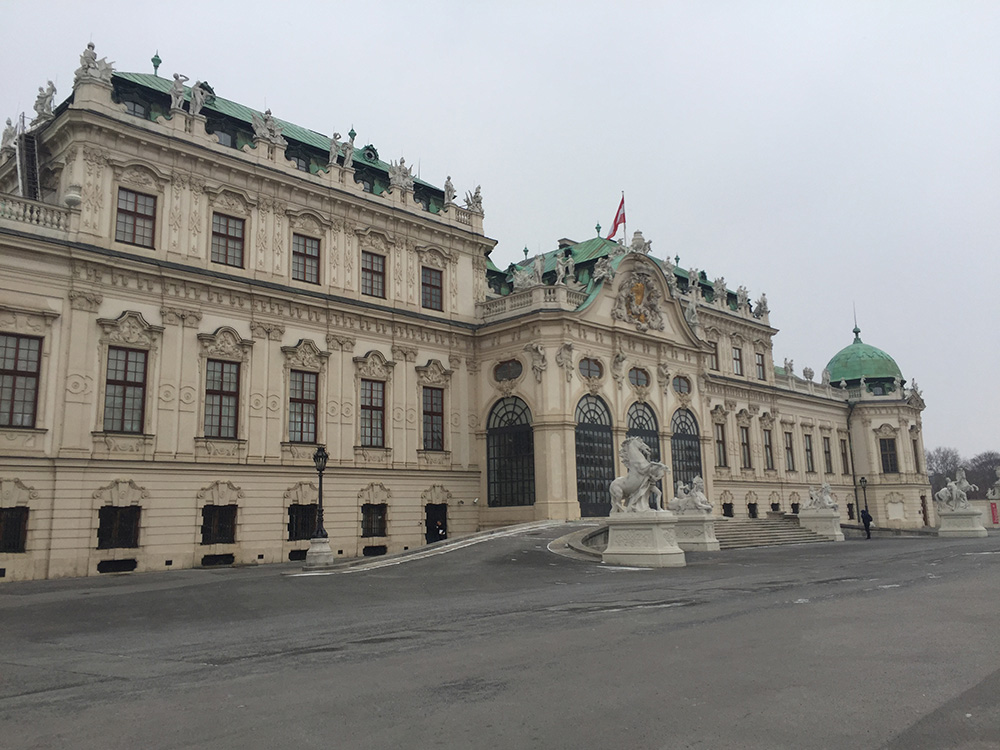
I love how the sphinx has dirty boobies because people keep rubbing them. Never change, everybody.

Here’s a picture through a rainy window of the gardens and the city in the distance.

On the front lawn was a fun piece of modern art. It’s one of the best-named pieces I’ve ever seen. It’s called “Fat House” and it’s… a fat house. The only name more descriptive would be “Morbidly Obese Cottage.”

The inside of the Belvedere had lovely gallery spaces that were very very Baroque.

The only time I got miffed was when they put perfectly good paintings of guinea fowl a million miles above the doorway, as shown by this picture here. I can’t see the guinea fowl, guys! Provide a ladder please and thank you!

We went in the main entry hall and immediately noticed the pervasive scent of church incense. The Moomins and I were confused because there’s no church in there. We decided to start with the Medieval Art Wing and headed to that area and the smell got stronger. When we opened the door to the wing The Moomins and I were greeted by a sight we were wholly unprepared for.

Get ready.

In the entry hall to the Medieval exhibit, with no explanation whatsoever, was an oversized white sculpture of a woman on all fours using a broken shard of mirror to tweeze her mustache while wisps of church incense puffed out of her butthole.

I was mentally not equipped to research the reasoning for this at the time but I just went to the Belvedere website and this is what I found:

Larger than life, she kneels on a tabletop with her blouse pushed up. The only sign of her divinity is the frankincense emanating from an opening in her body. Unfazed by the viewer’s gaze, in an all too human manner she plucks a hair from her chin. The intimate nature of this representation is in diametrical opposition to typical depictions of Olympian gods. This is Hera by Ines Doujak.

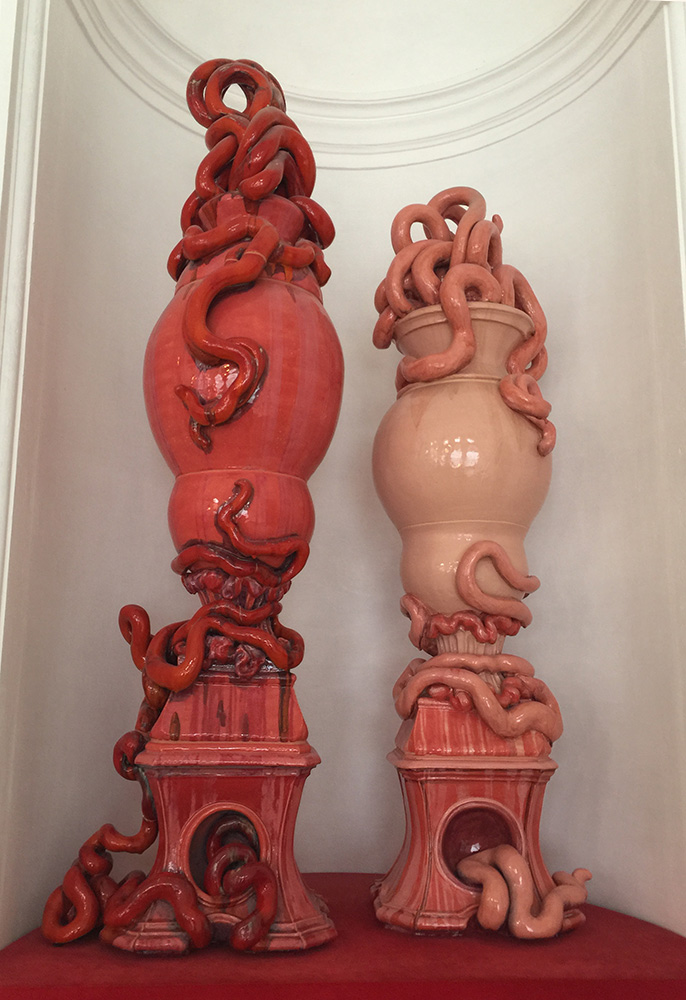
I do not understand why this is a thing that is. Later on I was climbing the giant staircase and at the top I saw what I assumed were giant ceramic jars decorated with snakes. Nope! Those are supposed to be intestines. It was at this point I turned to Moomins and said, “I’m concerned about the curators of this museum. I think they’re trying to tell us something. Like their mom didn’t hug them enough, maybe. Or their pet was hit by a car and that is their primary childhood memory. There’s definitely some weird trauma they’re working through.”
There wasn’t only disturbing confusing modern art. There was also old art which can be disturbing and confusing in their own way, but it’s different. For example, one of the elements I love about paintings from around 1300 is the exquisite way fabric is rendered and how everything else looks terrible. I appreciate that they didn’t know how to do perspective so that looks janky as heck:

And the horses look like they’re on drugs and are vaguely humanoid:

And these farm animals appear to be plotting to kill that old man doing a poor job of hiding his Fifth Element head:

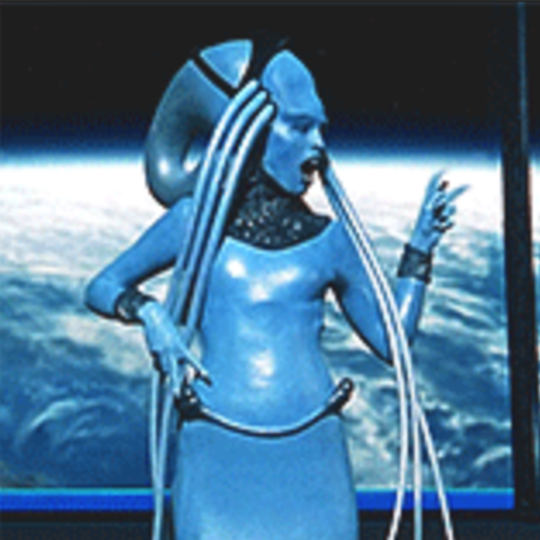
I fixed it to accurately portray what I think I’m seeing.

This was surprising. It’s a plague-ridden time, you would think there would be skulls all over for reference and the artists would be able to paint them accurately. You would be wrong.

There were a ton of other pieces of art from all different periods. The Belvedere is most famous for having “The Kiss” by Gustav Klimt but it’s not that amazing in person. I would recommend you go to the Neue Gallerie in New York City. That museum has “Woman in Gold” which I think is a far superior Klimt. I was very psyched to enter a room and bump into one of the paintings I studied in school, “Napoleon Lookin’ Hella Patriotic On A Horse” by Jacques-Louis David.

My favorite painting was a thoroughly non-famous one I just happened across. It’s an exceptionally well-rendered painting of four vultures. I really wanted to shove it under my shirt and take it home but it’s a large painting and I most likely would go to prison so my desires went unquenched.

And, of course, we had coffee and cake in their cafe. And it was magnificent.

Next entry: What else? More museums.
Vienna and Krakow, Part 2.

Tuesday, March 20th, 2018

Continuing with Vienna: I let The Moomins book our hotel. I have one rule about hotels, and that is I don’t want to share a bathroom. If I need to pee I’m not waiting. Private bathroom is a must. The Moomins took that and got us a room. Not a hotel room. A room. It was a good room, but we had to climb a flight of stairs and there was no breakfast or bellhops or free shampoo or ice machine. But it was also forty-five Euros a night and well-located so I think for the amount of time we were in Vienna (five days) that is perfectly fine. While our room had the depressing ambiance of a place two spies would meet to have their illicit and doomed love affair during the Cold War, it was toasty and comfy, the shower worked, there was a towel-warmer that did a stellar job of drying our freshly-washed socks, I would recommend it. Hotel Arpi. Check it out.

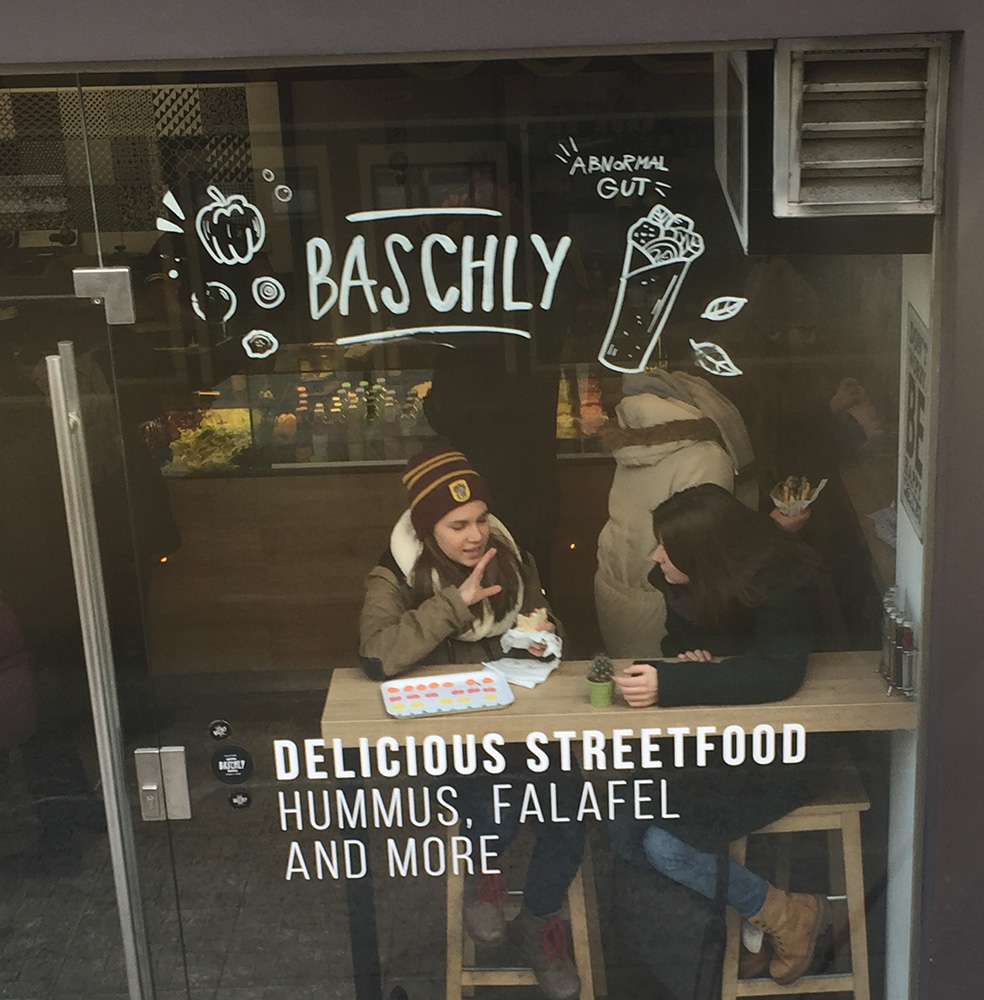
Before we get into one of my favorite moments of the trip, let’s look at some random bits that fit neatly into no category. I saw this eatery from the second level of a double-decker tourist bus.

Okay. If you’re going to have the majority of your signage in English I am going to assume all of your signage is in English. Therefore, if you write “abnormal gut” in the upper corner, I’m not going to think, “Oh, that means ‘abnormally good’ in German.” I’m going to think it has something to do with your food giving people IBS which is not a great selling point. A helpful hint from Auntie Jessica Who Works In Advertising.

And look at the level of concern about allergies on this menu. I saw this a few times and I was really impressed.

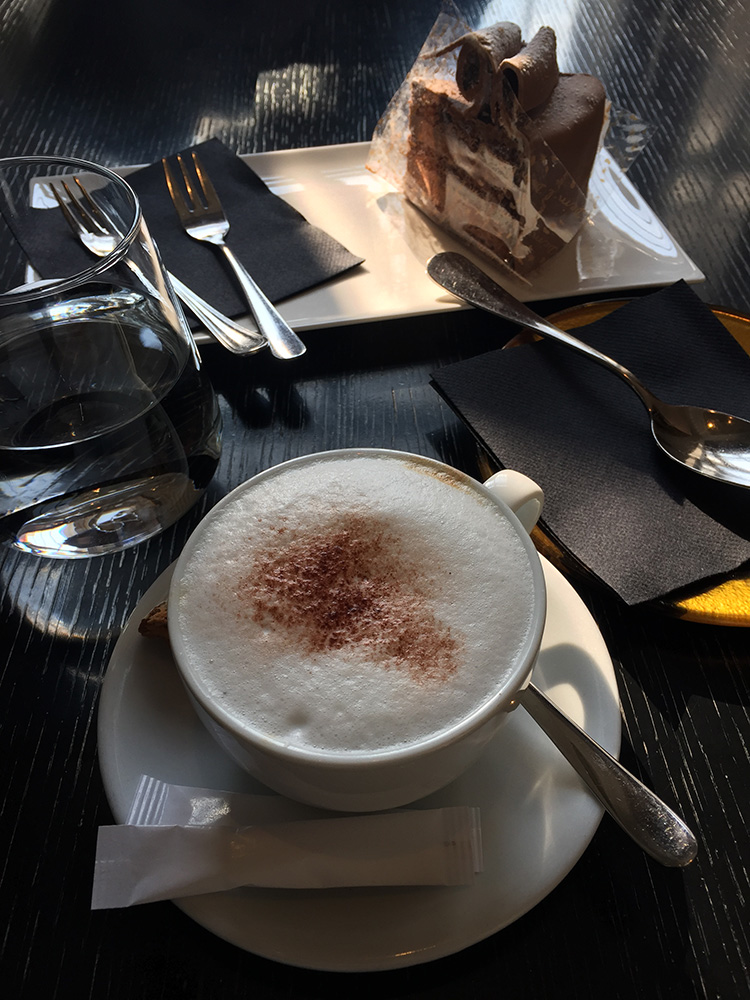
The reason I know so much about menus is because Vienna is a cafe culture and every single day The Moomins and I would stop in to a cafe and get tea or coffee and cake. There is no flavored coffee, but there is a myriad of ways for it to be served, and a big ingredient is whipped cream. It’s always served with a small glass of water as well. And sometimes a tiny cookie. They’re a classy bunch, the Viennese.

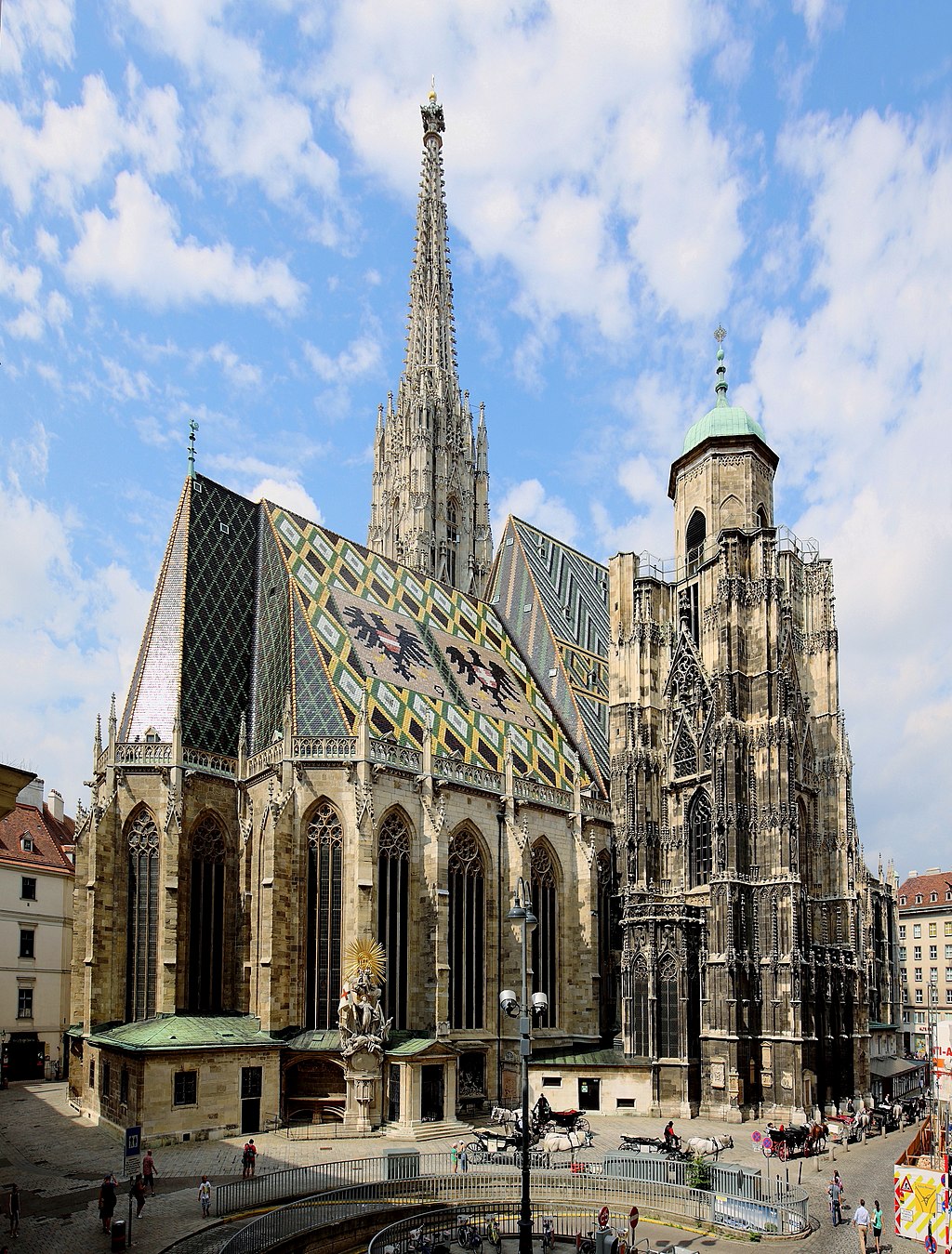
On to the focus. There is an enormous important church in the middle of town called Stephansdom and if you go to Vienna you are required to visit it. Here is Wikipedia’s description:

St. Stephen’s Cathedral is the mother church of the Roman Catholic Archdiocese of Vienna and the seat of the Archbishop of Vienna, Christoph Cardinal Schönborn, OP. The current Romanesque and Gothic form of the cathedral, seen today in the Stephansplatz, was largely initiated by Duke Rudolf IV (1339–1365) and stands on the ruins of two earlier churches, the first a parish church consecrated in 1147. The most important religious building in Vienna, St. Stephen’s Cathedral has borne witness to many important events in Habsburg and Austrian history and has, with its multicolored tile roof, become one of the city’s most recognizable symbols.

It is extremely beautiful and the roof is pretty great.

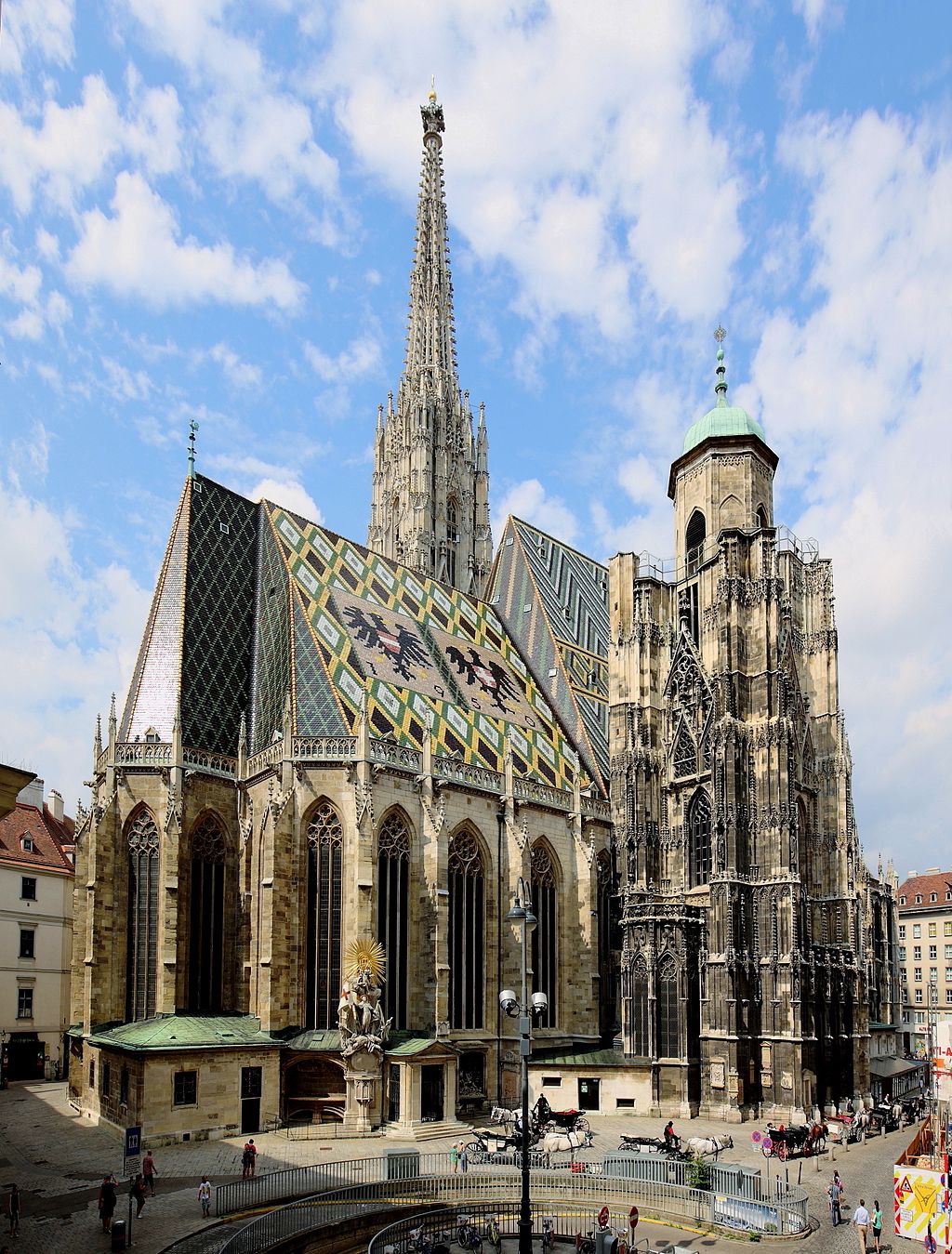
Here’s a picture someone else took of the other side. More fancy tile work on the roof.

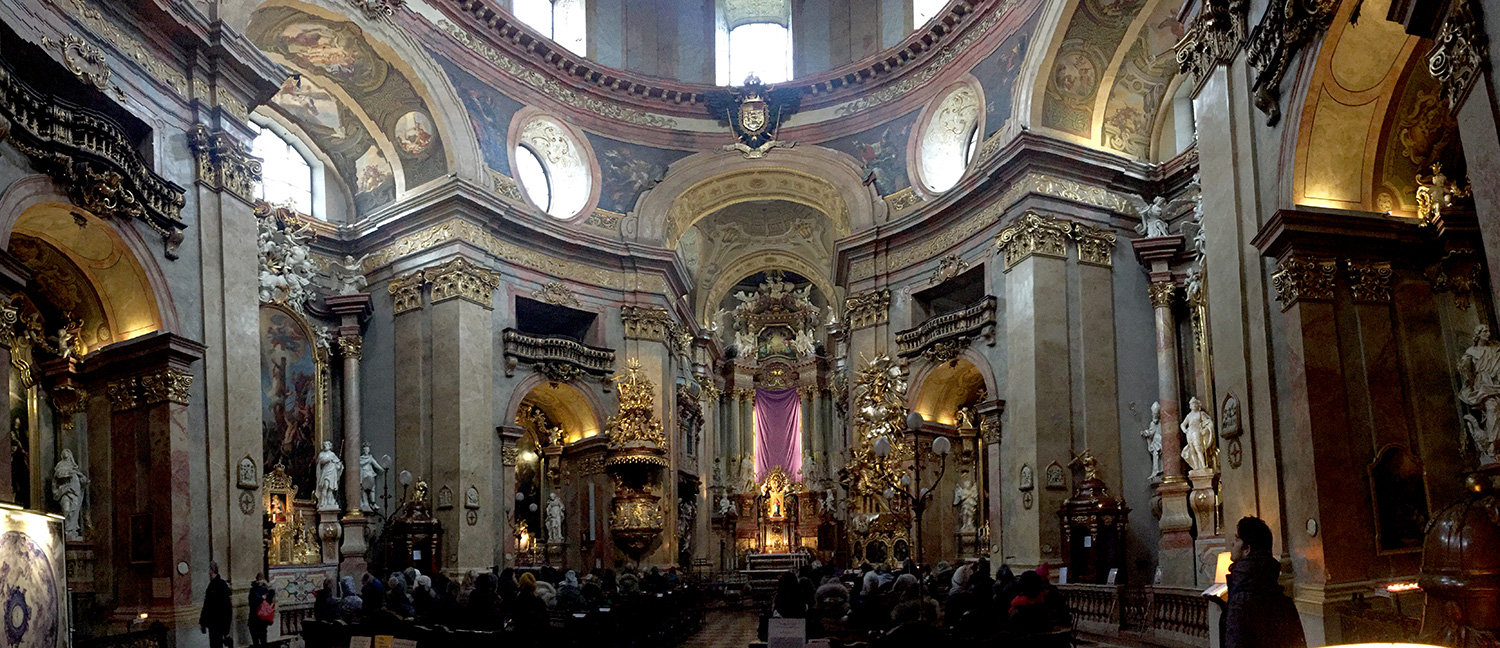
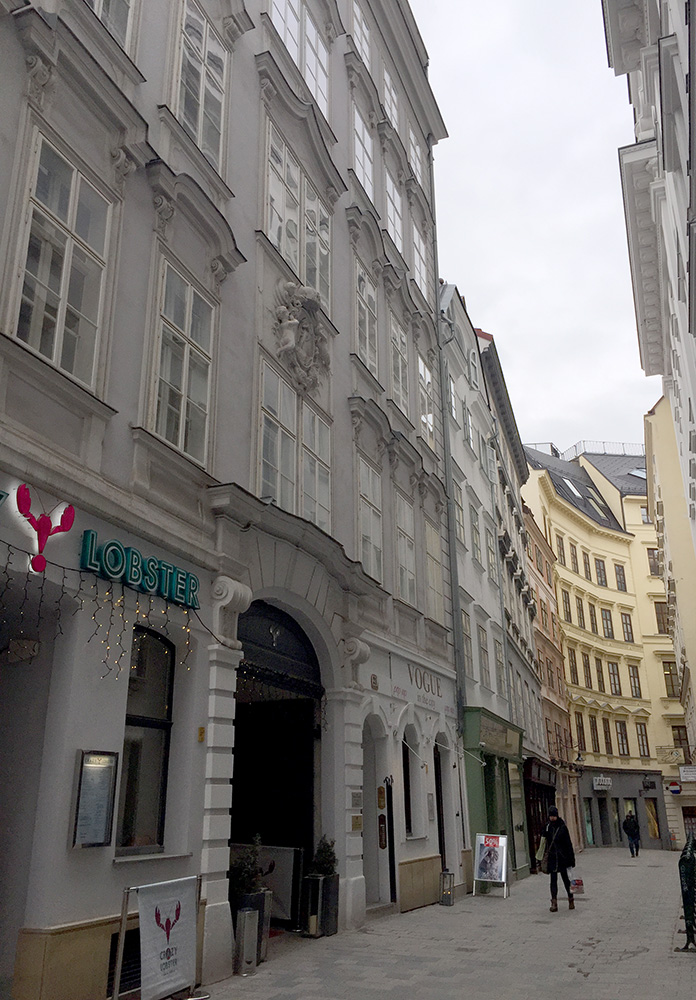
The inside is your standard major European cathedral filled with a hodge-podge of relics and art which is fine. Gorgeous, lofty, almost no original windows due to bombs dropping (boooooo). Here’s a video to give you a sense. However, around the corner maybe a block away was another church, Peterskirche, and that’s the one I want to discuss. It’s easily recognizable because of its large green dome.

The interior is a big round room and it’s the picture I used for the “stay tuned” post earlier.


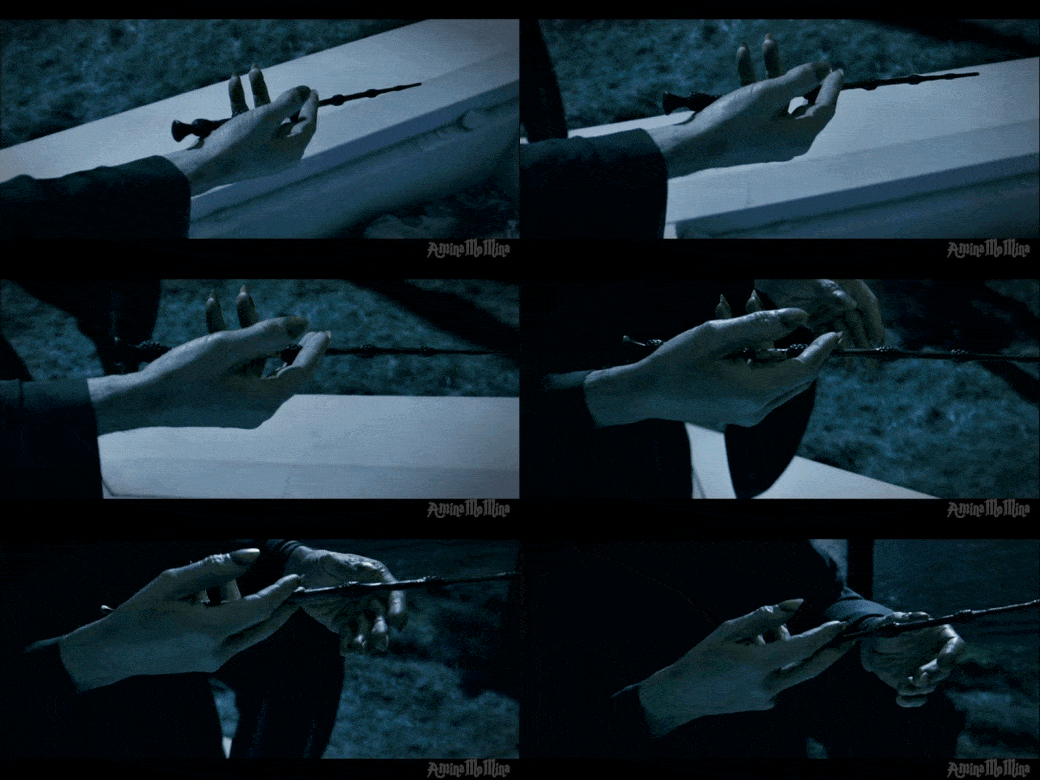
I went there for a concert the second night I was there and I sat up in front on the left. For over an hour I sat up in front on the left. The significance of that will become more important later. I enjoyed the concert quite a bit (chamber music with Mozart, Beethoven and Brahms) but I kept getting distracted by the massive gold statue in front of me. I couldn’t take any pictures because it was dark but I found a photo online that gives you an idea. The sculpture in front of me glinting in the light was a representation of the Holy Trinity – Father, Son and Holy Ghost. The Son and Holy Ghost were fine but the Father, aside from having the Illuminati Triangle Halo which takes some getting used to, was holding a wand that looked EXACTLY like the Elder Wand from Harry Potter.

I mean, REALLY.

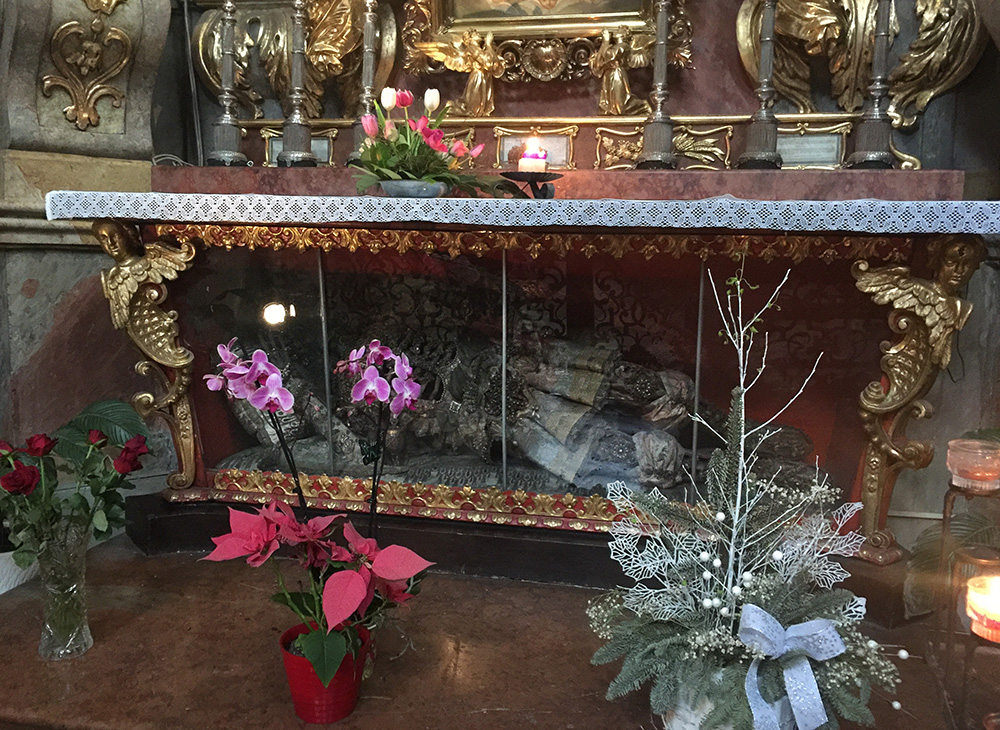
So that was amusing to me. The next day we found ourselves outside the church and we went in to see what it looked like in daylight. There was a service going on so I did my best to be respectful and quiet. That wasn’t a problem until I wandered up to near where I was sitting to try to take a photo of the wand. I noticed off to my side there was a big altar with someone’s painting on top and beneath that was… a skeleton dressed in full regalia covered in silver and glass jewels and doing what I can only describe as a sexy come-hither pose. “Hey ladies. There’s room in this ossuary for two.” *pat, pat, pat*

Oh. My God. I was sitting next to a jaunty skeleton for an hour and I didn’t know it??? It helps to know that there is a book on this, I book I own and covet and I had no expectations of seeing the Teutonic saints so happening upon one filled me with unbridled delight. Here’s the problem: services were going on and The Moomins is kind of deaf so I had no way to convey my joy. Bonus was the other guy on the other side in the same position but mirrored. Two! Two festive dead guys!

Next entry: More art and I think the Viennese museum curators need a hug.

Vienna and Krakow, Part 1.

Sunday, March 18th, 2018

You know what’s the best idea ever? Going to Eastern Europe in February. That was a testament to my smartitude, I’ll tell you what. Normally it’s not a huge deal but this year, whoooo. As I mentioned briefly before there was some atrocious mega-freeze that floated on over from Siberia (an area noted for its excellent production of cold) and it made being a tourist very difficult. I was convinced my nose was going to turn black and fall off like that guy from Mount Everest. Seriously, airports were closed all over and it didn’t stop Europe from functioning but it sure slowed it down.

But The Moomins and I persevered. We did so much and I saw so many art chums in museums. I don’t know if I’m alone in this but I studied art history in high school and college and when I encounter a painting or sculpture I’m familiar with I like to greet it like an old friend. “Hey, a Rembrandt self portrait! Hi Rembrandt Self Portrait! How’s it going for you, haven’t seen you in a while. Looking good, looking good. Love your lights and shadows, keep it up.” It is important to realize I say all these words out loud and that is why I think I’ve never been mugged. I make any would-be muggers floating around the museum uncomfortable. More on the art I shmoozed with later. First, we look at architecture.

If you visit Vienna it is entirely possible to to not go into any museum and still see some great art and desifn. The architecture in Vienna is a big reason many people travel there. It certainly was a major motivation for me. That and Viennese cake. About 50 / 50 between the architecture and the cake.


Because like most European cities there has been war and war and a massive fire and then some more war, most of the architecture is relatively new. Even though Vienna was founded in approximately 500 AD by some Romans there is none of that to be found. It’s almost all Baroque architecture dating from between 1600 – 1750 AD. Occasionally some Gothic will pop out (1100 – 1500 AD) and if you’re really lucky, some Medieval might make an appearance but get ready for Baroque. Which is unfortunate for me because I do not adore Baroque. It’s fine, but it’s definitely not my favorite art style. It can be… much. I’ve made my feelings clear about Baroque in this previous entry.

For example, Baroque loves clouds and angels. The problem with clouds is that they are great in paintings but when you try to make them out of stone they can look like plastic bags of liposuctioned human fat stapled to a pole. I am speaking specifically of this. First one is my picture but it sucks so I found a better one.

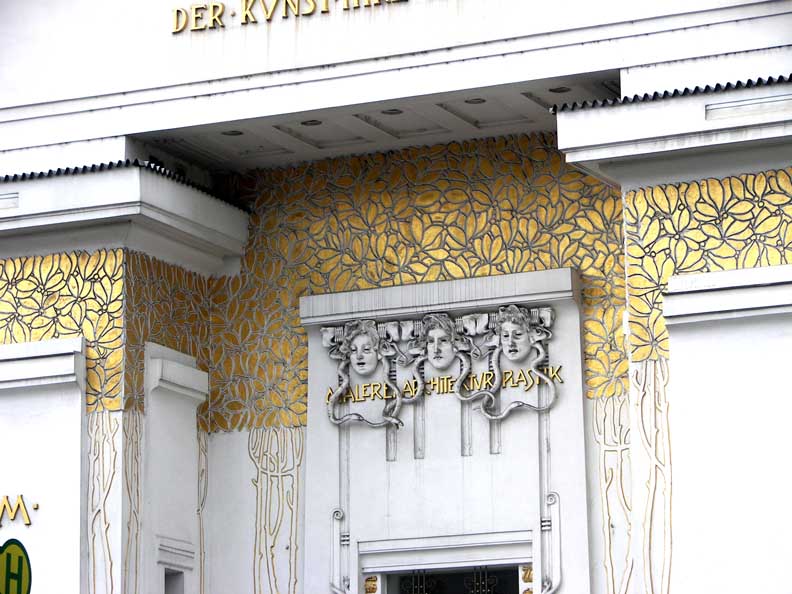
See what I mean? Lumpy. Overly ornate and lumpy. You need to be careful with Baroque. It can be absolutely beautiful but it can also veer into Jabba the Hut territory if you’re not careful. However, betwixt the Baroque is my favorite art movement, Secession. Secession is a sub-section of Art Nouveau and when it’s done right it is so beautifully balanced. The most famous of those buildings is the bluntly named Secession Building which looks like this:

I was so excited to see this building. I love it. I used elements of it in my college classes, like the three owls on the side:

But I didn’t take those pictures. Would you like to know why I didn’t take those pictures? Because the Secession Building is COMPLETELY COVERED IN SCAFFOLDING ARE YOU KIDDING ME. I understand that it needs renovations but whyyyyyyy? In between the scaffolding you could see the sassy lizards that guard the door.

And you could appreciate the enormous mosaic planters outside the front door.

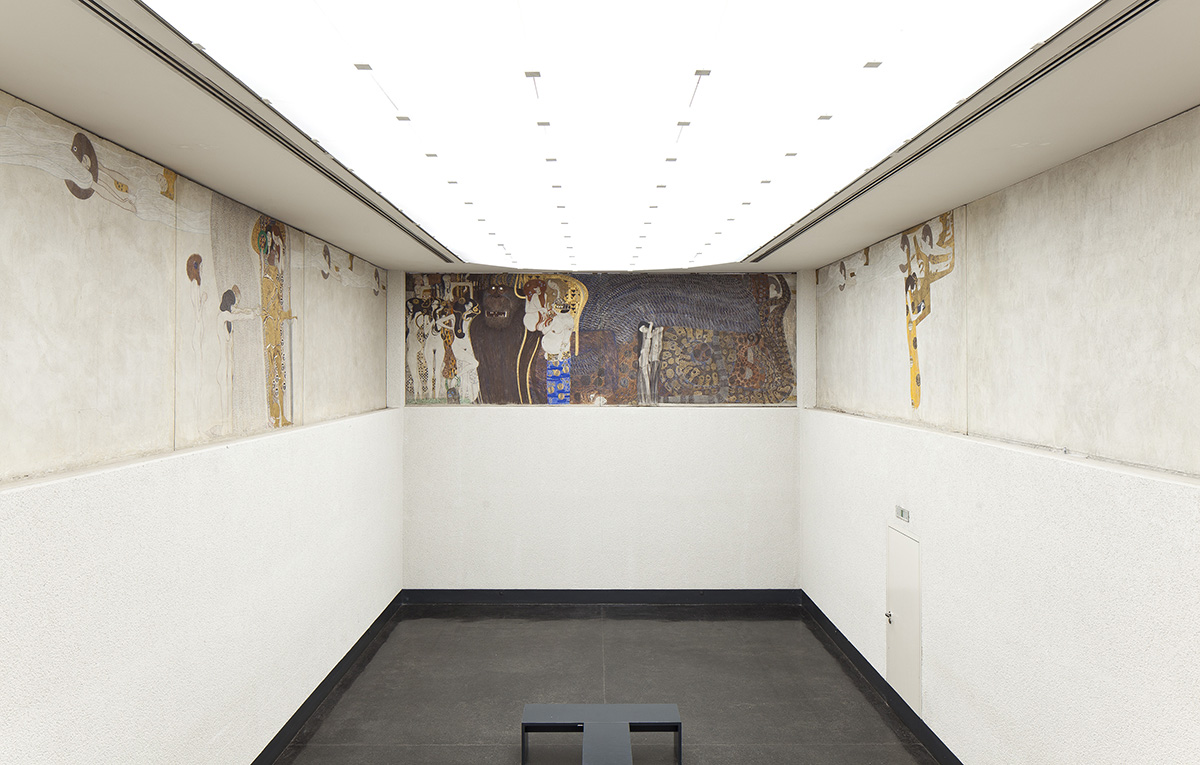
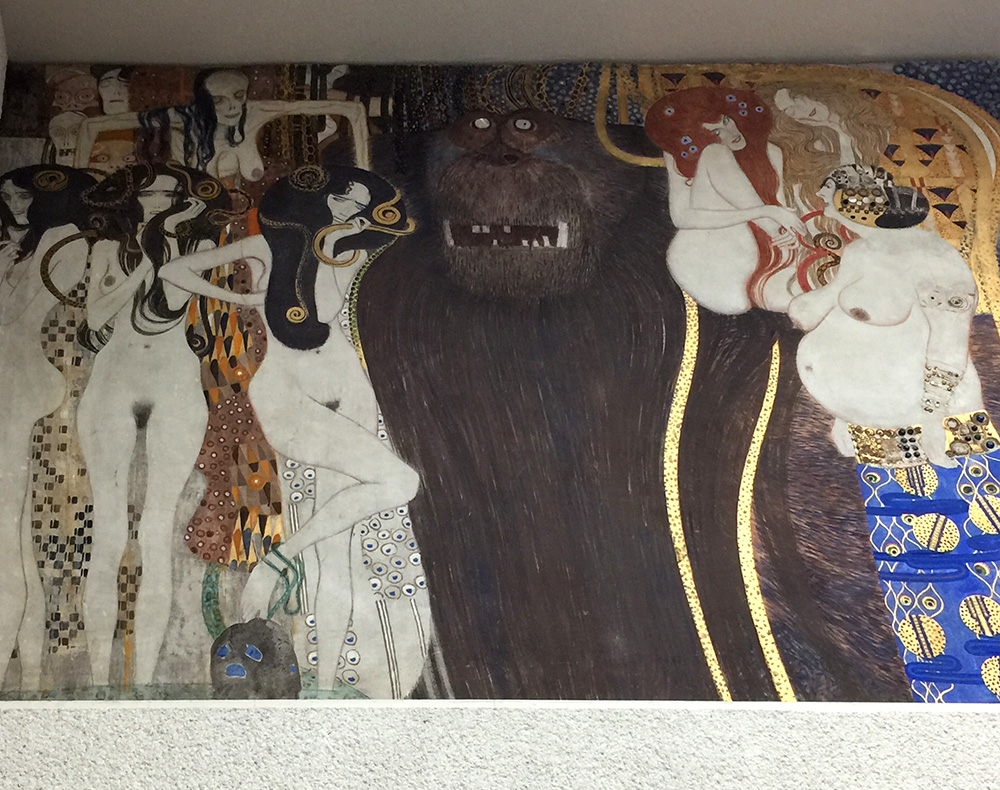
Aaaaaand that’s about it for the outside. Inside is a profoundly interesting painting done by Gustav Klimt called The Beethoven Frieze and it is magnificently weird and I can’t get enough of it.

It goes all around the top of the room but the most important part (in my opinion) is the giant dead-eyed gorilla (?) surrounded by women of all shapes and sizes and also Death (?). I love it.

I don’t know what’s happening. I don’t want to know what’s happening. I don’t want my initial reaction of confused glee to be tampered with by actual information on the meaning. No one tell me.

In the next entry: probably more architecture. Definitely more art.

I left! And I’m back! Sorry for not telling you!

Thursday, March 8th, 2018

Hey all, I went on vacation. Because when it’s winter where’s the one place you should go? That’s correct – Eastern Europe! Especially if there’s a polar vortex blowing over from Siberia, then it’s really perfect. So that’s precisely what I did. I went to Vienna, Austria and Krakow, Poland for ten days. Despite the frigid biting weather I had a really good time and as soon as I’m done sorting through my photos I will get to the telling of tales. In the meantime, look at this awesome picture of the inside of a Baroque church. Let it hold you over until further imagery comes.

Guatemala, Part 6.

Tuesday, November 21st, 2017

Lake Atitlan. Get ready.

But first, Antigua’s main plaza! That I forgot to add to the Antigua posts earlier! I love how there’s old ruins and new ruins and everything all sort of mooshed together.

And I only made it to the main cathedral at night so all my pictures are blurry, but here’s the best of the bunch. A beautiful building, beautifully lit.

Okay, Lake Atitlan. We stayed at a hotel with THE MOST AMAZING GARDENS EVER. The owner started them several decades before and lovingly caressed and cuddled them and now they’re mind-blowing.

You would think I had never seen a plant before in my life the way I reacted to this garden. Right outside our room there were some screamy parrots that came out of their enclosure during the day to sit in the vines and shriek violently at the guests. One was a scarlet macaw. He was extra-screamy.

And there was one tree on the far edge of the property with the most interesting pattern in its bark. I felt like I was in a werewolf movie.

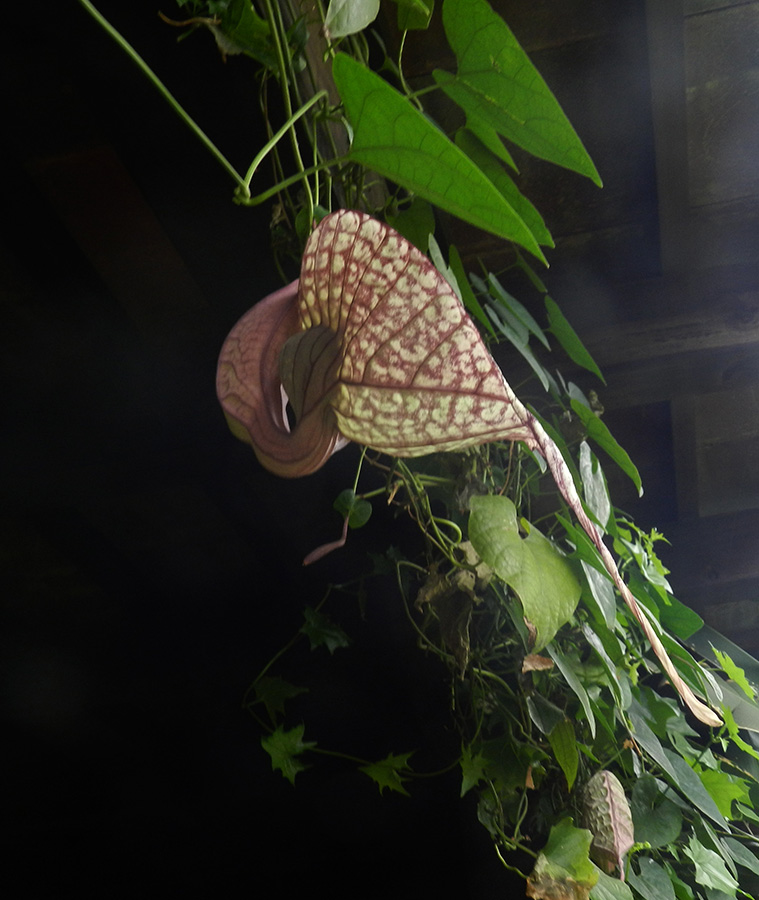
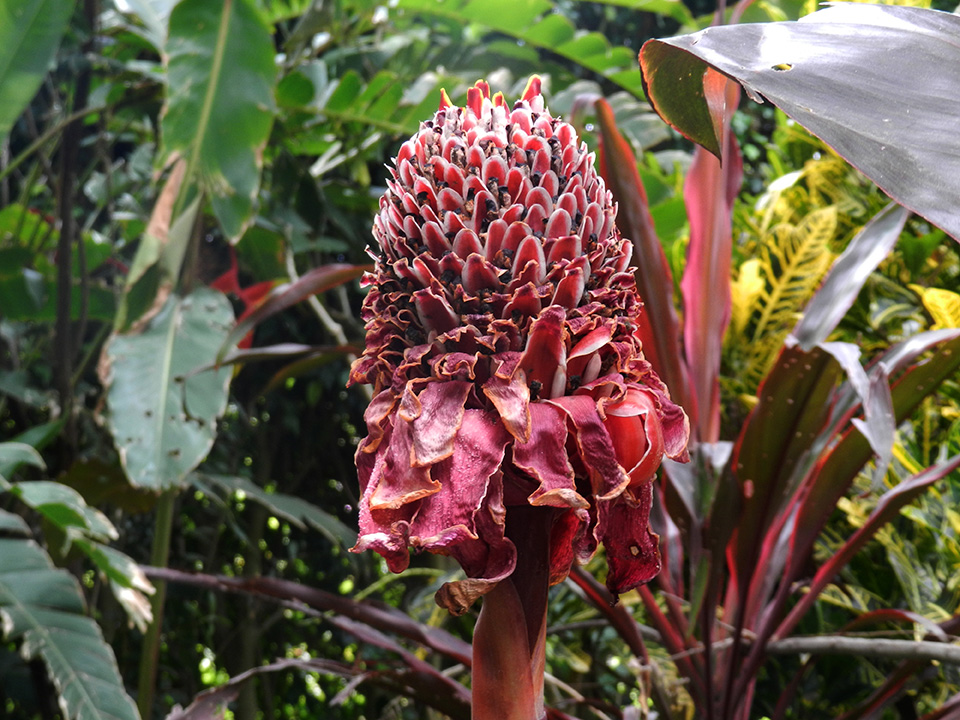
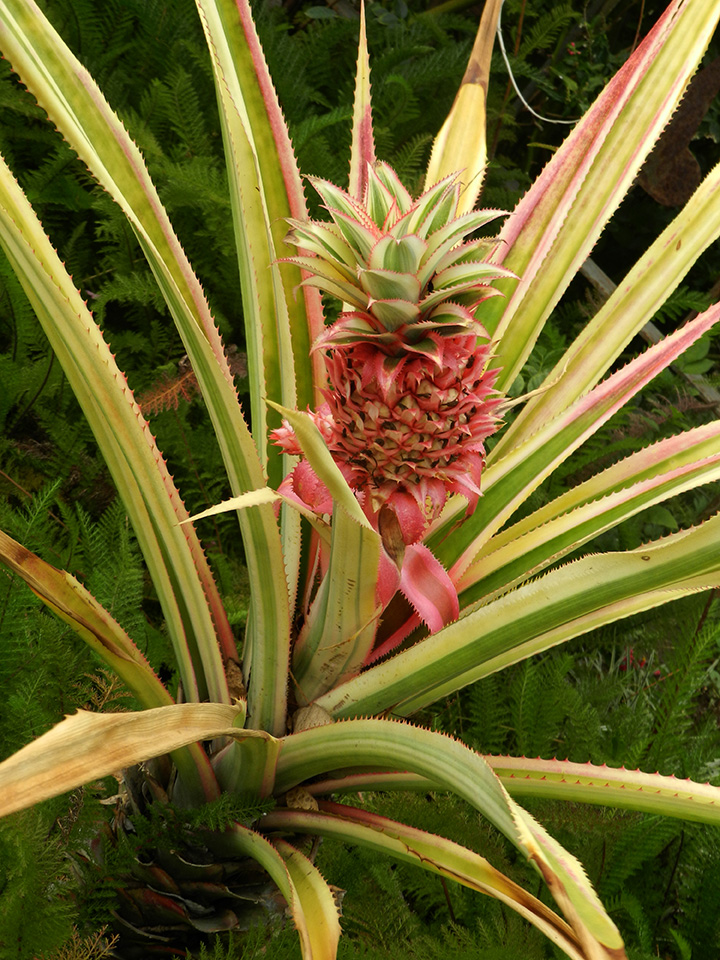
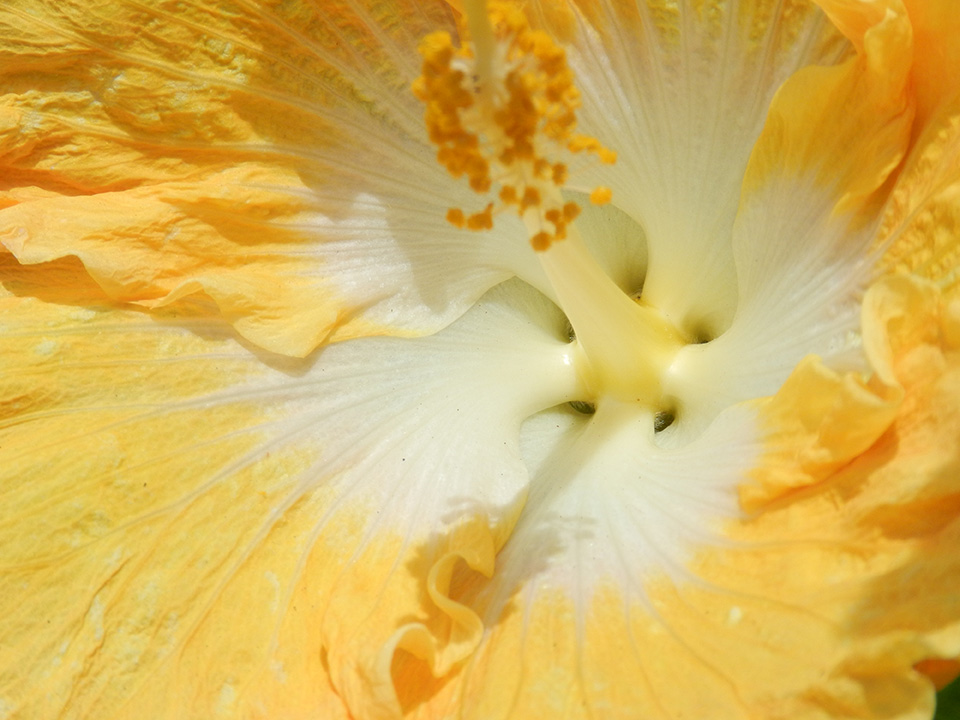
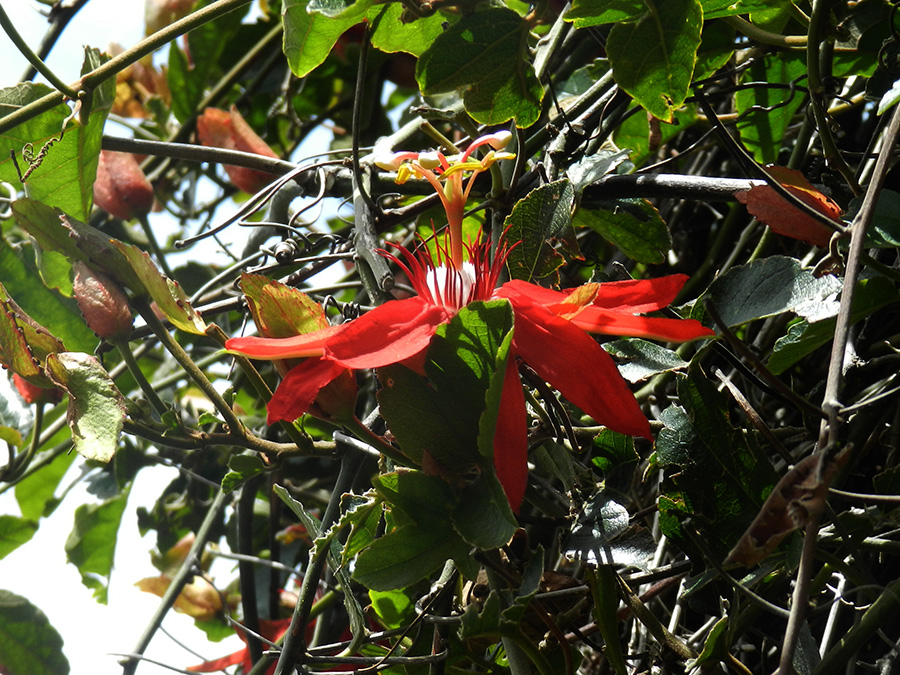
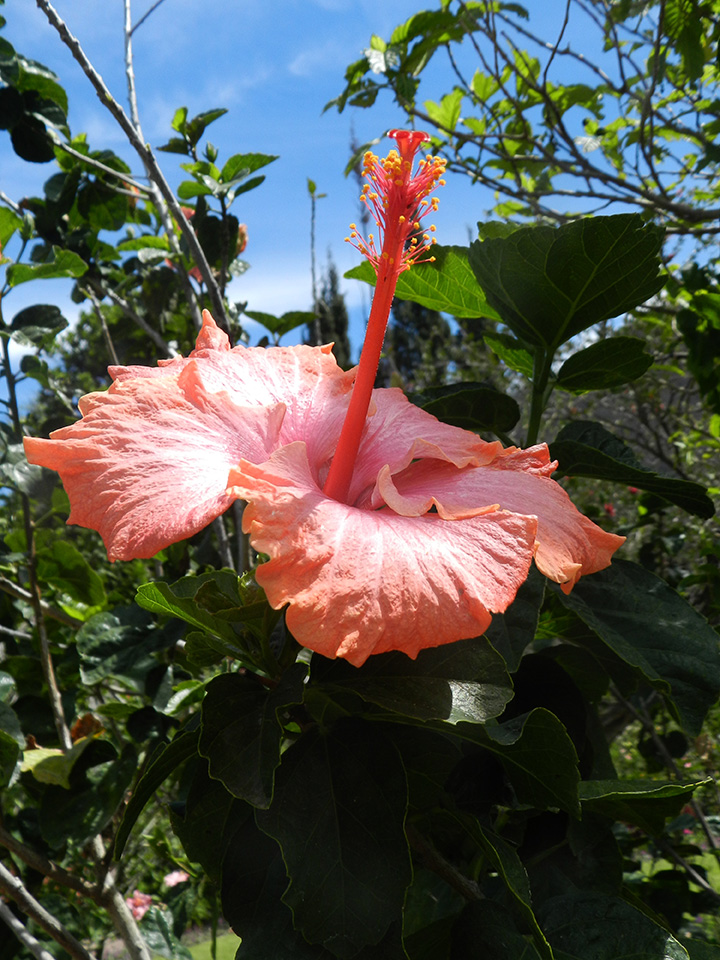
And here are the closeups I took of specific plants. Fun tidbit: while taking some of these photos, The Moomins had to protect me from getting attacked by an ornery goose that lives near a small koi pond on the property. I guess I got too close to the goose’s woman and he was disgruntled. It was worth almost dying at the hand (wing?) of waterfowl because these plants were something else, I tell ya.

We went out on a tour of the lake itself. I did not know that Antoine de Saint-Exupéry, the author of The Little Prince, crash-landed in Guatemala and saw the mountain there that inspired him to write the “draw me a sheep” portion of the book. Specifically the elephant in the snake that is mistaken for a hat. <—- That sentence sounds like I had a stroke but if you’ve read the book it makes sense I promise.

Here’s an article about Saint-Exupéry and Guatemala.

https://globalvoices.org/2008/07/11/guatemala-was-antigua-the-inspiration-for-the-little-prince/

There was also a napping volcano. Shhhhh, Volcano, everything is fine. No make ‘splosions.

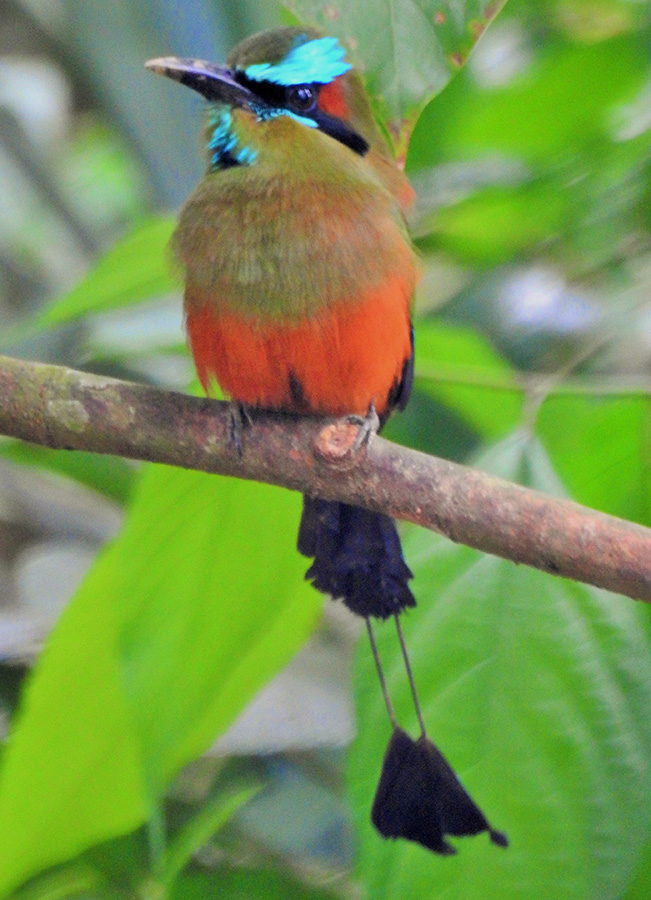
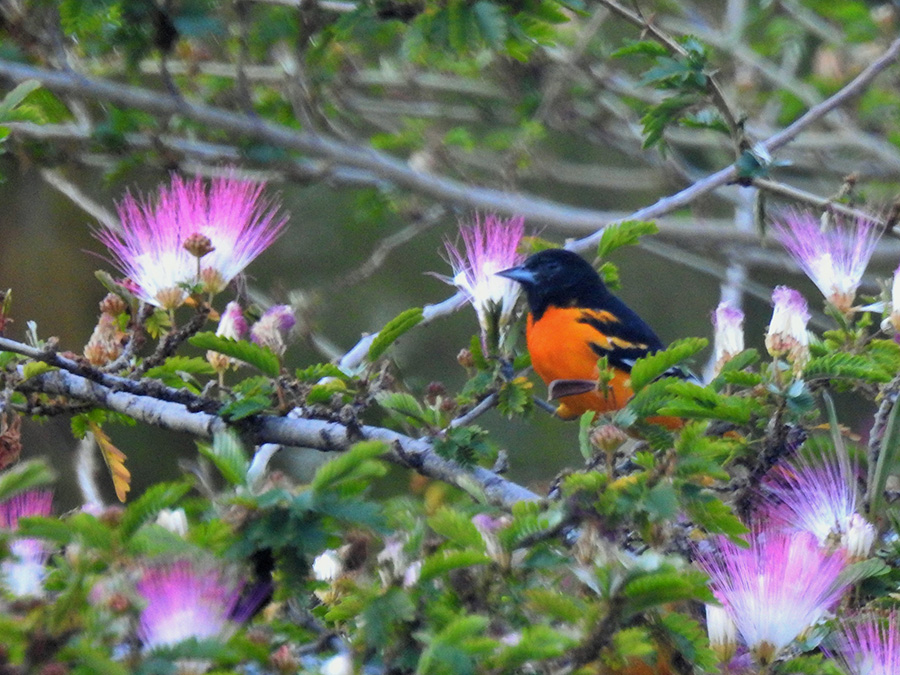
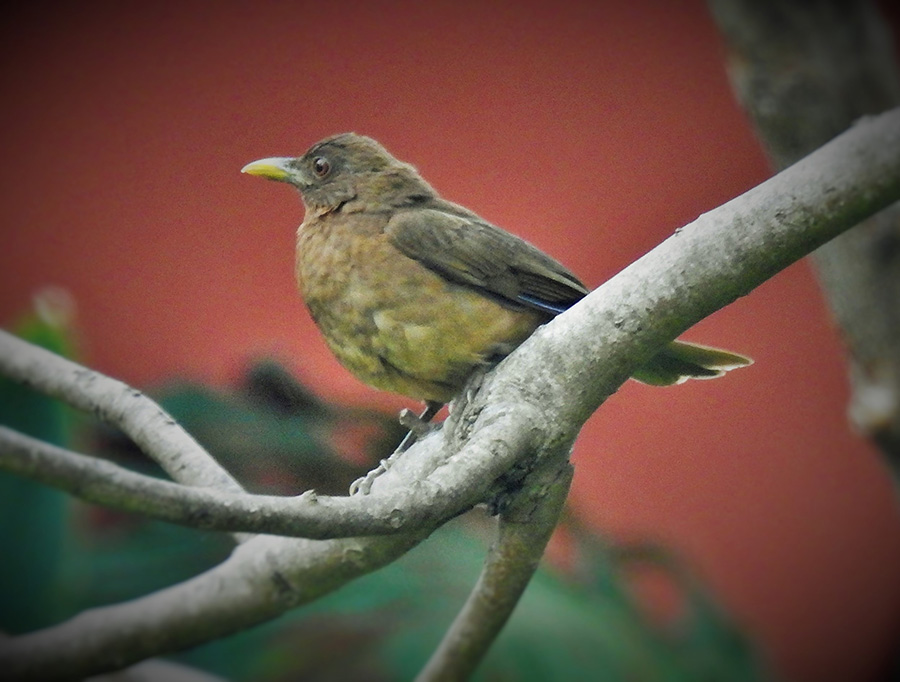
Aaaaaaaand that’s pretty much the highlights from my trip. However, one of the other people on the trip, Boris (who had THE BEST Russian accent in the world) had a far superior camera and took some unbelievable pictures of birds and other beasties. He was kind enough to share them with me, and now I will share them with you.

Guatemala, Post 5.

Friday, November 17th, 2017

More Antigua! But first, other things.

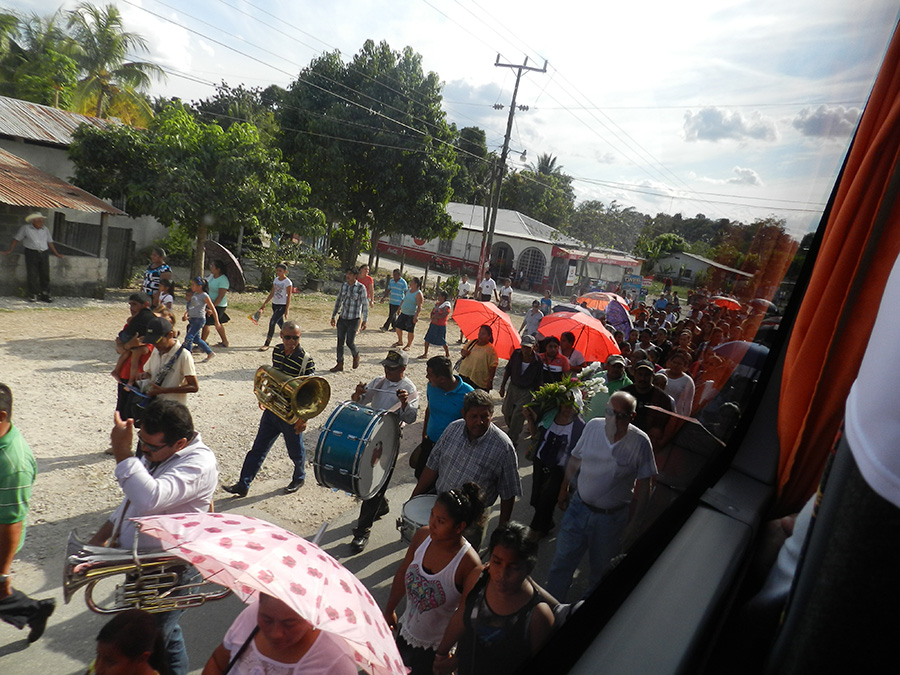
We drove past a funeral. It was quite sad. A police officer had been killed. I love how the whole neighborhood showed up and was walking with the family to show support. There was also a band playing mournful walking music and I think we as a nation need to get on that.

I saw a fountain and I liked how they planted flowers birds-of-paradise flowers the fountain. Plus there was a pigeon and I am on Team Pigeon 4 Lyfe. Extremely pro-pigeon. Not ashamed of it.

Okay, so Antigua. The buildings are very short and the roads are extremely wide because if an earthquake destroys a building and it pitches forward it doesn’t knock down the building on the opposite side.

There is a former nunnery in Antigua, Convent of las Capuchinas. It cost a lot of money to become a nun and that, combined with the constant battery of earthquakes, caused the nunnery to be shut down.

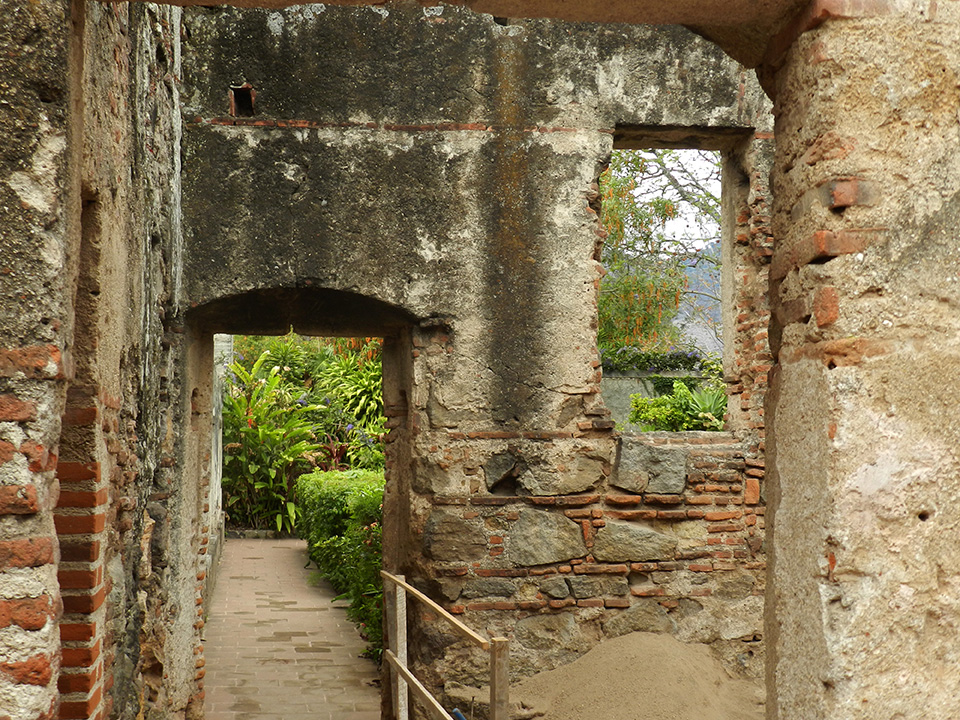
The grout that holds those brick walls together was a mixture of sand, gravel and egg whites. The city apparently ran out of eggs during the construction of this building.

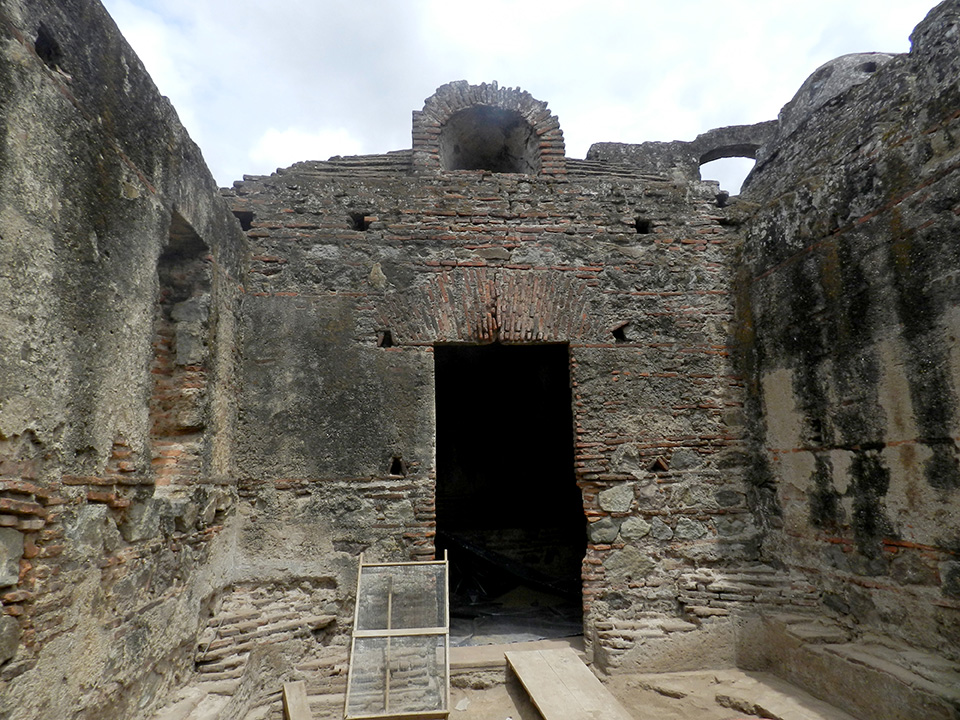
The wine cellar for holy ceremonial wines was build like a doughnut with a big column in the middle which is how it survived all the earthquakes. It has great acoustics so the nuns used to go down there and sing and maybe sample the wines.

And there are gardens which are beautiful. It’s not too hard to have a gorgeous garden in Antigua, I saw many of them.

As we walked along the street during the sunset on the last night we found a rooftop bar in an old mansion-type home. The fancy older buildings reminded me of Spain. They tended to have huge scary exterior walls:

And gorgeous compound-like interiors with gardens. This was no exception.

When we went up to the roof you could really appreciate how the city is nestled in between the mountains.

• | • | • | INTERMISSION | • | • | •

Dia de los Muertos-type dolls! Same store as the decorated antlered skulls. I showed restraint and did not buy them.

• | • | • | INTERMISSION OVER | • | • | •

That’s all my photos on Antigua. I only have four photos for the town of Panajachel, a town on the edge of Lake Atitlan (more about Lake Atitlan in a bit) so let’s go through those.

CHARCH! In Panajachel we visited the church. I liked the architectural style

The inside of the church looked like and upside-down boat.

And there was a nice carved monster holding up the display board in the back.

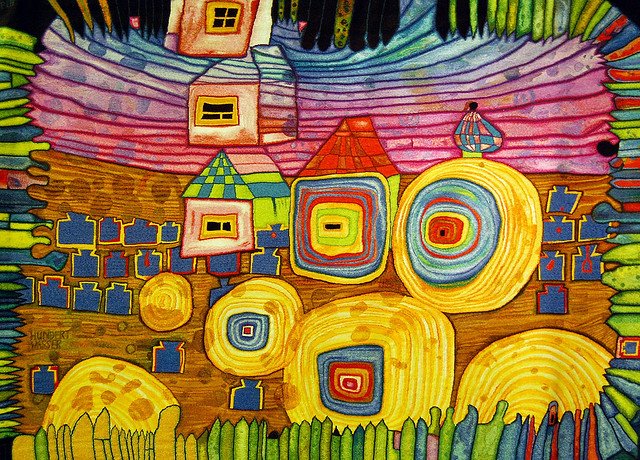
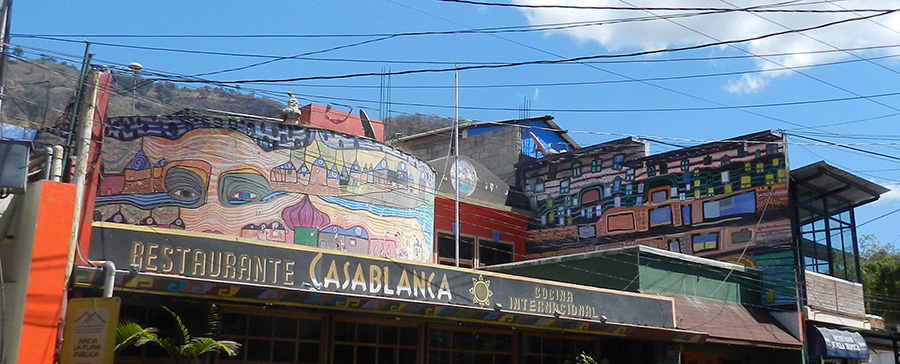
Here was the biggest surprise for me in Panajachel. Stay with me here: There is a semi-famous artist from Vienna Austria named Friedensreich Hundertwasser (1928 – 2000). His artwork is extremely distinctive. It’s difficult to mistake it for someone else’s work. Here are some examples.

Which is why I was pleasantly surprised to see a rather large mural featuring some of Hundertwasser’s work in this small village in Guatemala.

Whattup, Hundy? How you doin’?

Okay, coming up next: Lake Atitlan. Get ready for the most insane plants you have ever seen.

Guatemala, Part 4.

Thursday, November 16th, 2017

Antigua! A city in Guatemala with, like, 30 churches! Some are still functioning, some are only facades. Everything is protected because the whole city is a UNESCO site. Here are some of the façades. You can see there ain’t nuthin’ back there.


A popular motif in Antiguan churches is St. James on a horse leaping over the three giant mountains that surround the city.

Antigua has been around for almost five centuries and our guide called the prominent architecture style “Spanish seismic baroque.” As in, oh the earthquake broke this chunk of the building off, we will replace it with little to no concern to whether it matches or not. In addition, when the church insisted that the indigenous people build these new houses of worship, the people incorporated elements of their existing religion in there. For example, here is one of the most famous Antigua churches, the Iglesia de la Merced.

In my photos it looks like it’s a muddy mustard but in real life it’s a festive banana pudding color. Now, one might assume that those are grape vines on the pillars around the front door, right? Nope! Corn! It’s corn! One of the most sacred things to the Mayans!

And that four-pointed motif in the archway, that must represent the cross, right? Nope! Symbol for Mayan sun worship! Sneakin’ it all in there!

Moving on to other churches: Here is the Catedral of Antigua. Many of the hands of the outdoor sculptures are missing because of the earthquakes. I guess that’s the first part to break off.

If this is their approach to Baroque, I like it. Baroque as a design system can be a little overwhelming, especially the end of the period, known as Rococco. Here, have some examples:

https://en.wikipedia.org/wiki/Rococo#/media/File:BasilikaOttobeurenHauptschiff02.JPG

https://c1.staticflickr.com/6/5012/5399173556_01eeb03ca5_b.jpg

https://upload.wikimedia.org/wikipedia/commons/thumb/7/73/Amalienburg_Spiegelsaal-1.jpg/800px-Amalienburg_Spiegelsaal-1.jpg

http://www.macklowegallery.com/images/CMS/Glossary%20of%20Terms/Rococo.jpg

See what I mean? Lots of stuff on all the surfaces all the time. That’s why I prefer this atypical approach to Baroque. Enough stuff on some of the surfaces some of the time.

While staying in Antigua I went tot a walk down the street and came across the Iglesia de San Francisco El Grande. They have it lit beautifully at night.

Near the small side chapel door was a mosaic of a fish. I thought he looked friendly.

There was a cross sculpture in front. That’s not unusual in itself. What was unusual was the symbolism. Note the stop sign hand, the tunic, the gambling dice, and less easy to see are the ladder and blacksmithing instruments across the horizontal beam. Does anyone know why those specific things are there? If you do, let me know. I could not figure it out.

Other church-related things: The view out of the door of one of the churches.

The altar of one of the churches clearly done in Empire style, that’s Napoleon’s time (which was a rebirth of Greco-Roman style, errybody be stealin’ from errybody else):

This wall tableau of The Father, The Sun and The Holy Ghost. I loved that instead of a normal round halo, The Father has a triangle representing the all-seeing eye, the same one on our dollar bill. And please note Jesus’ halo which resembles a Mayan crown.

http://cropcircleconnector.com/images/stela1.JPG

We were there during a festival of some kind (Easter? Maybe Easter? Sure, let’s go with Easter) and the Guatemalans have a really cool way of decorating their church. They dye sawdust and using stencils they create beautiful temporary carpets on the floor.

This was a small one that SOMEONE SMUDGED UP THERE IN THE FRONT. I would be so angry if I had toiled on this carpet and someone let their dog or kid mess up my work. I wouldn’t kick a dog or a kid but I might kick the person responsible for that dog or kid.

In another church there was a far larger carpet surrounded by ripe fruit and vegetables. It smelled very, very good. Could have done without the angel lawn ornaments but it’s not my carpet or church.

Next entry: more Antigua.

Guatemala Part 3.

Monday, November 13th, 2017

Coffee beans! But first, chicken buses.

Chicken buses are one of the primary ways people get around in Guatemala. It’s called a chicken bus because people would tie baskets of chickens to the roof with the rest of their luggage. They are school buses from America that we’re done with. Guatemala buys them, paints them in the jauntiest of colors, gives it a name like “Esmerelda,” slaps some chrome and maybe some lights on there and uses them as mass transit. Not surprisingly, I loved them.

Type in “Chicken Bus Guatemala” into Google Images and scroll through that. It’s a vibrantly-festooned good time.

Coffee beans! I went to a coffee plantation in Costa Rica and a lot of the information is the same concerning how the plant grows and how its harvested, etc. Here’s a link to that:

https://design-newyork.com.fwtrading.x10host.com/wp/2012/02/28/costa-rica-2012-part-7/

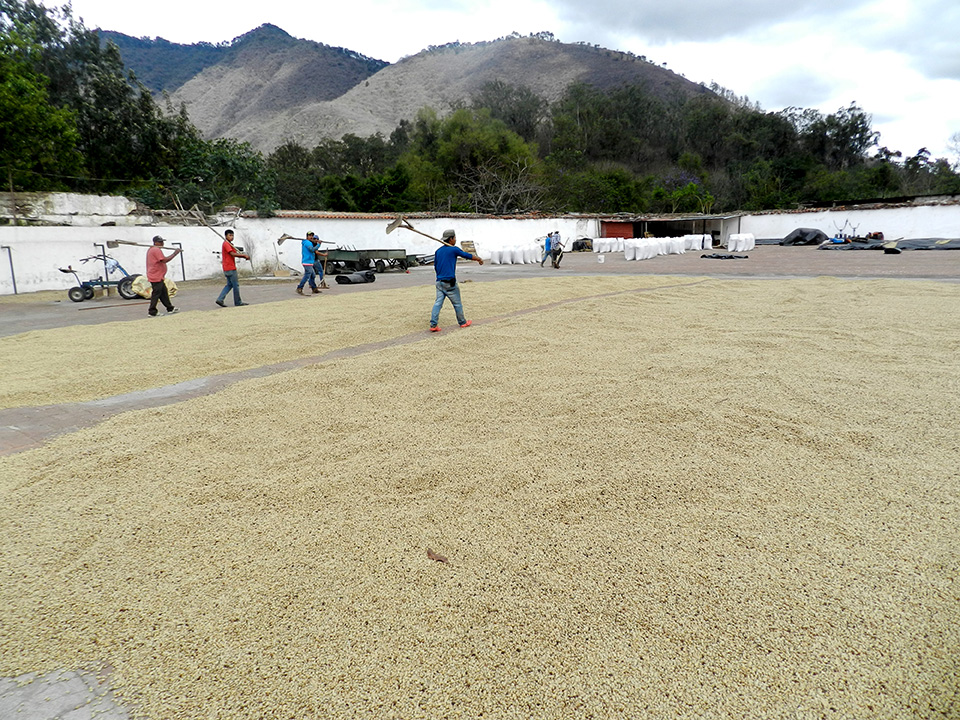
Here is the enormous cement area where the coffee beans are spread out to dry.

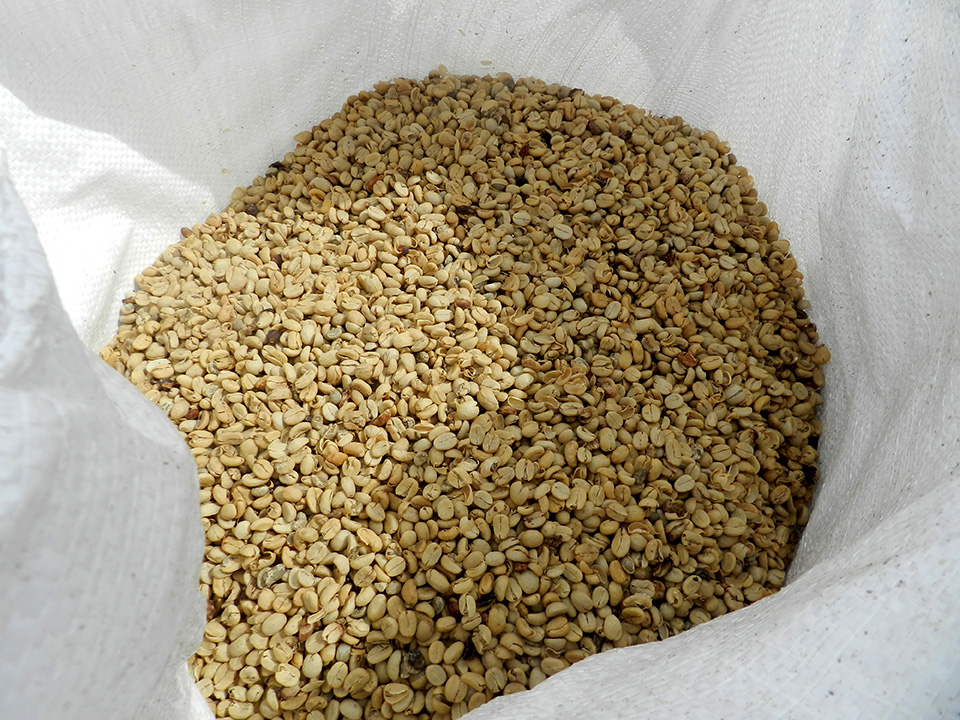
Here are the beans dry before roasting.

These are coffee bean plants and a little pollinating bee. You go, bee! I’m proud of you.


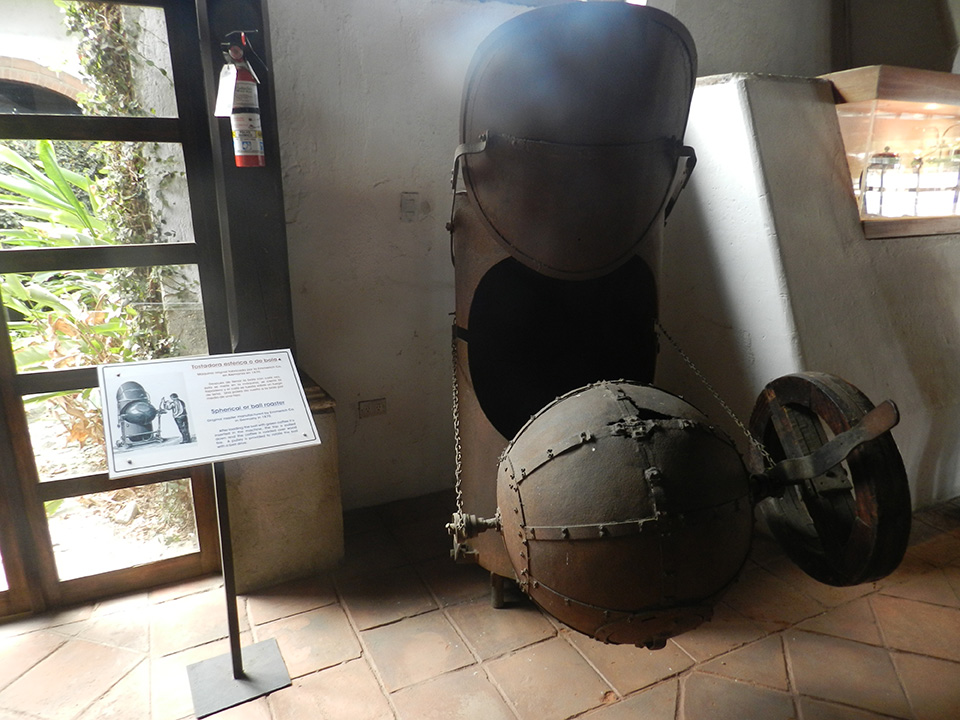
Would you like to see the scariest roasting machine ever? Here ya go. If someone wheeled that into a room where I was being held captive I would immediately start spilling state secrets.

Teeniest church ever on the coffee plantation. Fits four parishioners max.

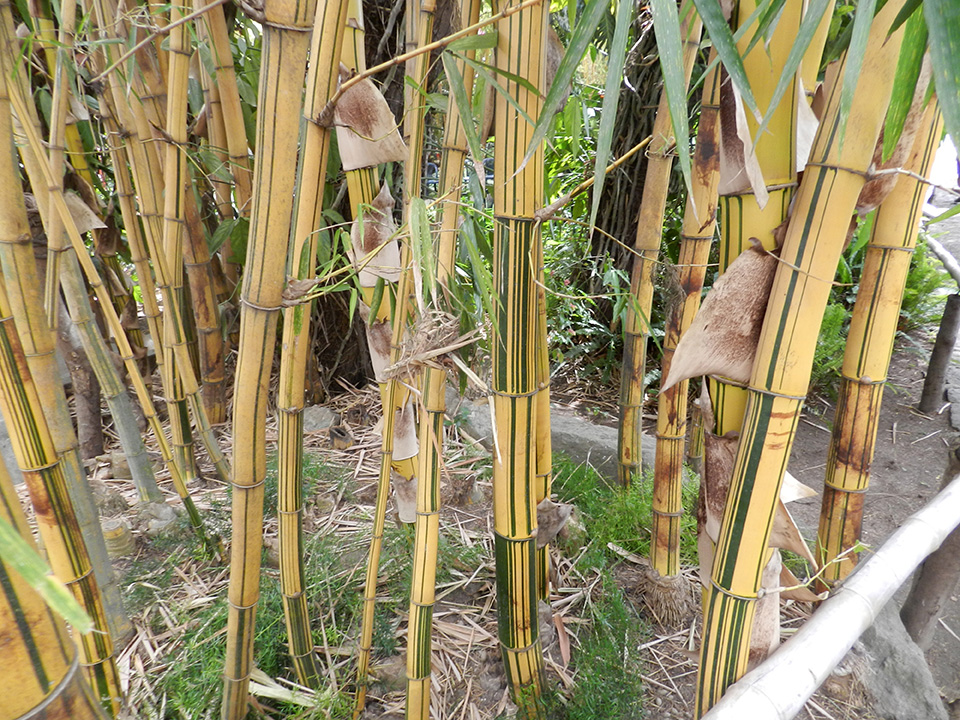
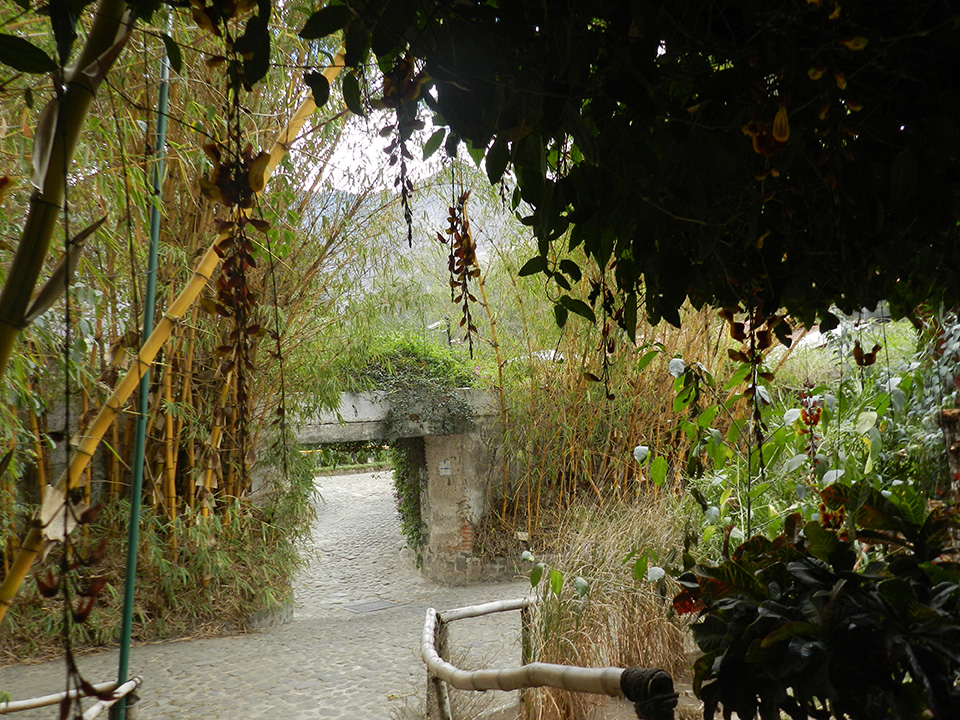
And gorgeous plants all over the property, especially the striped boo.

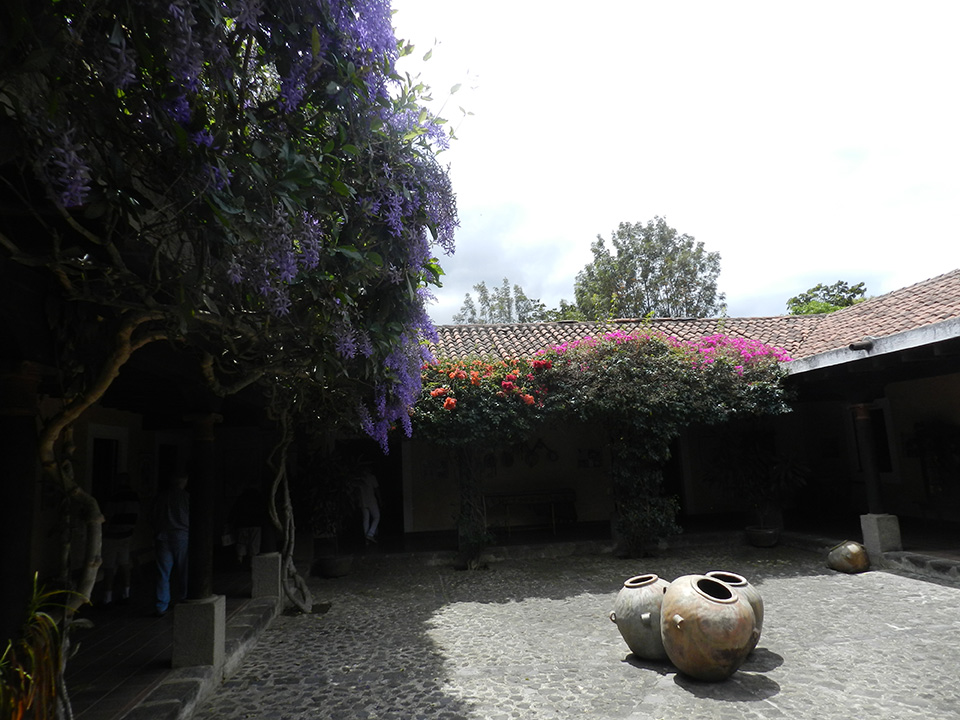
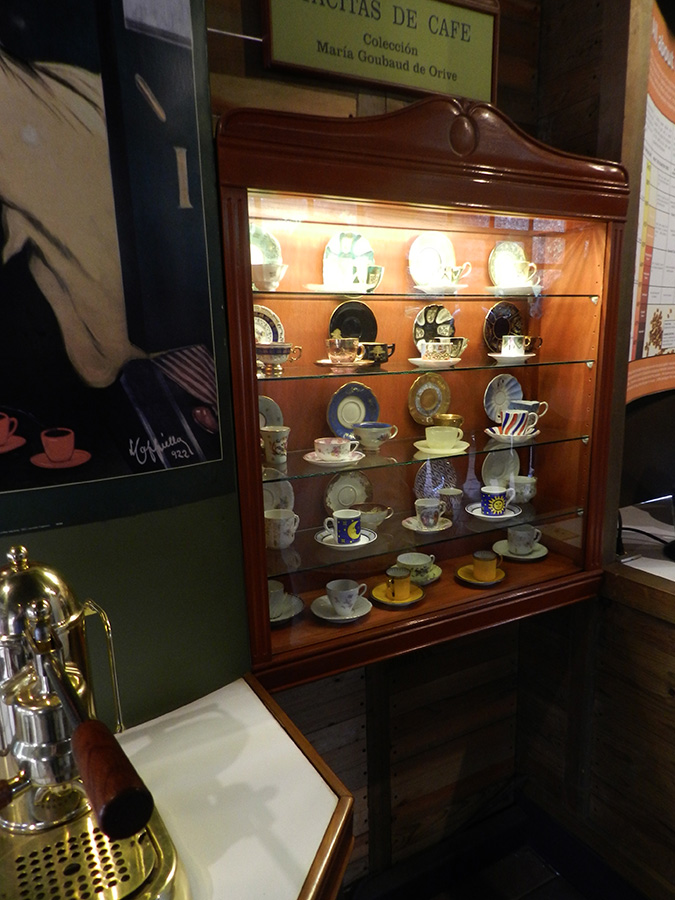
In the main house the owner had some coffee-oriented items. There was a collection of spoons.

And cups.

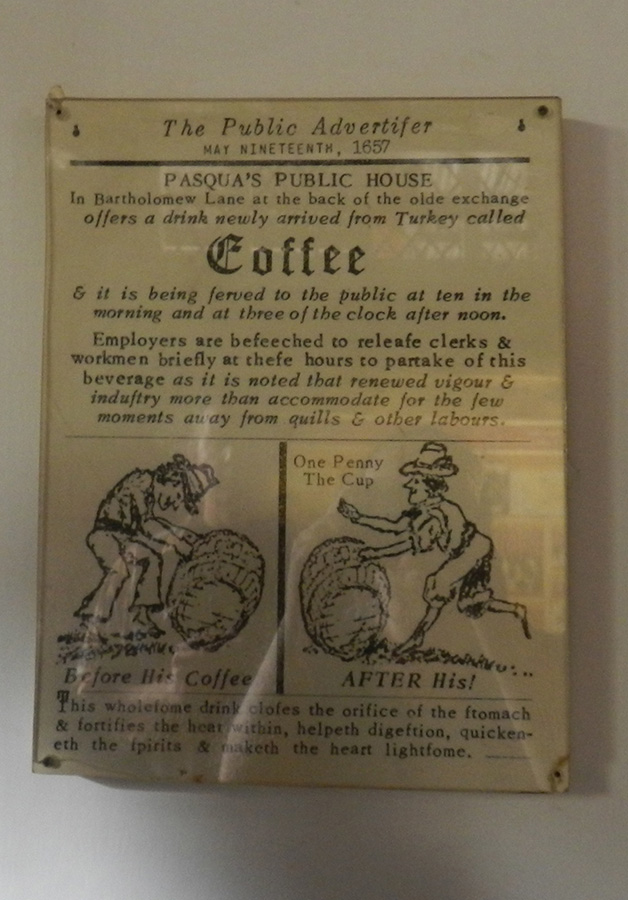
And a coffee advertisement from 1657. It looked like an olde versionne of a 1950s ad:  “Coffee puts pep in your step!”

There was a small museum on the coffee plantation. Similar to Mexico (which is not surprising since they share a big ole border) Guatemala uses those lovely paper-cut decorations on their ceilings.

And also, not surprisingly, there’s a whole bunch of spiritual non-Christian religious traditions that are still practiced. Here is a small costume worn in a ceremony. Common themes are mirrors and masks which you can see here.

There was a store in the city of Antigua (more on Antigua later) where they had a whole wall of these kinds of costumes and masks decorated with sequins and antlers. I wanted everything on that wall. It’s a good thing that place was closed most of the time because I would have laid my credit card down and asked them to fill up a truck.

While we’re here, let’s look at some random bits and pieces that relate to anything else specifically. First, geckos in light fixtures! I do love me some geckos in light fixtures.

A cemetery on a hillside. Vibrantly-painted mausoleums. I think that’s something we should adopt here, everyone should have their tomb painted the color they loved most. It tell you a little something about the deceased.

Every culture has a craft that they are excellent at. In Guatemala it’s thread-based. The embroidery / cross-stitch / loomwork / quilting / braiding is unreal in both its skill and diversity of styles. I bought some stunning bracelets using a popular pattern but different colors.

Here’s a Pinterest page that shows a pretty good sampling of the variety of threadwork. It’s pretty phenomenal.

https://www.pinterest.com/CasaAmarosa/guatemalan-embroidery/?lp=true

And here is something that made me laugh every time I saw it. In one of the hotels we stayed in there was a gift shop. No big whoop there. There was, however, a painted box on display. I assume the artist was trying to make a lovely tableau of Guatemalan items together, a themed still life. The only problem was there was an owl that looks like it had been sucker-punched in the back of the head while witnessing something profoundly traumatic. Every time I saw it I got the giggles.
Next entry: the town of Antigua.

Guatemala Part 2.

Thursday, November 9th, 2017

Tikal! I saw jungle pyramids, everybody! Jungle. Pyramids.

Let’s see what Wikipedia has to say about Tikal.

Tikal is the ruin of an ancient city, which was likely to have been called Yax Mutal, found in a rainforest in Guatemala. … After the Berlin Academy of Sciences’ magazine republished the report in 1853, archeologists and treasure hunters began visiting the forest. Today, tourism to the site may help protect the rainforest. It is one of the largest archaeological sites and urban centers of the pre-Columbian Maya civilization. … Though monumental architecture at the site dates back as far as the 4th century BC, Tikal reached its apogee during the Classic Period, c. 200 to 900 AD. During this time, the city dominated much of the Maya region politically, economically, and militarily, while interacting with areas throughout Mesoamerica such as the great metropolis of Teotihuacan in the distant Valley of Mexico. There is evidence that Tikal was conquered by Teotihuacan in the 4th century AD. Following the end of the Late Classic Period, no new major monuments were built at Tikal and there is evidence that elite palaces were burned. These events were coupled with a gradual population decline, culminating with the site’s abandonment by the end of the 10th century.

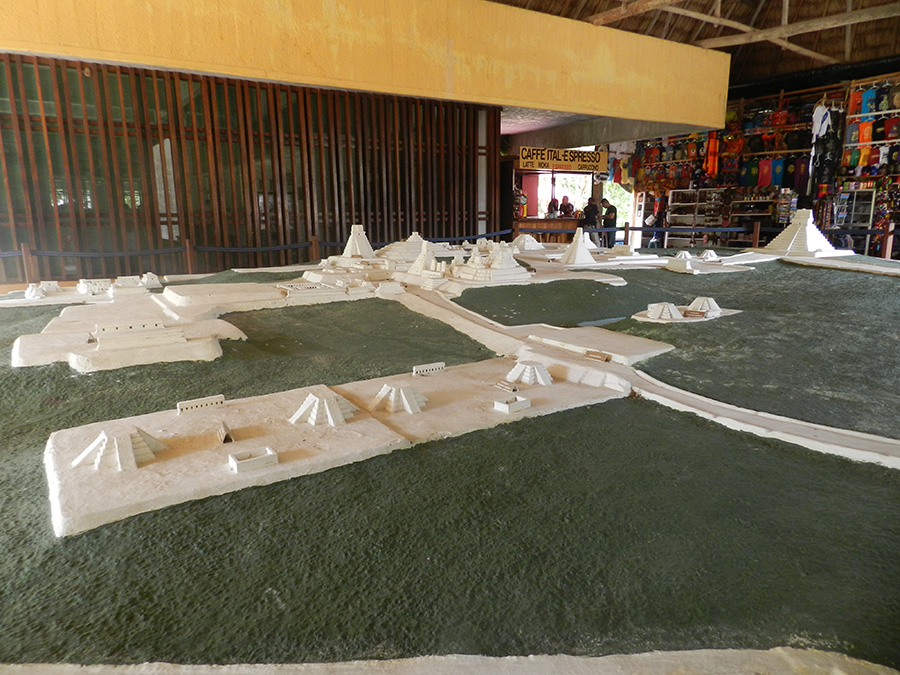
No one from the modern era knew the pyramids were there. They were completely covered with dirt and trees. Some of them are still covered or partially covered, archeologists are still working on the site and it is massive. There was a 3d map in the main entrance center.

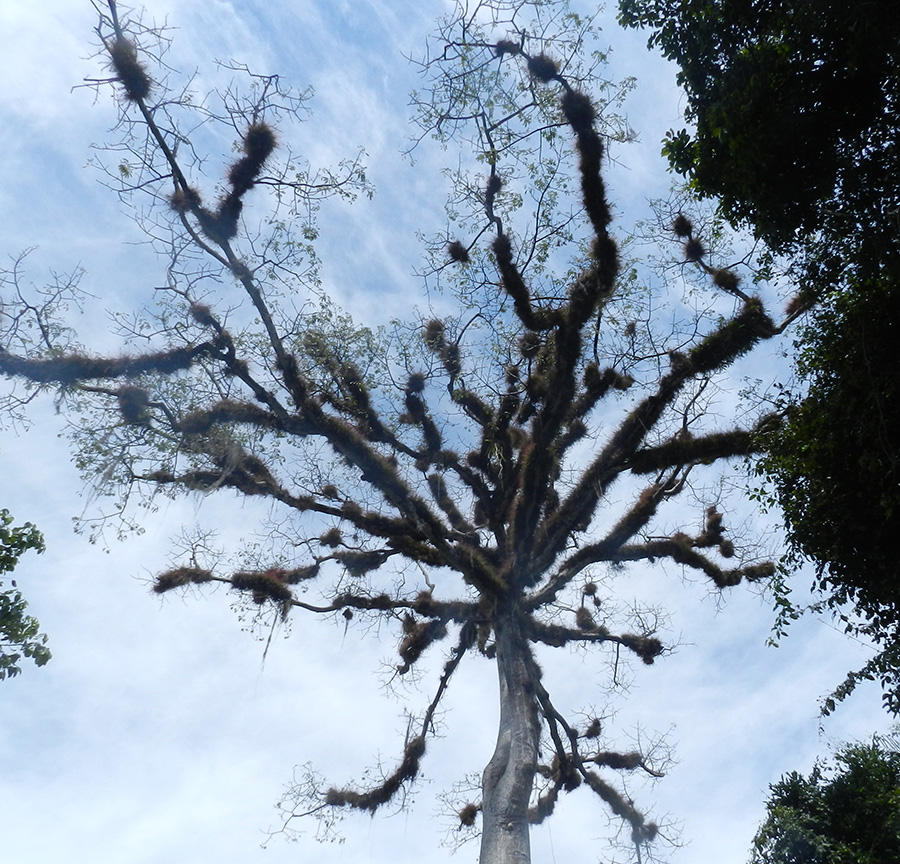
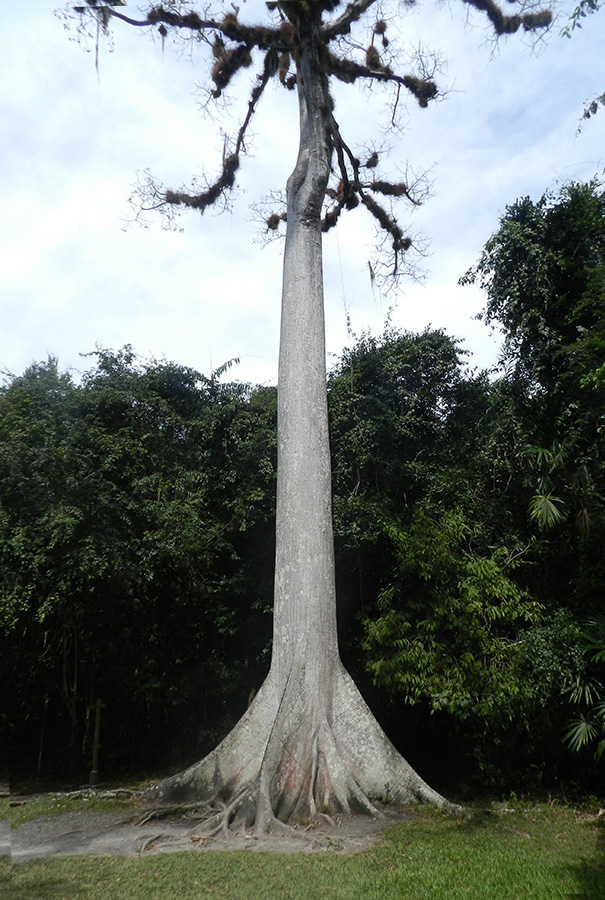
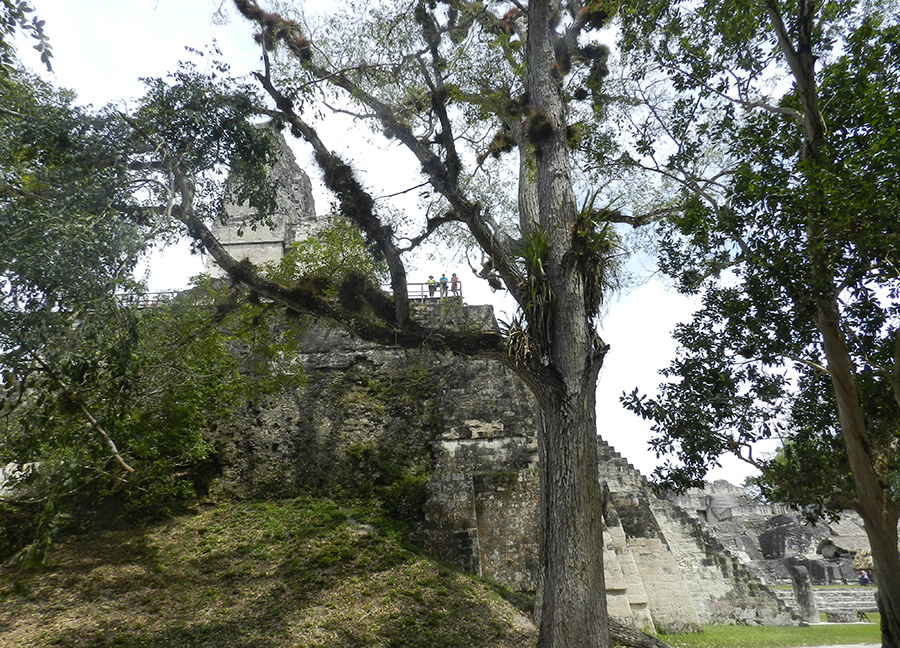
Also tall trees filled with air plants.

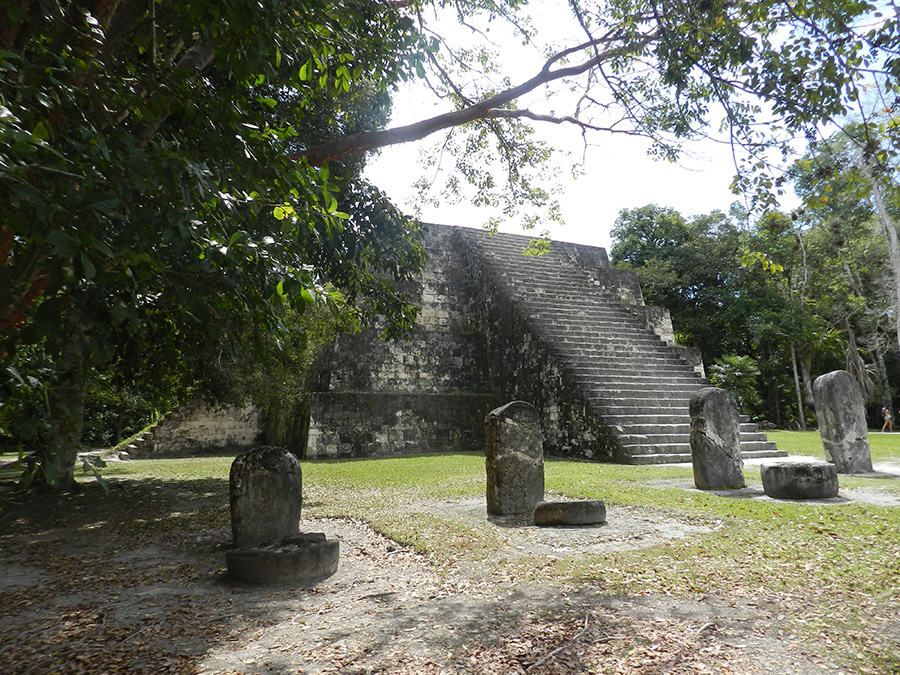
You basically wander around the rainforest on neatly organized trails past very very large stone structures. I imagine there’s some kind of system but because of the trees and unexcavated mounds it seems very higglety-pigglety.

You can tell the Mayan’s belief system was similar to the Aztecs because at Teotihuacan they considered the circle to be holy and used it a bunch on their art and refused to use wheels because they thought it would be disrespectful. On a building at Tikal I saw the wheels represented as well. So, I’m guessing overlap.

Some of the gargantuan temples you were allowed to climb. I didn’t, of course because any form of athletics are not my jam ever ESPECIALLY in a hot sweaty rainforest, but The Moomins did and I took a picture of her at the top. Very proud.


A lot of the buildings are still covered or in the process of being dug out of the centuries of soil that has accumulated on them.

There were beasties roaming the property. The most visible were the coatimundis. There were two right next to where we were sitting snuffling around in the dirt eating fruits that had fallen from the trees. Sorry there’s so many photos – they’re very cute animals and it was extremely difficult for me to cull the pile of pictures.

Coatimundis are in the raccoon family. These must have been males because the name means “forever alone.” The females and babies hang out in family units but the males are forced to forage by themselves. Further on the trail we saw a family unit. I think the pale ones are teenagers (this fact is based on precisely nothing, don’t get mad if it’s wildly untrue).

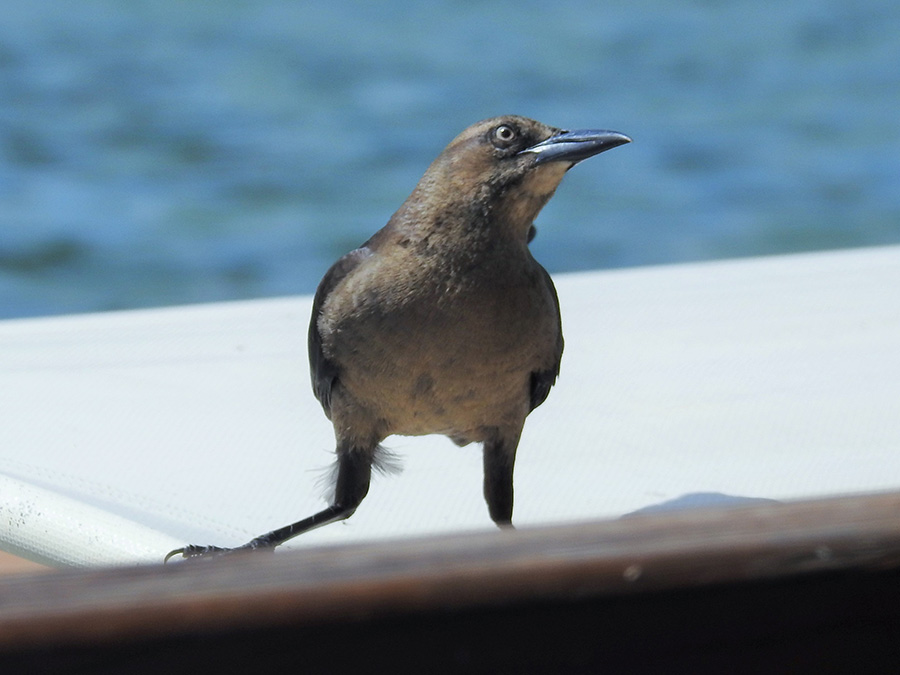
I saw a bird from the corvid family (crows, jays, ravens, magpies, etc.). I think it’s a jackdaw.

We saw a snekkie-snekk but he slithered off with great haste.

Small lizard friend.

We almost got peed on by a troupe of spider monkeys that were high in the treetops. And we glimpsed a toucanet betwixt the leaves.

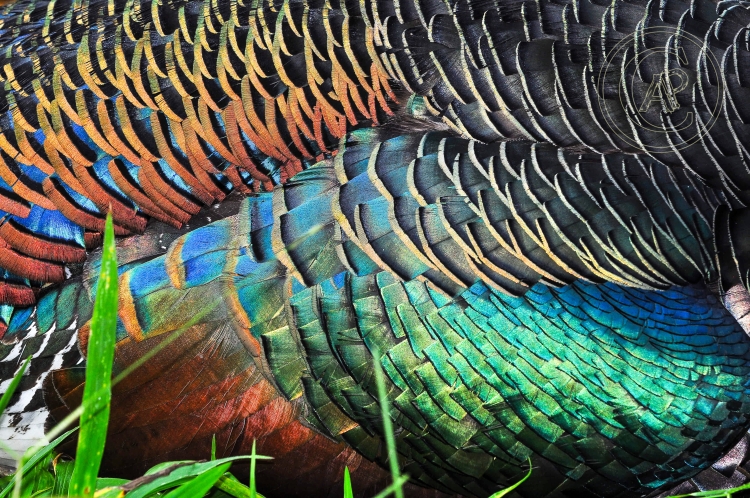
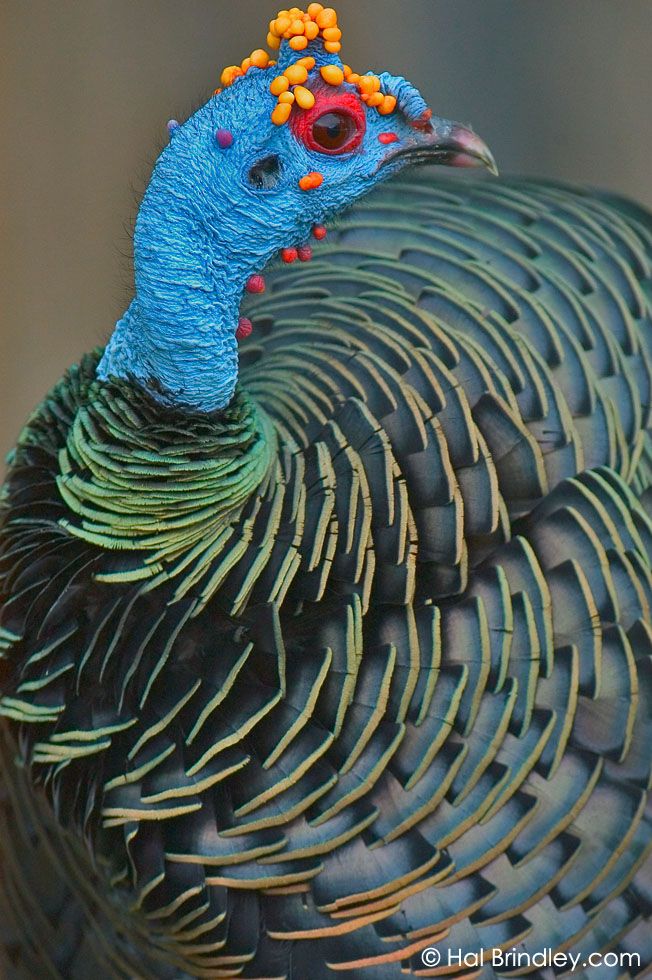
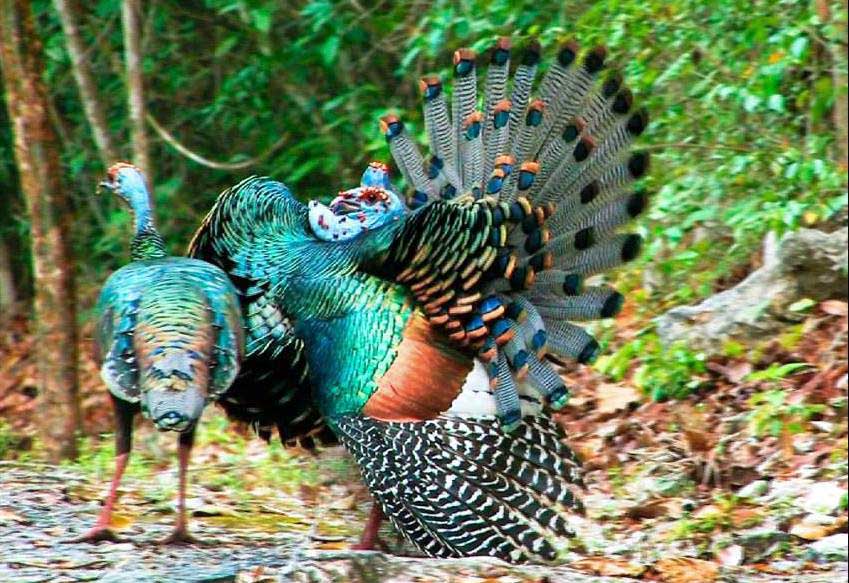
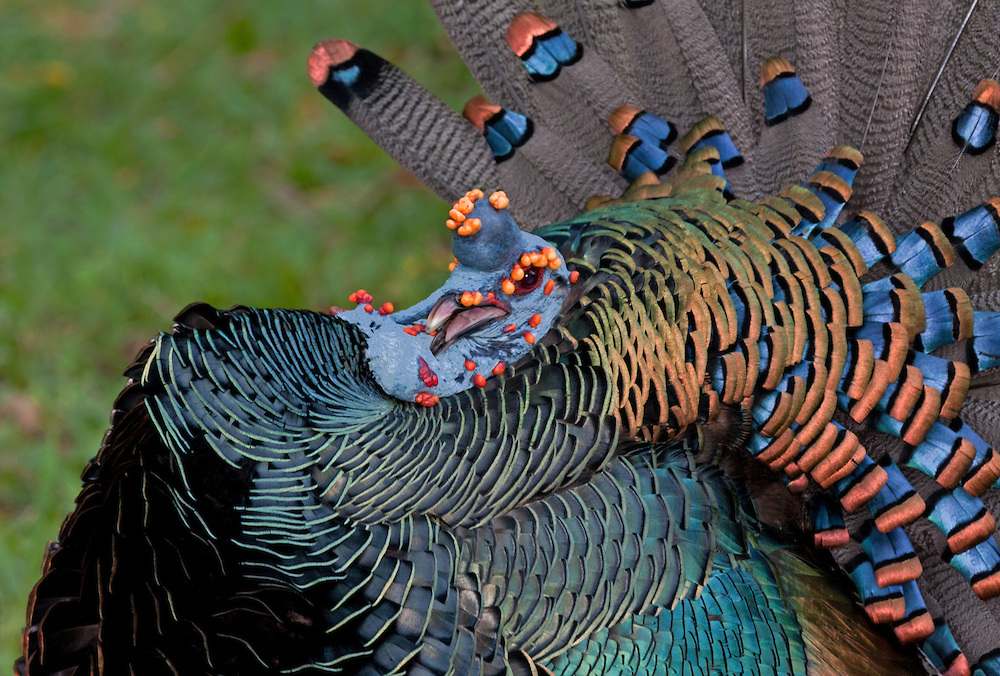
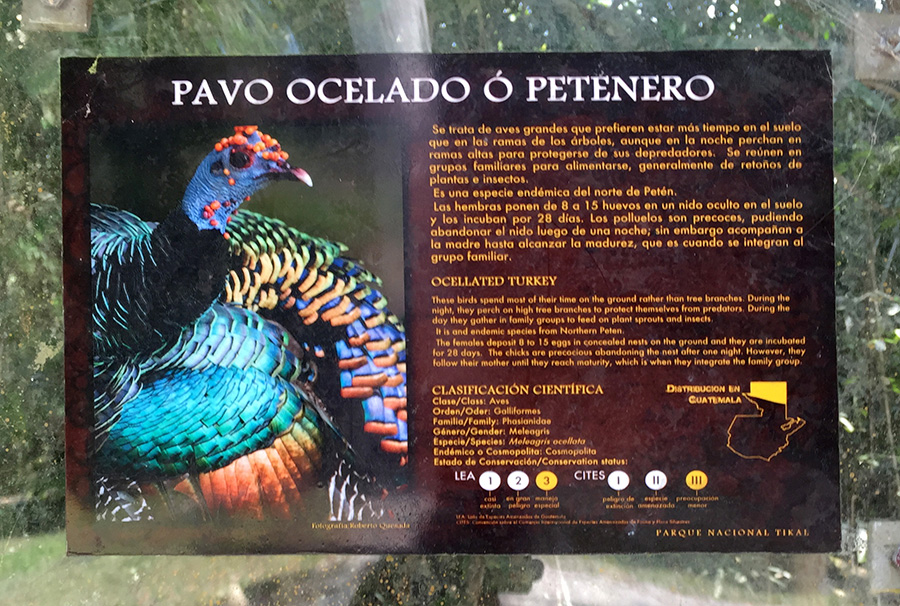
However, I was exceptionally excited to see an ocellated turkey. They are the most beautiful ugly animals ever in the history of things. I once saw a taxidermied one for about two thousand dollars and I was sorely tempted to buy it because, c’mon, amazing. Better than peacocks. Like a turkey designed by Lisa Frank. See for yourself. These are all photos I found online.

See? GORGEOUS. Hideous and exquisite simultaneously. Even the female is dope and rainbow. Therefore I was so very excited to see one. I saw this sign and readied my body for the magical bird to appear.

Aaaaaaaand nothing. I know from safaris that you see what you see because nature can’t be controlled but … it’s a turkey! Not a jaguar! I feel like I was making a reasonable request to the heavens. I wanted to see the blue heads with what looks like little mandarin oranges stuck all over it. Sigh.

(If anyone is feeling real generous and wants to buy me a present, here’s the link to the taxidermied occelated turkey for sale.)

http://www.creelandgow.com/prod-pages/CaGa2880.html

Coming up: Coffee plantation.

Guatemala Part 1.

Tuesday, November 7th, 2017

I’m back everybody! Back to blogging! I worked and worked and accomplished goals and I’m feelin’ good about it. Get ready to see a WHOLE BUNCH of art I made. But first, Guatemala. Back in March I went to Guatemala with my parents and now you’re going to learn things about it. I have completed the trinity of seeing the remains of all three major ancient cultures – The Mayans (Guatemala), The Aztecs (Mexico) and The Incas (Peru). Pre-Columbian fist pump to me. Let’s dive right in and see how much I remember from six months ago.

A good place to start would be the Popol Vuh which we visited on Day 1 or 2. Wikipedia gives a good definition of what that is.

Popol Vuh is a pre-conquest narrative dating to the Post Classic period, roughly CE 1000–1500. The actual written text, however, is a product of the Spanish colonial period. The title translates as “Book of the Community”, “Book of Counsel”, or more literally as “Book of the People”. Popol Vuh’s prominent features are its creation myth, its diluvian suggestion, its epic tales of the Hero Twins Hunahpú and Xbalanqué, and its genealogies. The myth begins with the exploits of anthropomorphic ancestors and concludes with a regnal genealogy, perhaps as an assertion of rule by divine right.

Just say “K’iche’ Bible,” it’s so much faster that way. K’iche’ is the language that was spoken in the area before Spanish became the lingua franca. It has a lot of gutteral stops which makes it a cool language to listen to (our guide spoke a little). Popol Vuh is also the name of the museum that houses most of the relics and archeological finds. If I had to sum up the art style I would quote our guide verbatim:

“The Mayans would mix toad venom with water lily essence, introduce it anally via an enema, and this allowed them to have visions and transcend different planes of existence.”

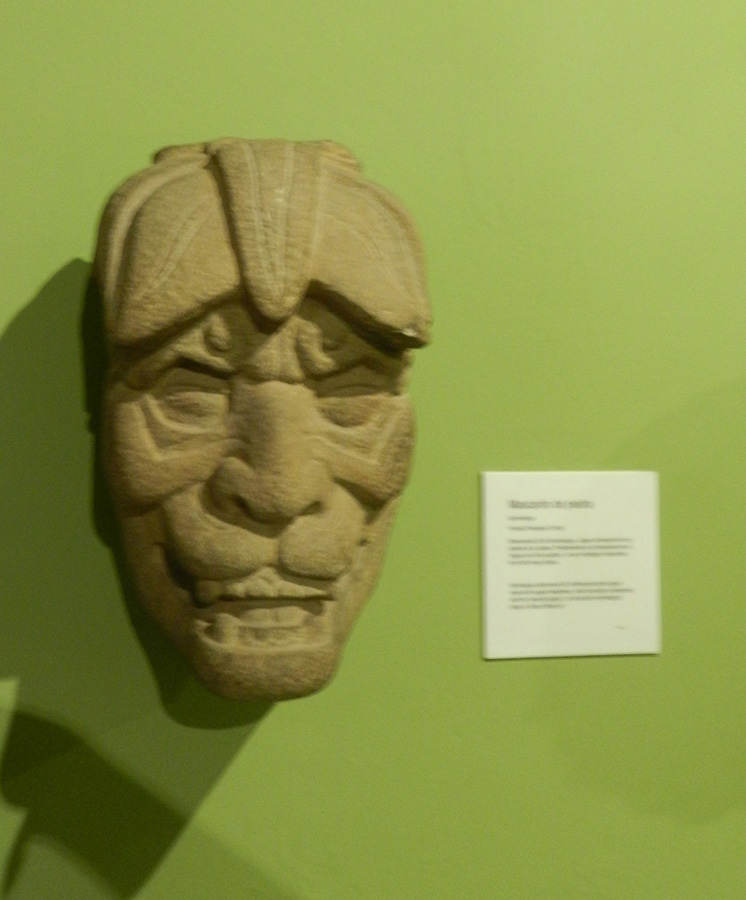
You know you could also… drink it. Does the tincture taste that bad? Maybe that’s a clue that you should not be ingesting it. Perhaps. Whatever. You do you. Anyway, the artwork really captures the aesthetic of drug-infused spiritual journeys. There were these baby-heads peering at me from the edge of a bowl:

This screaming pig (I’m unsure and picking pig as the animal represented but I could be wrong):

These jaguars with corn cobs growing out of their heads (corn is VERY big in the religion):

Men with mushrooms for heads:

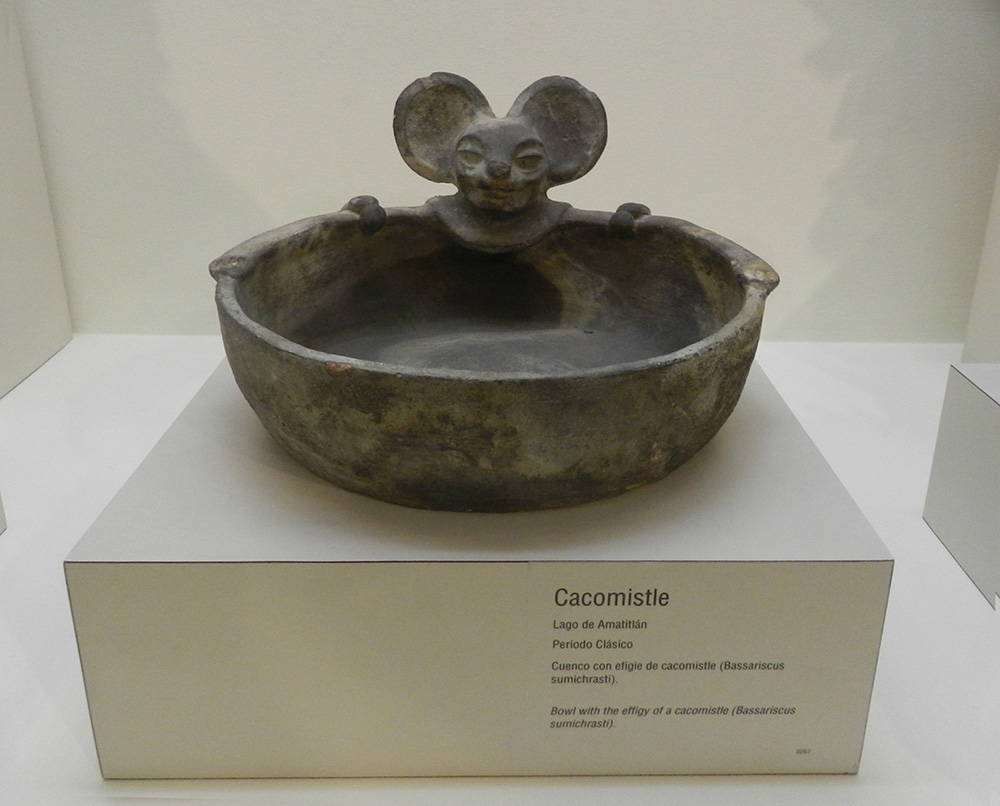
Proto-Mickey Mouse chillin’ in a hot tub:

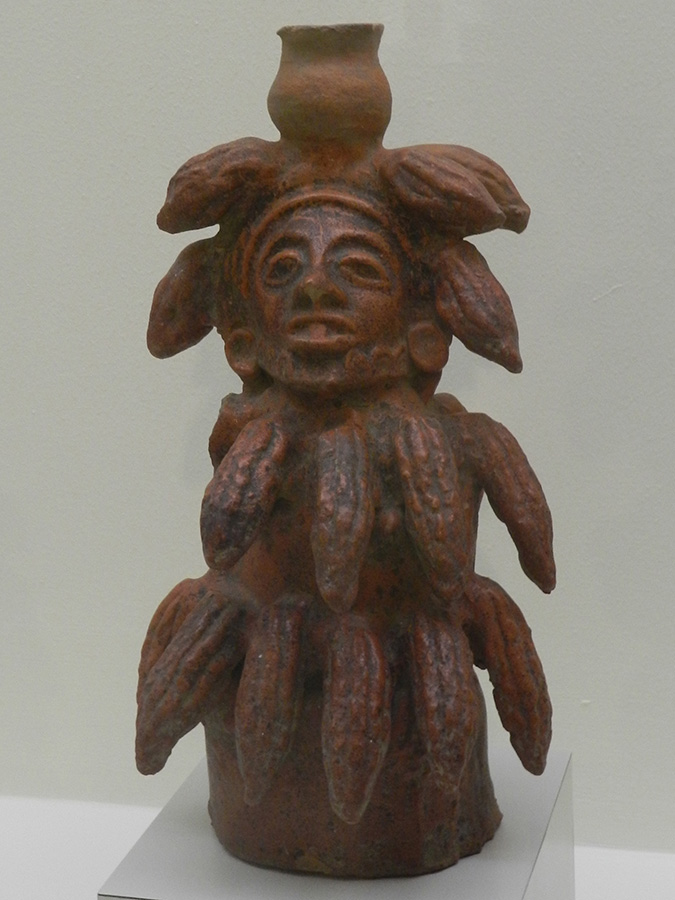
A man made of corn or cacao, I can’t remember which:

Small frogs and toad sculptures that I wanted to steal but didn’t because I have restraint and am afraid of prison:

Really Happy Jaguar Man with Leaf Hat:

This sculpture that I called Person With Runny Nose Riding Disgruntled Duck:

This guy who has the expression of someone who is holding two angry housecats that are going at each others’ throats and he’s like, “whoa, whoa, settle down guys:”

And my personal favorite, Spooky Bat:

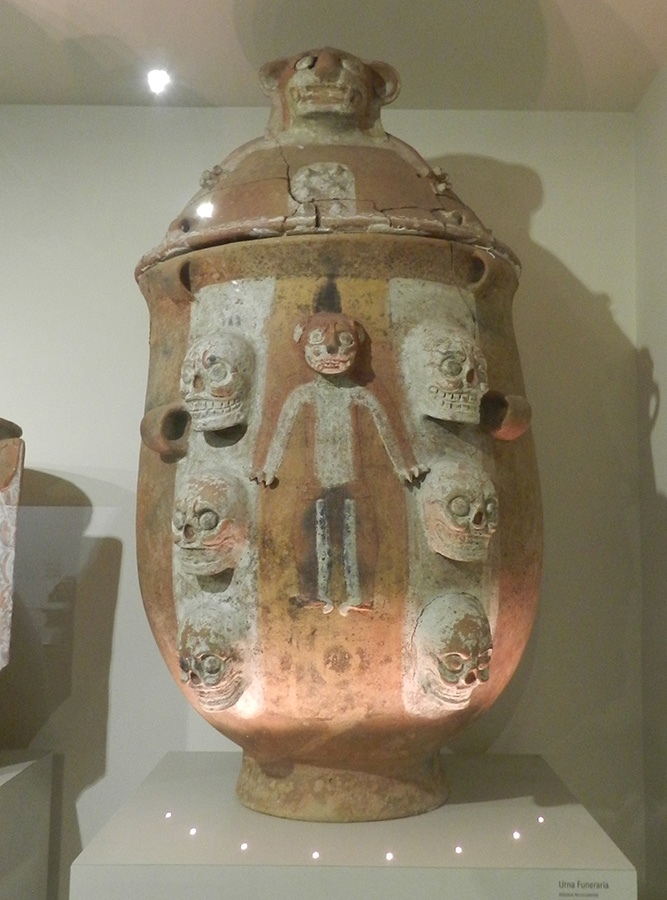
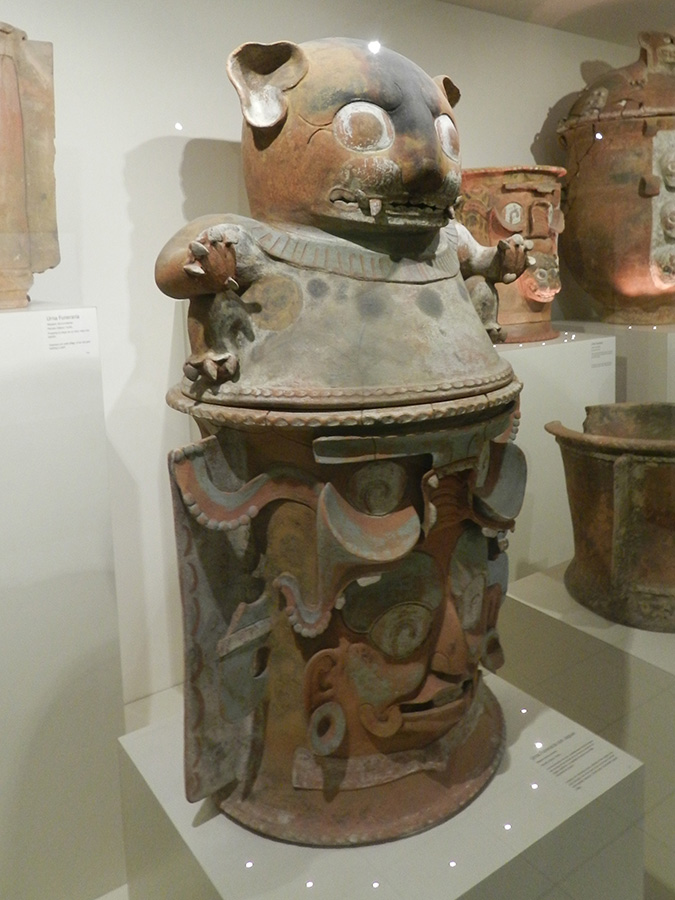
In addition to that there were mumlettes! Mumlettes are what I call mummies that were placed in urns in the fetal position. I was first introduced to mumlettes in Peru.

https://design-newyork.com.fwtrading.x10host.com/wp/2015/09/01/south-american-2015-part-1/

The actual bodies are long gone but the urns are still around. Unsurprisingly, I loved them.

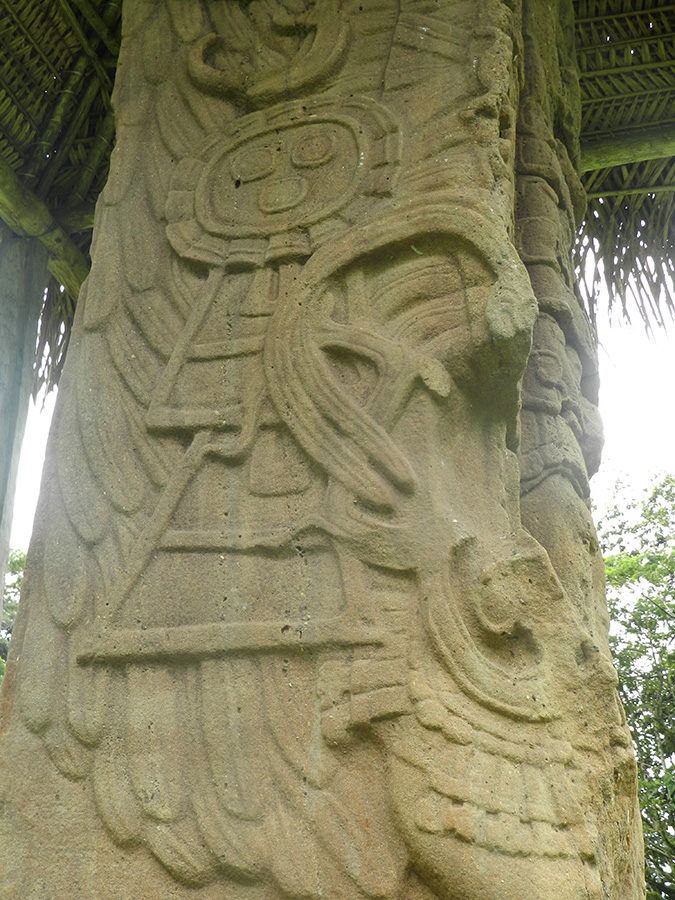
In the first two days we also visited the place where the “The Earth is going to end in 2012!!!!” came from. It’s called Quiriguá (pronounced Kih-ree-GWAH). It’s a collection of stelae (an upright stone slab or column typically bearing a commemorative inscription or relief design, often serving as a gravestone) hanging out in a field predicting the future. The front parts had portraits of the kings and the sides had hieroglyphics and dots and lines telling us what year it was made. This website, The Stelae of Quirigua, explains it far better.

The glyphs are read from left to right, starting from the top, with the pictures denoting the periods of time (i.e. years, months, days), and the dots (equaling 1 each) and vertical bars (equaling 5 each) providing the quantity of those periods. For example the top left is 9 B’ak’tun – approximately 3546 years, as each baktun roughly equals 394 years. This is followed by 18 Katuns – about 360 days, and so on. The full text provides a date of 9.18.15.0.0 3 Ahau 3 Yax, which equates to the July 22nd, 805.

That’s not even my favorite fact on the page. This is:

It is also interesting to note that monuments were defaced when the cities were abandoned, with particular attention being made on breaking the nose off – an action repeated across Meso-America. It is thought that this is symbolic of a belief that the statues were filled with the living power of the person they represented and that the soul of a living person resides in the nose – curiously, this belief was also held in Asia. Therefore, destroying the nose was effectively killing the monument.

Oh, and here’s a bit on the importance of corn:

On the side if Stela H is a wonderful depiction of Cauac Sky as the young God of Maize, emerging from the roots of “World Tree.” Corn was the main sustenance for the ancient Maya, and any ruler who could provide corn in abundance was considered to be an embodiment of the God of Maize and highly revered.

I remember something about their main god being made from four types of corn – white, yellow, red and black.

And concerning the end of the world happening in 2012, yes, the Mayan mention 2012 as the beginning of their new calendar. Nothing ends. It’s like when spring follows winter. Our guide said people camped out in front of the stelae and sang songs and anticipated the End of Days while the archaeologists and professors who knew what the stones meant and were probably hoarse from repeating themselves over and over rolled their eyes straight into the backs of their skulls.

Celestial events recur through time so using them to reference times in the past and the future was a very elegant solution – and one that appears to be built into the Mayan Calendar. … Curiously, the Mayan Calendar is not linear, but cyclical with a cycle length of 5,125 years, which perhaps confirms that it is based on a celestial event.

I think this is the text that caused all the hoohah.

And I took this picture for a reason but I’ve forgotten what it is. If anyone knows, let me know.

To protect the stelae from the elements they are under leaf roofs. They look like cute little chess pieces from a distance. In truth the stelae are huge, 12 feet tall and the like.

The trees are also insanely big. Here is The Moomins standing next to one.

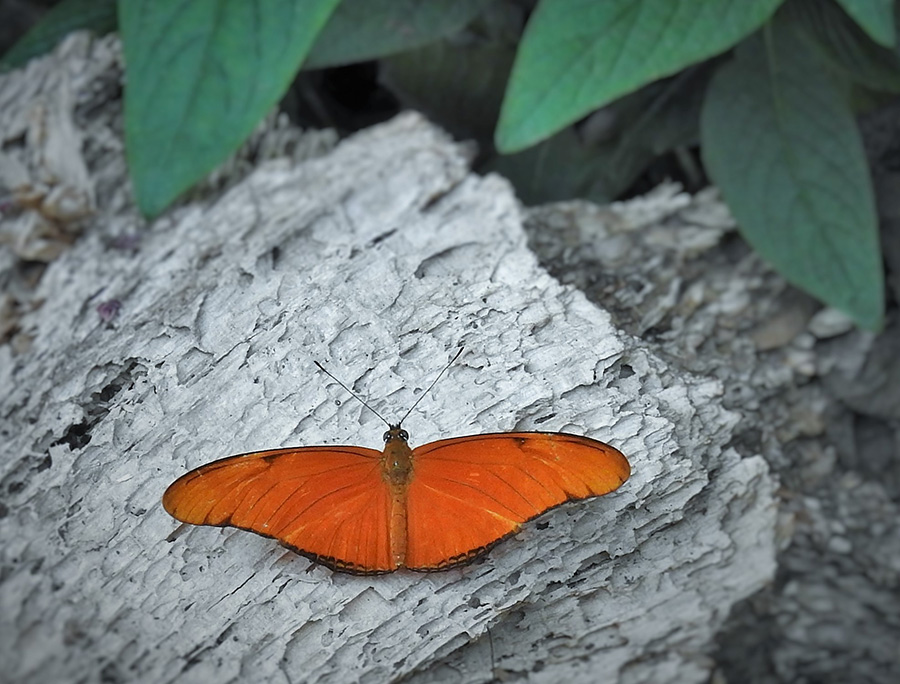
And here is a wee orange butterfly that landed on one of the stelae and was photogenic.

Next entry: Tikal. BIG New World pyramids. Get psyched.