Japan 2014, Part 7.

March 14th, 2014

Nara! My whole life I’ve been hearing about Nara. My father was stationed in Okinawa between the Korean and Vietnam wars with the Marines and on one of his leaves he went to Nara. He’s told me many times how there are sacred deer just walking around and you can feed them. How am I not suppose to go commune with sacred deer?. Luckily in the tour I signed up for the first stop was Nara. It’s not just a town with some deer chillin’ outside. There’s a massive temple there as well, the Todaiji Temple.

nara3

Look at the size of the people to get an idea of the size of the building. It’s big. Inside is a Buddha that was built in the 700s, using up almost all of the bronze in Japan at the time. And the building only burned down twice! That’s pretty good for Japan. There were two seven-tiered pagodas on either side also built in the 700s, but due to either earthquake or fire they are gone. If you’re wondering why the Buddha’s face looks fresher than, say, his knee, it’s because his head was starting to sag at one point so in the 1700s they replaced it with a new head. I think they replaced his hands too.

nara4

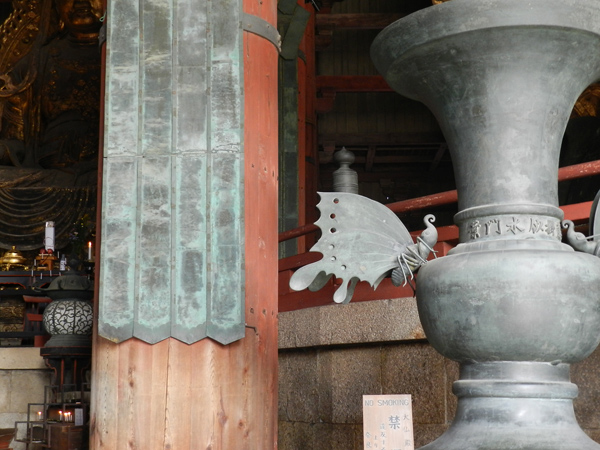
There were emergency-backup golden Buddhas on either side, similar in appearance to the big central Kannon in Sanjusangendo. And poles made of metal with giant bugs on them. I liked those.

nara5

In the back was the weirdest part. One of the pillars holding up the roof has a hole bored through it. It is the exact size of the nostril of the Buddha statue. You are supposed to shimmy through the hole, and while you’re in there you make a wish. This is a real thing.

nara6 nara7

As you walk towards the temple, our guide Kimi-San said not to step on the long metal bar in the gate because it represents Buddha’s shoulder and it’s rude to step on a god’s shoulder. See what I mean about having a guide? I would have never known that without her telling me. There was no sign or anything. I would have stepped on the bar and everyone around me would have seethed and I would have put another nail in the coffin that is the reputation of Americans overseas. Get a guide. For America.

nara1

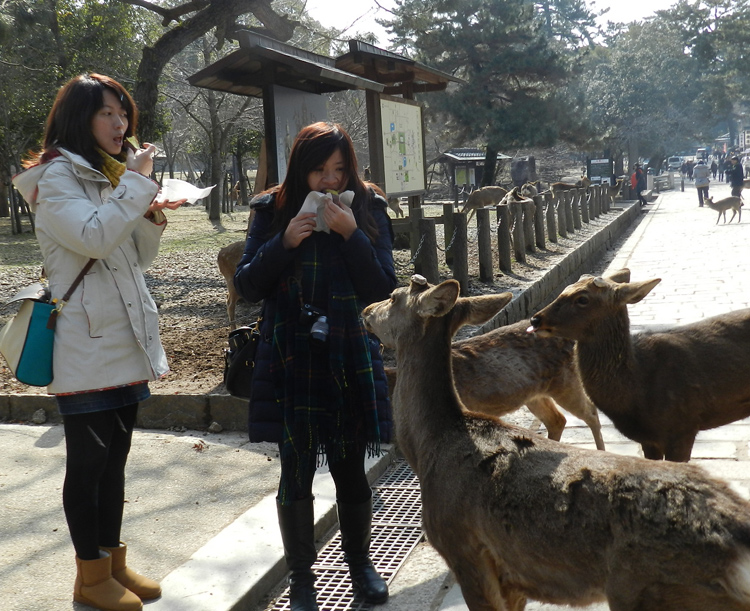
So, there’s deer. Sacred deer. 1,000 of them, standing there. They are pleasant and on the smaller side, smaller than the deer we have here on the East Coast. They are not, unfortunately, bright in any way. If anyone wants to make an argument that certain herbivores are food, these guys would be a good place to start.

nara12 nara10

The deer have hearts on their rumps.

nara9

Most of the time they stare off into the distance until anything vaguely edible happens. These poor ladies were trying to eat some lunch and were getting hassled.

nara11

See how the antlers are trimmed down to nubs? That because for $1.50 you can buy a packet of deer-cookies and the deeries will perk right up, come over to you and commence head-butting you and nipping at your clothing. When Moss went she sent me one of my favorite texts ever. “GOT BIT IN THE ASS BY A SACRED DEER.” The Moomins got a bruise on her thigh from the head-butting. I got shoved into the parking lot. Imagine how much that would hurt with antlers. (Correct answer: a lot). So that’s why their antlers are shaved off.

nara14

I cracked up with the guy above. He was feeding the deer their cookies and one was startin’ stuff with him so he smacked one in the face with the palm of his hand and it didn’t even notice. A equally good text would have been “SMACKED A SACRED DEER IN THE FACE.”

Anyone who knows me knows I have no deep love for children. I don’t hate them, I just don’t need them around me or anything. The exception was Japan. The kids there are so freakin’ cute. I took pictures of some of them. This is so completely out of character for me. It’s like me saying, “Then I solved that crazy-complicated math problem after going rock-climbing.” A bus full of little kids showed up and some of them could not wait to touch the deer. The teacher would talk to them and they would listen, but one of their tiny hands had to be in contact with the deer always. It was so adorable it hurt a little bit.

nara13

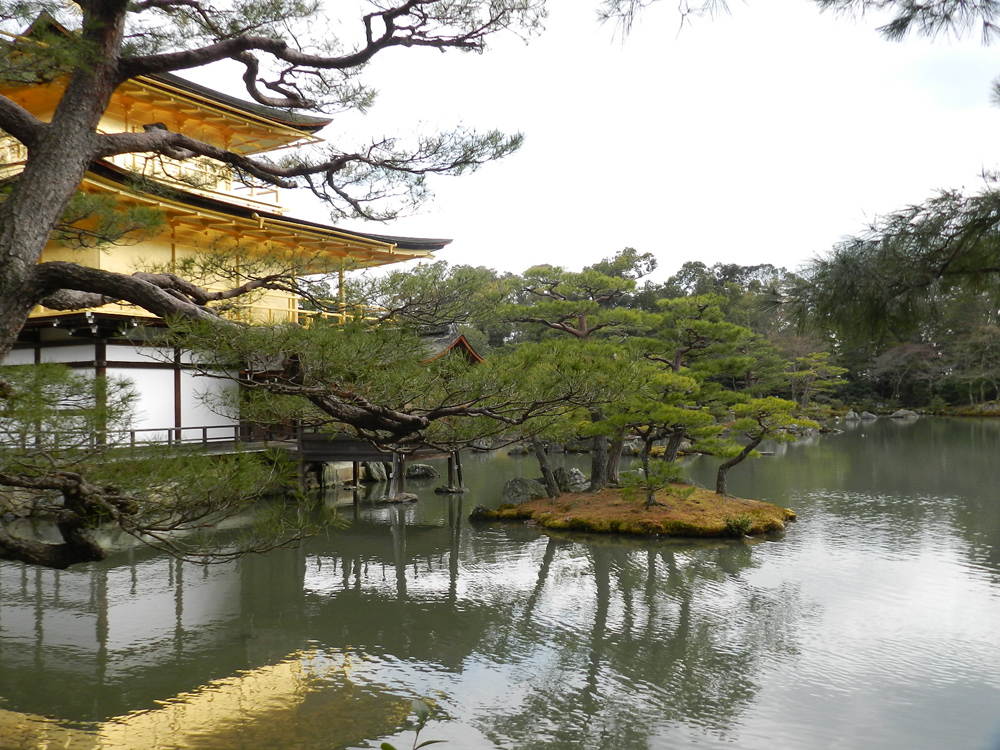
After we left Nara we went to the Golden Pavilion. It was built in the late 1300s and made it all the way to 1950 when a mentally-ill monk burned it down in a suicide attempt. Luckily someone found drawings of how the building was put together and in the mid-1950s it was rebuilt exactly the same. It’s called the Golden Pavilion because the top two floors are covered in pure gold leaf. It is also famous for having one of the best gardens in Japan surrounding it. Most of Japan is pretty darn photogenic:

photogenic1 photogenic2 photogenic3 photogenic4 photogenic6

But the Golden Pavilion takes the cake. It was so perfect with the gardens around it the whole thing looked fake.

golden-pavilion1 golden-pavilion2 golden-pavilion5

This was the phoenix on the roof.

golden-pavilion4

There were some statues where you could throw coins and make a wish. I suppose they’re Buddhas. As you can see, they’re carved very loosely and it’s hard to make out precisely who they are. Since there is a Buddhist temple right next to it, I’m going to go with Buddha on this one.

golden-pavilion6

Off to the side was the temple and the priest’s quarters and a odd-looking pine tree. It’s called the “Land Boat Tree” and it was a wee bonsai long ago that the owner decided to plant. It got bigger and bigger and that bottom branch grew out facing West which, according to Kimi-san, is where Buddha’s “happy place” is (I think she meant heaven or the like).

golden-pavilion3

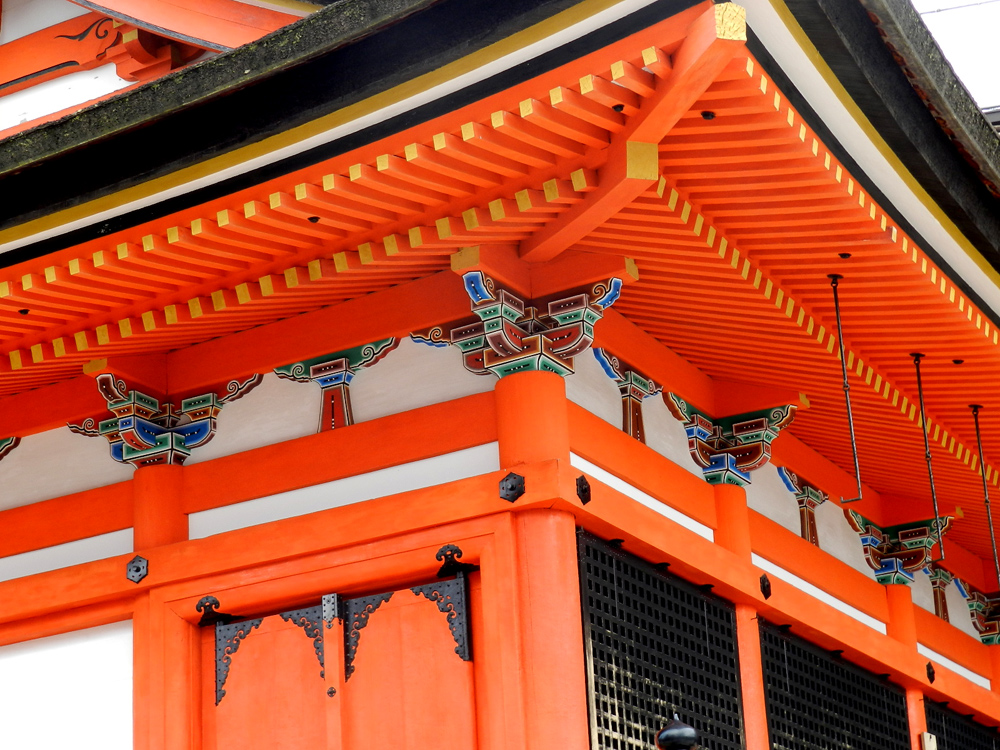
The last site we went to on that day was Kiyomizu Temple. I mentioned that I swung by when I was doing the walking tour with The Moomins, but I got the thorough experience this time. It’s a big complex. Most temples aren’t just the one building, there’s ancillary buildings all around them and this was no exception. Almost all the buildings were painted this really vibrant orange.

kiyomizu-temple1 kiyomizu-temple9 kiyomizu-temple2 kiyomizu-temple3

And the main building, built in the 1600s, doesn’t have any nails holding it together. It’s all tongue-and-groove or a similar technique and when you appreciate how impressive that is is when you see the complexity of the pillar system holding up the side.

kiyomizu-temple6

I found this on Wikipedia:

The popular expression “to jump off the stage at Kiyomizu” is the Japanese equivalent of the English expression “to take the plunge”.This refers to an Edo period tradition that held that, if one were to survive a 13m jump from the stage, one’s wish would be granted. Two hundred thirty-four jumps were recorded in the Edo period and, of those, 85.4% survived.The practice is now prohibited.

Something that was pointed out to me was that to the Japanese, religion is more like a superstition that an organized entity. Both the Buddhist and Shinto religions live side by side in harmony and you can casually switch between the two with no repercussions. There’s a lot of wish-making and the like. It seems very calm and drama-free. I found it soothing.

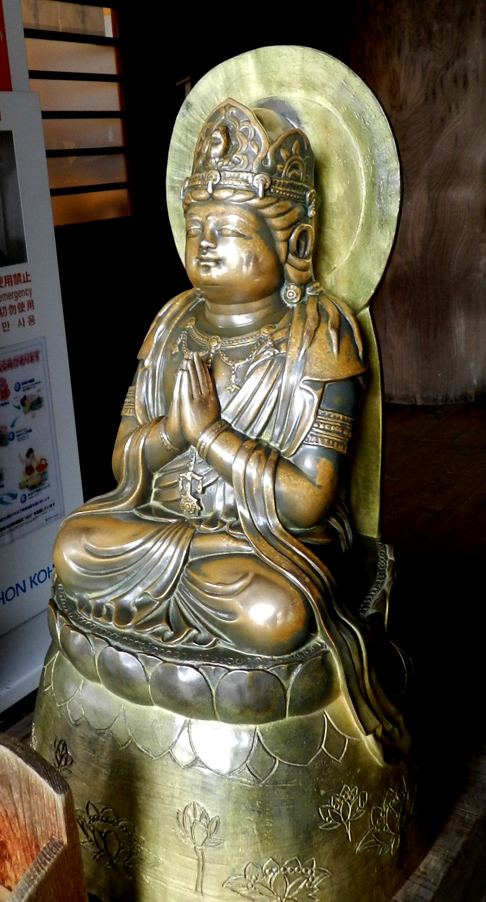
There were several examples of this relaxed attitude at the Kiyomizu site. One, there was this statue. I was told she was the statue that granted beauty. You rubbed her face and then rubbed your own face and you would be made beautiful.

kiyomizu-temple4

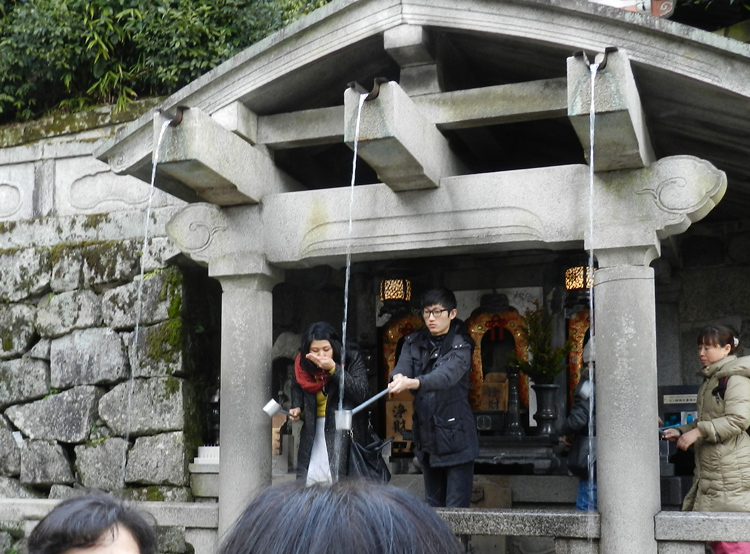
Second, there was a long line to drink from one of three cups of water. The one on the left helped with education, the middle with love, and the right with longevity. You could only drink from one.

kiyomizu-temple10 kiyomizu-temple8

And third, there was an shrine dedicated to the God of Love, where there were two stones about fifteen feet apart. You were supposed stand at one stone, close your eyes, and walk to the other stone. If you made it and you were already in a relationship, it was a good relationship. If you made it and you were single, you were going to find love soon. It was recommended not to do this if you were married because most people didn’t make it over to the second stone. AWKWARD.

kiyomizu-temple5

The only time I participated in any of these rituals was when I saw this sign:

engrish10

And after I smiled at the Engrish you bet I put money in there and prayed for the people hurt in the earthquake. Either my prayers won’t do anything, or they will reach whatever God they’d like me to pray to and it will help.

A couple unrelated bits:

A cute sign on an automatic door.

pinch-crab-sign

A slide built on a mound of dirt. That’s brilliant! If you fall off the slide, you don’t go far and you won’t get hurt. Why don’t we do that?

playground

An umbrella-locking station.

umbrella-lock

Fun cephalopod decals on the ceiling of the public bus.

cuttlefish-bus-decals

And one of the worst attempts to mimic the Yahoo logo ever.

manboo-yahoo-logo

Next entry – snow monkeys.

Japan 2014, Part 6.

March 13th, 2014

Fun Japan tidbit: Outside many establishments is a sculpture of a happy smiling bear-type creature. When I got back I mentioned to my friend Moss (who has been to Japan before) that I saw this bear all over the place and I didn’t know his significance. She said, “His name is Tanuki and he brings good fortune and money. Did you notice his balls?” I was like, nooooooo, was I supposed to notice his balls? She said the larger his balls, the more fiscal goodness. I took a photo of one while I was there and when I went back and looked at the shot, indeed he was rockin’ some mega-nards. I was more focused on his man-boobs and that creepy belly button, and in doing so I had completely ignored his whole undercarriage situation.

fat-bear

So when you go to Japan, be sure to check out the testicles on the bear sculptures outside various businesses. I can’t really believe I just typed that sentence.

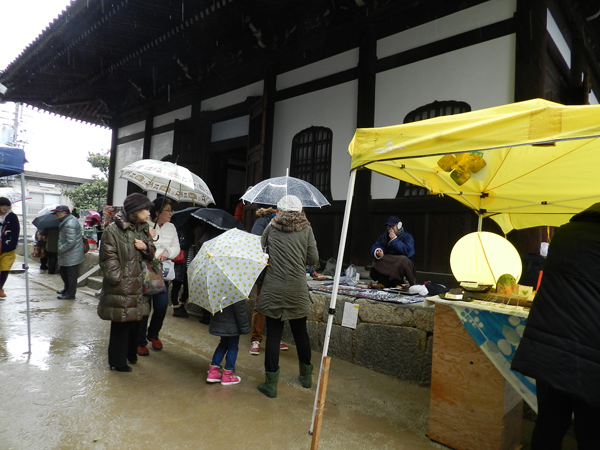
I read in my Frommer’s guide book that on the 15th of each month there is a fair in the large temple courtyard of Chion-ji Temple. The Moomins and I happened to be in Kyoto on the fifteenth, so we went. I’m so glad we did go because it wasn’t touristy at all. It was all Japanese people selling things they made to other Japanese people. My only complaint is that it was RAINING. Not raining, RAINING. We got soaked to the skin and I got mud all over my shoes and socks. But The Moomins and I are tough cookies and we didn’t let a torrential downpour prevent us from having a jolly good time. If all these people could drag their wares out and be pleasant and sociable, so could we.

temple-fair1 temple-fair5

Look, someone brought their beautiful bonsai trees and plant clippings! I tell you, if I lived there my house would be filled with all manner of plants and trees. It would be like a teeny-tiny arboretum. I got so excited by the plant life.

temple-fair6

I ended spending a healthy chunk of money at this thing. First of all, it was huge. It filled every available inch of space around the temple. Secondly, the prices were completely reasonable. And thirdly, it was all hand-crafts often being sold by the person who made them, which I am a big proponent of. I love meeting the artist. There was an elderly woman selling her temari balls. Everyone remember what a temari ball is? If not, here’s the blog entry I have referencing them.

https://design-newyork.com.fwtrading.x10host.com/wp/2014/01/08/japan-is-going-to-take-all-my-money-and-im-okay-with-it/

So Nice Lady was under a booth made of tarps selling this temari balls and other fabric pieces she had made. I had seen some other balls elsewhere for $84.00 each and figured I’d wait until I found some that were maybe slightly less expensive. She was selling hers for $5.00 and $10.00 and that was an amazing price, so I snapped up four of them. You can see my entire stash of temari balls in this photo I took of all my Japan swag when I got back. The temari balls are on the left.

swag

Nice Lady was so happy that I bought a whole bunch of her temari balls that she threw in little pincushions nestled in walnut shells are you kidding me that is the cutest thing ever Japan you are trying to kill me.

There was a potter there across from one of the pickle vendors (pickled vegetables are a big damn deal in Japan, they take great pride in it and it’s served at almost every meal) who made delicate little sake cups, and he had a sign I liked.

temple-fair11

True, true. We ended up buying several of his cups. Not because of the sign, they are nice cups, but the sign didn’t hurt.

It the middle of all this was a temple having services. It was a beautiful temple as many of them are, but it had these unique things sitting on pillows. I didn’t know what they were for, but each one was carved differently.

temple-fair3 temple-fair4 temple-fair7 temple-fair8

Later a group of monks or priests came in and chanted in front of a few of these things while banging on them rhythmically. This is one of the problems with traveling on your own in Japan. There are no signs in English and many people don’t speak English, so you miss out on a lot of information. When I was on the tour, any time I had a question like, “Who are those men and why are they hitting those maracas?” I could turn to my guide and she explained it all to me. This was only one of a hundred times I felt like I needed to know more stuff and was at a loss. I don’t really recommend going to Japan all on your lonesome. You can do it, of course, but you’ll miss out. Either hook up with a tour or get a personal guide, a college student or something, to take you around and explain things to you.

temple-fair10

In case you want to go to this fair, some of things being sold that I remember (I’m sure there’s a bunch I’ve forgotten), all handmade: foods, pottery, hair adornments, jewelry, toys, dolls, woodwork, stickers and stationary, furniture, and purses. Here’s a flickr cluster of Chion-Ji pics. Fair ones are near the bottom.

http://flickrhivemind.net/Tags/chionji/Recent

While we’re on the topic of temples, one of things I saw was a water dragon at the entrances to most shrines / temples. With cups on sticks in front of them.

buddhist-dragon1 buddhist-dragon2 buddhist-dragon3

I later learned what to do with them. Before you pray to Buddha, you clean and purify yourself. What that means is you pick up a cup of water and pour it into your left hand to clean it, then your right hand, and then you pour water into your left hand, rinse your mouth, and spit into a trough on the side. That way none of you touches the cup and contaminates it for others.

Final thing at the temple fair: a woman, a real in-the-flesh crazy cat lady, brought her cat to the fair. In the pouring rain. Why would you do that? That cat’s expression says it all. I know cats can’t change their facial expression. but humor me this once.

temple-fair9

Lady, you need to sleep with one eye open because that cat is going to kill you in your sleep for sure.

Next entry – Nara and the Golden Pavilion.

Japan 2014, Part 5.

March 11th, 2014

One of the things I’ve mentioned to people that I found most different about Japan is the lack of Christianity. It’s there, but it’s sparse and not that noticeable. I grew up in a town of 17,000 people and we had six churches, all with tall steeples, taller than most of the surrounding area. They were visible everywhere. It was fascinating to be someplace where Westernized religion isn’t really a thing at all. The Moomins and I went to heaps of temples and shrines. They are are tucked into every nook and cranny. I got very attached to them.

shrine-swastika

I looked up the swastika thing and I learned a bunch. Thank you internet! I learned that the word “swastika” is Sanskrit for “it is good.” It is used in Buddhism to invoke Lakshmi ( the Vedic goddess of wealth, prosperity and auspiciousness). And it’s called a tetra-gammadion in Greek, which I think is a super-cool name. It was even used as a good-luck symbol in Western cultures until the Nazis had to go SCREW IT UP and now it’s banned in Germany. Butt-weasels, taking a nice symmetrical symbol for happy stuff and ruining it. Back to shrines. The Moomins and I stayed in a hotel right next to the extremely old Sanjo shopping arcade. Here’s one of the storefronts in it.

since1615

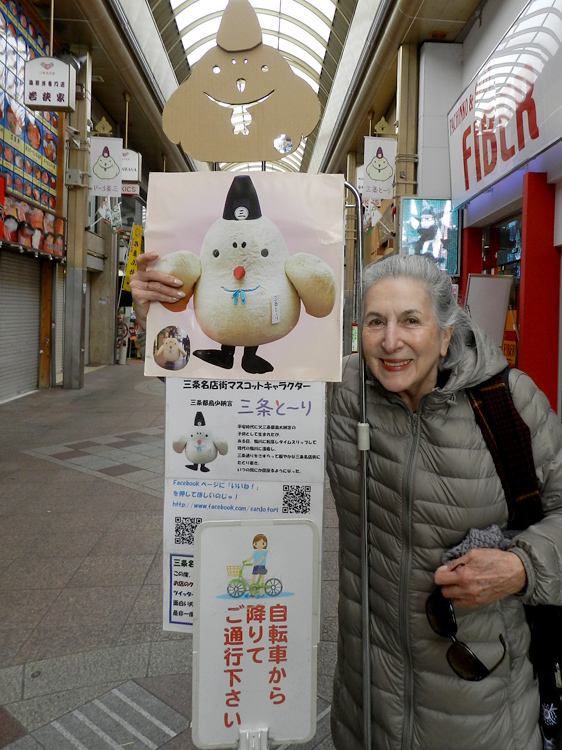
See? Old. It was a wonderful covered arcade with an adorable mascot. I think it’s a baby chicken wearing a traditional headdress. Can’t be sure, though.

arcade-chick

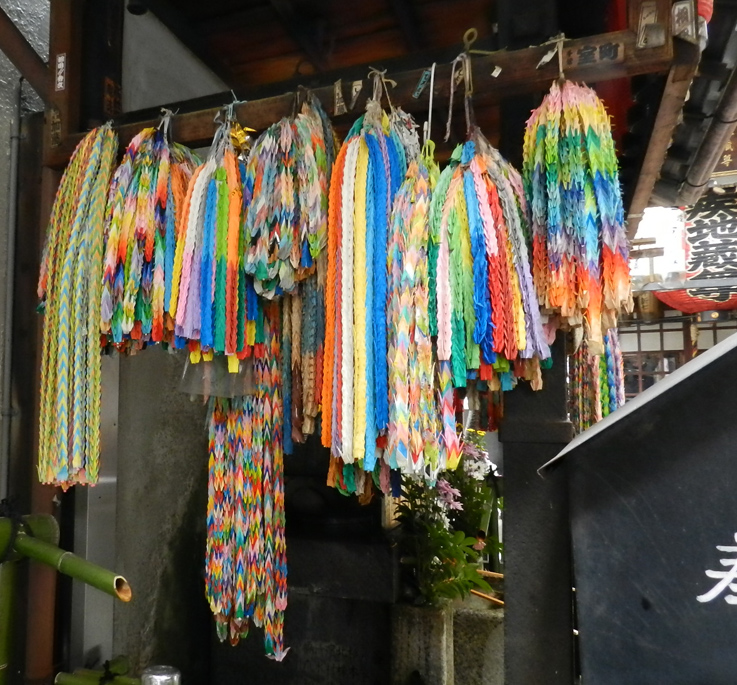
In the arcade was a beautiful shrine tucked away between two storefronts. It appears to be the place to leave your thousand folded origami cranes (called senbazuru).

shrine-garbageman crane-shrine1 crane-shrine2

I walked past the shrine one night after some rain. It looked extra-beautiful.

crane-shrine-at-night

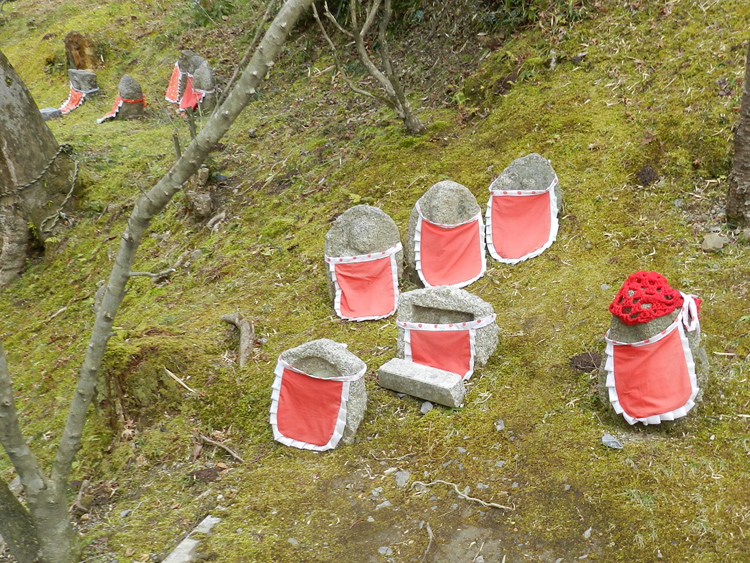
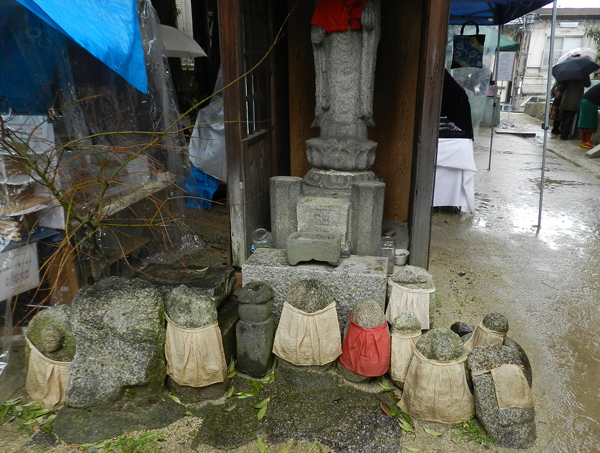
Get ready to get really bummed out: do you see those red bibs on the statues in the shrine itself? Later on I finally found out what they meant. In Buddhism after you die you go back to Buddha and heaven. But if you’re a baby or a small child, you do not know the path back to Buddha, so mothers who have lost an infant or child sew these red bibs and put them on statues of Buddha so the child can see their way to salvation. And they’re on so many statues. It’s so sad. Predominantly they’re on a cheerful-looking childlike monk statue named Ojizo-san.

bib1

But really, they’re on anything in a shrine/temple.

bib2 shrine-bronzebull

Look at these ones that are bleached by the sun. That sound was my heart getting a little splintered.

temple-fair2

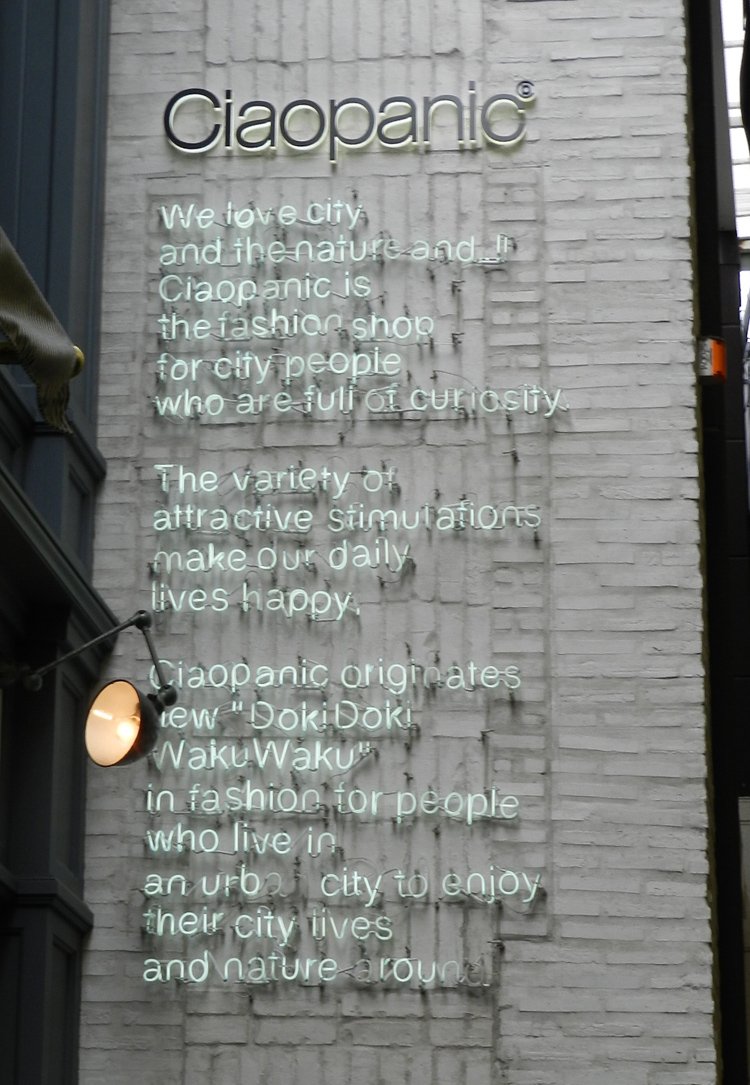
The shopping arcade was the home of the finest piece of Engrish I saw on my trip.

engrish7

In case you can’t read it, I will type it out for you.

We love city
and the nature and.!
Ciaopanic is
the fashion shop
for city people
who are full of curiosity.

The variety of
attractive stimulations
make our daily
lives happy.

Ciaopanic originates
new “Doki Doki
WakuWaku”
in fashion for people
who live in
an urban city to enjoy
their city lives
and nature around.

There was the pig statue (once again, making the assumption it’s a pig, not quite sure):

pig-statue

And several pachinko parlors. I did not go into a pachinko parlor because I don’t much care for gambling, but I passed many on my trip. Most of them had no name, just an enormous sign that said “Pachinko!!!” or “Slots!!!!”, but some of them did have names, and I wondered what the criteria was for picking those names. There was this one:

pachinko3

“It’s an important part of your diet!!!” and this place which was in the arcade:

pachinko1 pachinko2

This is a good time to talk about “Let’s.” The Japanese use a ton of “Let’s.” “Let’s go to Ota City!” “Let’s fold origami!” I found this stellar example online.

Exif_JPEG_PICTURE

The Japanese use it a great deal and for some reason it irks me to no end. I found myself saying, “LET’S NOT” through gritted teeth at inanimate signs.

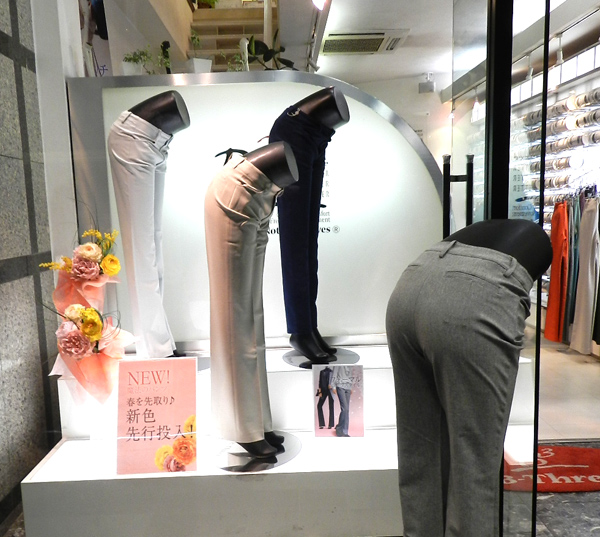
In the arcade was something I thought was super-racist.

bowing-mannequins

“What the hey??? Bowing mannequins??? SERIOUSLY??? Oh, we’re in Japan. You know, where lots of people bow. It’s pertinent to their lives. I should take it down a notch maybe.”

Additional things in the arcade: a dentist’s office with a charming sign.

dentist-office1 dentist-office2

Look, the dentist got flowers with ragged edges, I believe, to resemble teeth! How delightful.

dentist-office3

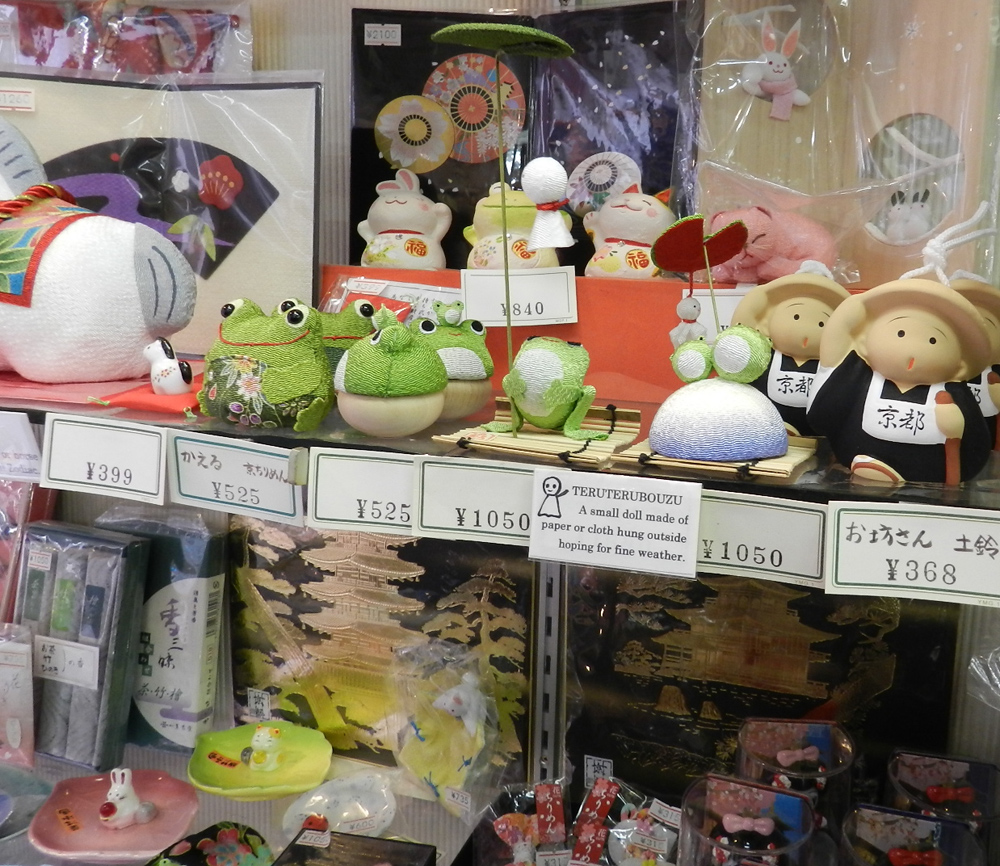
A variety of nicety shops. The word “niceties” in my family mean little, usually useless things that exist solely for prettying up the place. My grandmother had small handpainted porcelain flowers she kept on her bureau. Perfect example. There are a million nicety shops in Japan everywhere you look, and you have to go into as many as possible because their tiny horse figurine might be different from everybody else’s tiny horse figurine. In the arcade I found one shop selling this little guy. The teruterubouzu (TER-OH-TER-OH-BOE-ZOO). The blue-to-white mound with the two wee froglets under a leaf and a weather ghost.

weather-frogs

Until Snorth said the word about four times to me, I called it a Teterboro. Because I am lazy.

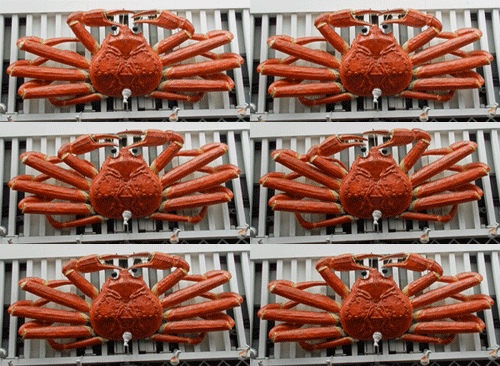
At the intersection of two of the branches of the arcade was one of the greatest things ever. An enormous 3D crabitorium sign.

crabatorium-crab1

I bet you’re saying, “The only thing that could make this better is if it moved.” Well, it did! Merry Christmas, kids! Mommy made an animated gif for you!

animating-crab

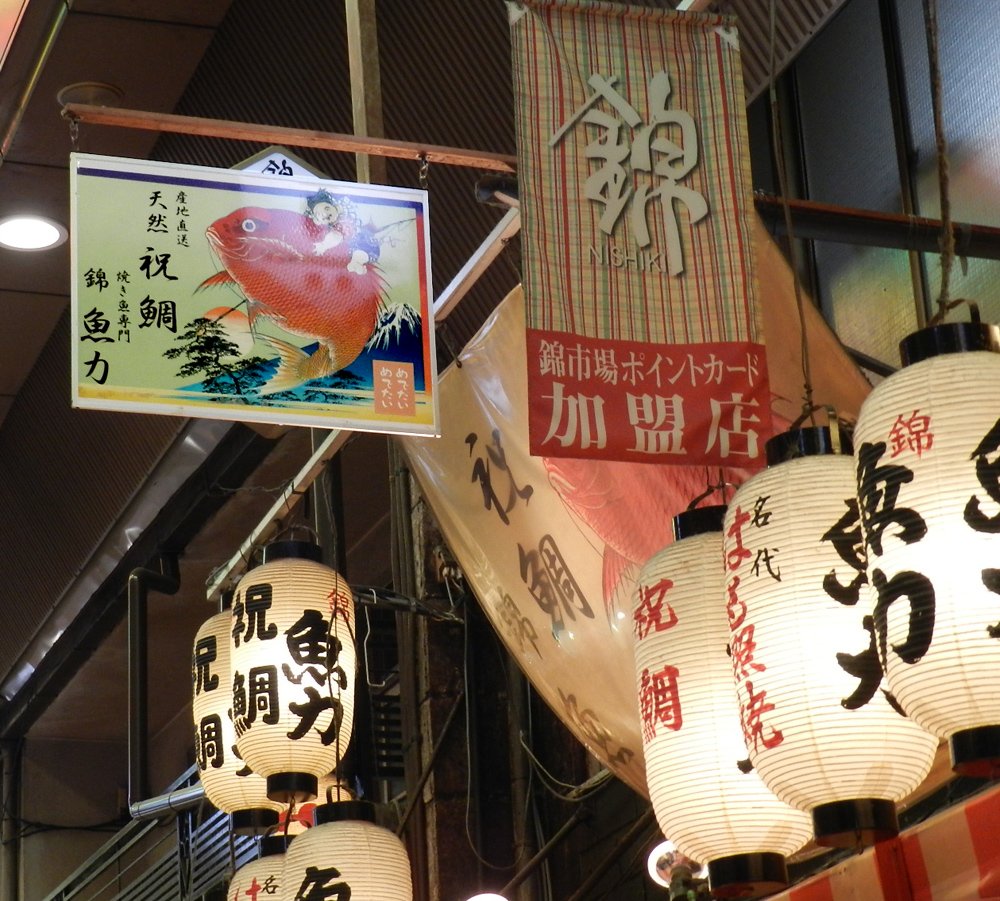
In a dedicated covered area was the Nishiki Market, a food market that originally started with one fish seller in 1310, but is now a whole long alley of all kinds of food stalls. It was lovely. Go to Google Image Search, type in “Nishiki Market” and tell me your mouth doesn’t start watering from the sheer variety of textures and colors. It’s good stuff.

I loved the signage.

nishiki-fish-market4

There was tiny gray shrimp with different flavors:

nishiki-fish-market2

Beautiful desserts:

nishiki-fish-market3

Terrifying whole fish with death-chompers:

nishiki-fish-market5

A whole lot of grilled eel:

nishiki-fish-market6

All the seaweed a girl could want:

nishiki-fish-market8

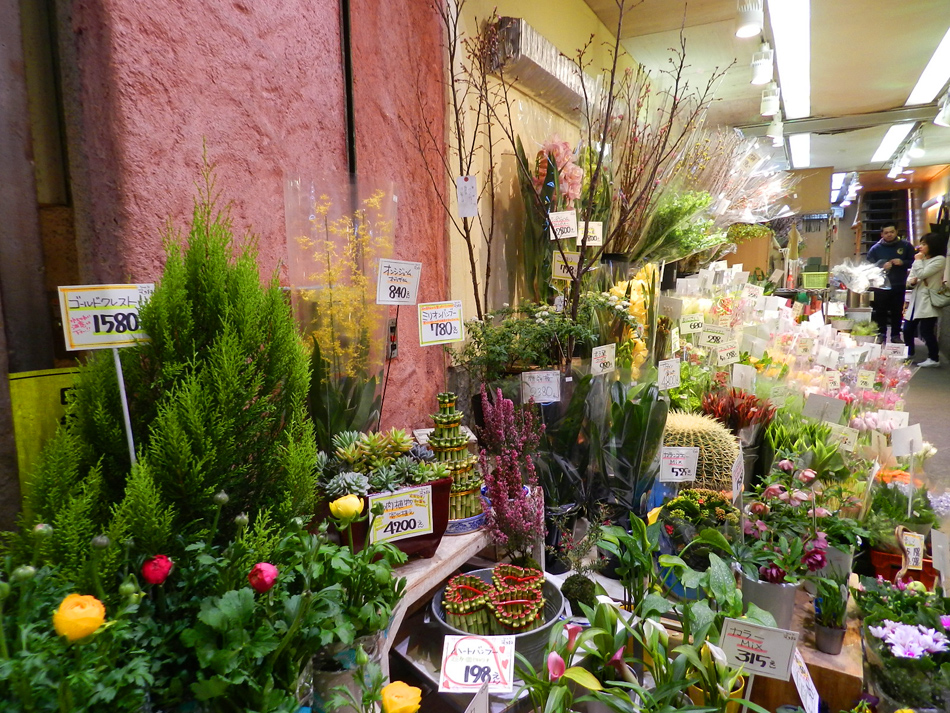
Flowers:

nishiki-fish-market7

And most importantly, these.

nishiki-fish-market1

The Moomins had one and said it was extremely tasty. First she ate off all the legs and then she popped the head in her mouth and the quail egg flavor happened and it was yummy.

Next, a temple fair in the pouring rain.

Japan 2014, Part 4.

March 7th, 2014

One of the many things that I enjoyed about Japan was the fact that everything was the same as we have here, but slightly off. Here’s a picture of the subway. We have subways. Japan has subways. However, either due to drunk or suicidal people, the Japanese have decided to put barriers that stay shut except when a train has pulled into the station and the train doors have opened.

subway-barriers1 subway-barriers2

Advertising for things: we have it, they have it. The difference is their ads are non-sexual. All of them. Imagine that. This was the most sexual advertising I saw while I was there.

advertising

I always wondered why the Japanese are famous for their eclectic sexual proclivities and I think if most of the females are dressed like FLDS women and none of your ads show even a glance of side-boob, you’re going to need a whole lot more to get where you’re going in the bedroom. Oh, speaking of advertising, someone asked me if I saw any famous American celebrities in Japanese commercials and I saw only one, this one:

http://www.youtube.com/watch?v=wrSd7DqSO5k

I cannot figure out how Elijah Wood and Peter Rabbit are selling this car, but they are so good for them.

Oh look, cake. We have cake. Wait… are those kernels of corn on top of the frosting?

corn-on-cake

Transitioning beautifully from corn, the Japanese are really into poop. It’s a thing. I passed more than one store selling golden turds on pillows.

poop-golden

Then I saw this outside a pharmacy. Imagine this outside a CVS here.

poop-ad

I want elves and Pac-Mans cleaning my entrails.

The pinnacle of this was when I saw a book for Snorth. Snorth reads books to children during Storytime in various libraries, so I glance at books wherever I happen to go seeing if they might be good for her. My first day on my way to the Ghibli Museum I passed a bookstore that was selling a book about a sentient toilet with a Dali mustache who travels through the forest where various anthropomorphic forest creatures void themselves in him. I didn’t buy it and I regretted that for the duration of my travels. I went on a quest to find the book near the end of my trip. I will reveal the result of my journey in my ultimate or penultimate entry (because I’m trying to remain chronological). I’m building toilet-book suspense. Will I find the book? Won’t I? Tune in to find out.

Kyoto! It is a really charming city. It’s a little like a fairytale. During the war the Allies decided not to bomb Kyoto at all to maintain the architecture, so it wasn’t damaged at all. It’s an excellent walking city. In fact, our Frommer’s book gave us a walking tour that I would recommend. We did most of the walking tour our first day there. We started at the Sanjusangendo (SAN-JOO-SAN-GEN-DOE) Temple, home of the 1,001 Kannon (don’t worry, I didn’t know what that meant either). It’s a Buddhist temple built in 1164. It has really nice gardens as well (YAY PINE TREES).

sanjusangendo3 sanjusangendo2

Sanjusangendo is the longest wooden building in Japan. It needs to be really long because it houses a giant statue of the Goddess of Mercy, flanked on either side by 500 golden human-sized statues of her as well (that’s what the word Kannon means, Goddess of Mercy). If you’re wondering why each statue clearly does not have 1,000 arms as intended, I found this explanation:

1000-armed Kannon are equipped with 11 heads to better witness the suffering of humans and with 1000 arms to better help them fight the suffering. Note that the actual statues have only 42 arms each. Subtract the two regular arms and multiply by the 25 planes of existence to get the full thousand.

To me this sounds like the sculptors were like, “Are you serious? 1,001 statues, each with 1000 arms? No. Forty-two arms. We’ll make it a divisible number or something. I’m not carving a bajillion arms for eternity.”

I wasn’t allowed to take photos, but other people have so here’s what it looks like in there. It was beautiful, rows and rows of glimmering figures in the dim light.

Sanjusangendo_9508 Sanjusangendo_Thousand-armed_Kannon

Standing in front of all the golden statues were twenty-eight profoundly disturbing Buddhist guardian dieties. They were disturbing because they were human-sized and while they were carved out of wood, their eyes were made of crystal so they totally resembled human eyes. Most of them had intense expressions and ripped muscles, so the shiny eyes became even more off-putting. I believe they were constructed to put the fear of God in people, and I was certainly afraid. Stop looking at me, Wind Guardian! You too, Thunder Guardian! You’re making me uncomfortable!

114530994_5b892ec9fa Sanjusangendo_statues_kyoto

It’s such a long building that they hold archery tournaments in there. And in January people with chronic headaches can line up outside and be touched on the forehead with willow branches in an attempt to be healed.

Now, here’s something you’re going to hear over and over again. Sanjusangendo burned down in 1249 and was rebuilt in 1266. I cannot tell you how many buildings I visited that had burned down and been rebuilt. I visited one that I think burned down eight times. Hey! Japan! Here’s an idea: don’t build all your buildings out of wood and paper. You have rocks. I saw them all over. You have an impressive clay culture. You can make bricks. You know what bricks are known for? Being not flammable. I know you get earthquakes and the wood probably flexes in a way that works for you, but at least build part of the building out of stone or something so you don’t have to start from scratch each and every time. I’m exhausted just thinking about building these colossal structures over and over.

After leaving Sanjusangendo, we walked a bit down several streets until we got to a house that belonged to a potter named Kanjiro Kawai, and when he died  in 1966 it was turned into a museum of his work. This is important. If you go to Kyoto, you must go here. Not because of the pottery (I didn’t much care for it, too thick and heavy and rough-looking for my taste) but because they kept the house intact and chances you will not be able to walk around a typical two-story Japanese house otherwise. It was so exciting for me to go into a home done in a style that has been the standard in Japan for centuries and centuries. I loved it.

potters-house1 potters-house2 potters-house3

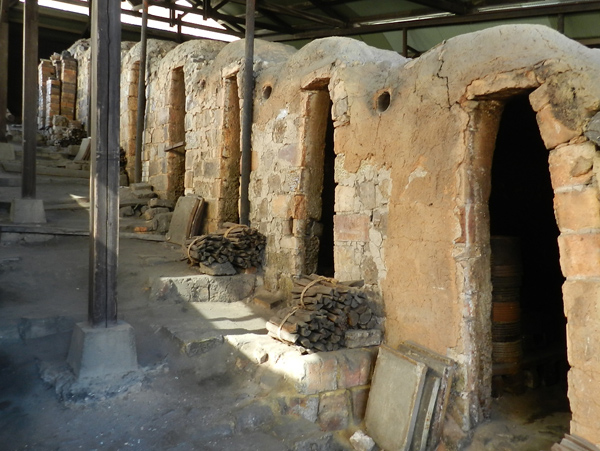
Because space is such a premium, it was amazing how the house was laid out. It was labyrinthine. In the backyard Kawai had built a really impressive series of kilns to fire his work (there was also a dirt kiln built under a covering to protect it from the rain, that was cool too.) Regardless of my feelings for this guy’s work, he clearly cared about making pottery and his care for his craft really shows. It gives you warm fuzzies to be there.

potters-house5

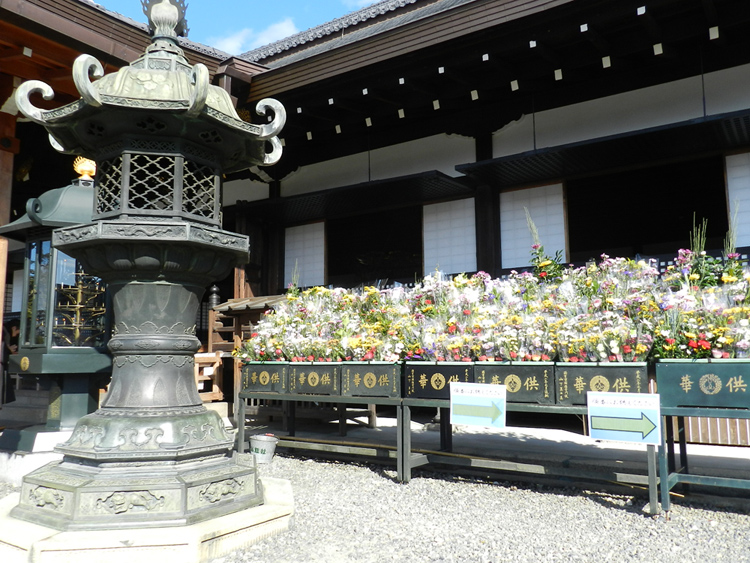
After we left Kawai’s home/museum, we trekked up the side of a mountain. Ugh. It was rough. I am not an athlete and I had to pause several times to lean against something and catch my breath. The only problem is the entire side of the mountain is covered in graves, so more often than not I was leaning up on a family’s tomb. There are cemeteries everywhere in Japan, tucked in corners. I think that because they cremate their dead, there’s no worry of contamination if there’s flooding or something like that, so the graves are right next to apartments or restaurants. First we walked past an enormous crematorium with tons of flowers outside.

cemetery-3

And then the mountain of tightly packed graves. You better know where your family plot is because otherwise you ain’t gonna find it ever.

cemetery-1 cemetery-2

After finally making it to the top of the mountain we came upon the Kiyomizu Temple, but we knew that was going to be covered in our organized tour the following week, so we gave it a casual pass-through. We then walked down the mountain down a great touristy road. It had all kinds of fun stuff to check out – snacks specific to Kyoto, green tea ice cream, souvenirs, fans, yukata and pottery. The Moomins is obsessed with pottery so we had to check out the main pottery shop which was two floors of pure awesome. I would have bought a great many items except the prices of things in Japan are depressing. Here, I took some pictures in the store:

ceramics1

Okay, these are little soy sauce dishes. Very wee. Plain. Basic. There’s 100 yen to 1 dollar, so if you move the decimal point over you’ll notice that the entire front row is $115.00. Why? That was pretty much the case for the whole trip. I would see a teapot I liked, nothing special or extravagant, and I’d say, “I would like to own that! It would be a lovely addition to my home!” and it would be $9,000.00. Seriously. Not an exaggeration. It kept me in check because about 90% of the things I wanted forced me to contemplate selling my car to pay for it, so, not surprisingly, I didn’t get them. Have another example:

ceramics2

That lumpy small rinkydink sake cup that looks like an elementary school kid’s project is $336.00. Yeah, no.

After walking for several hours we started heading back to our hotel room. On the way we passed one of the restaurants specializing in only crab which I christened “crabatoriums.” The Moomins decided after looking at the stellar plastic food examples with claws sticking out of them that she wanted crab for dinner and it’s her vacation too, so even though I’m not heavy into crab I was like, sure, let’s do this. We walked in and realized that this was four restaurants, one on each floor, each one serving a different type of cuisine. We had to mime walking sideways and clicking our pincers so the maitre d’ would understand which restaurant we wanted. We probably looked super-smooth. After we had Marcel-Marceau’d enough, they said they understood and they told us to leave our shoes with the shoe-keeper and go into the elevator to the fourth floor. This was the sign in front of the shoe-keeper’s booth.

crabatorium8

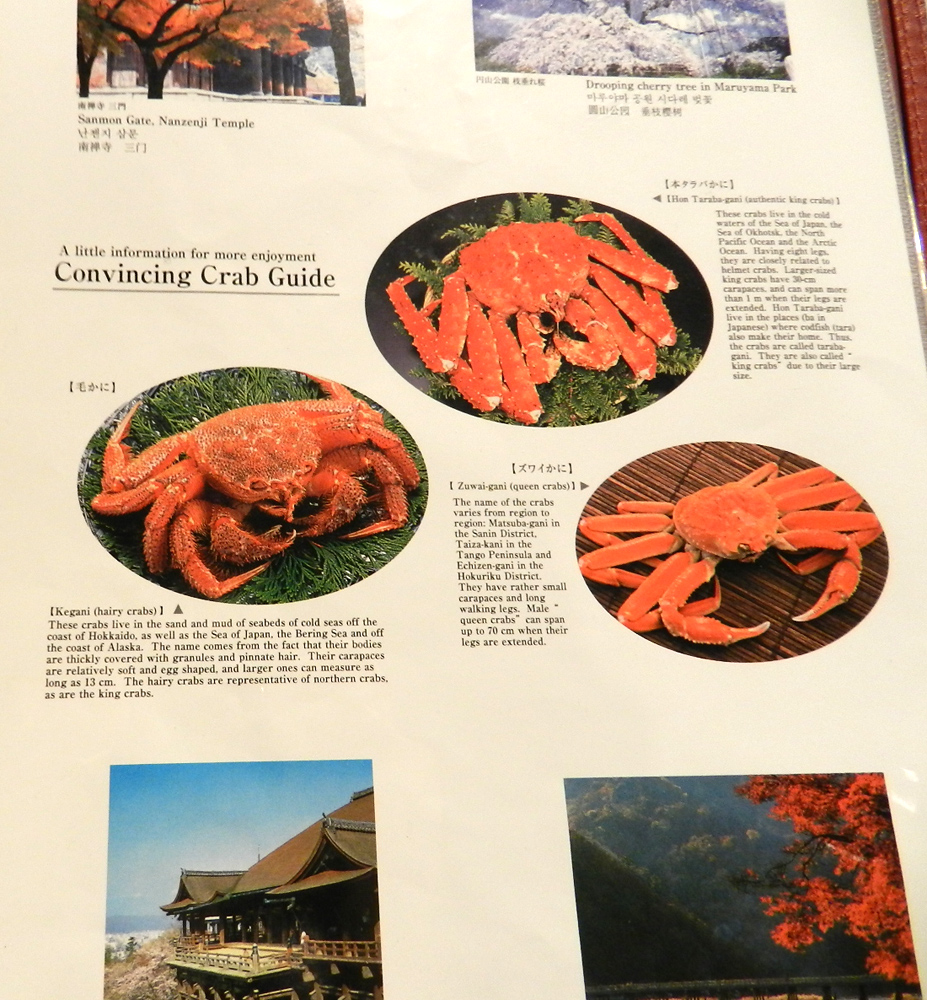
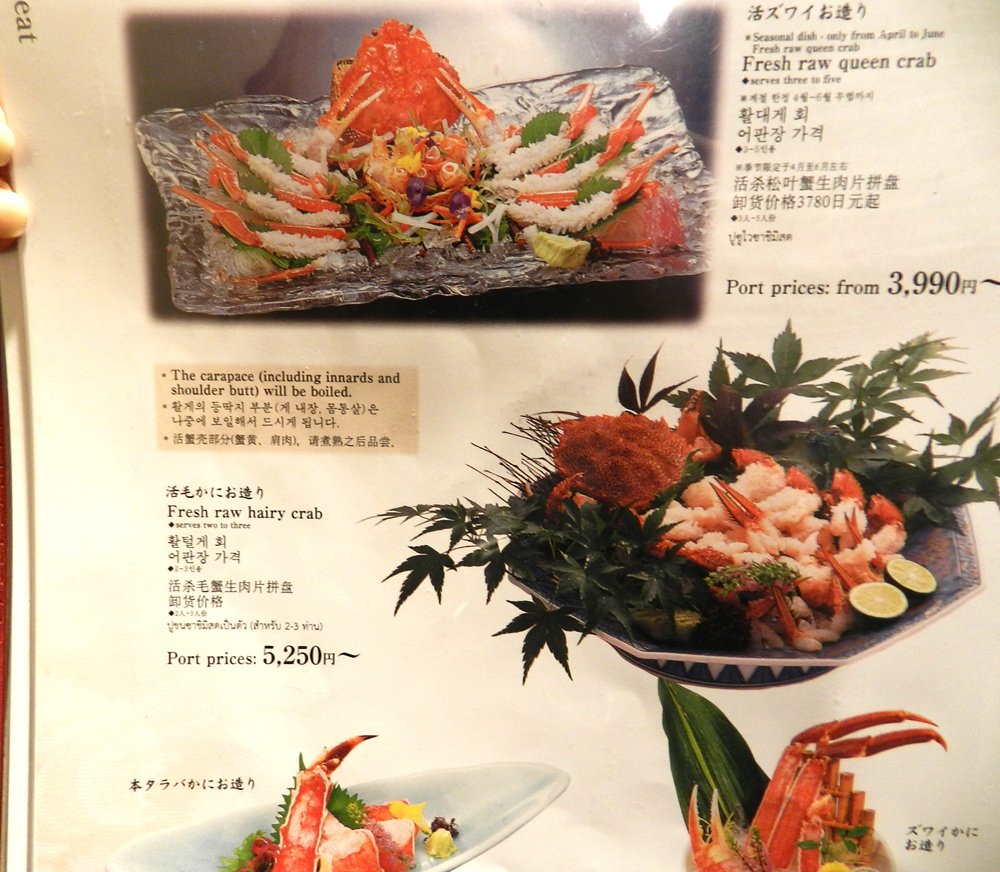
Anywhere else in the world, the act of walking into a building, surrendering your shoes and stepping into a tiny elevator going to an unknown floor feels SO VERY SKETCHY. I said, “If this was happening in New York or Prague or someplace like that, this evening would end with us in bathtubs full of ice missing our kidneys.” But this is Japan and crime isn’t even remotely close to what we’ve become accustomed to. We arrived at the fourth floor where the waitress took one look at us and led us to a Western table and chairs. Then she handed us the menu which blew my mind. You think you like crab? You better. It’s in everything.

crabatorium2

Crab.

crabatorium1

Crab.

crabatorium4

CRAB.

crabatorium5

Craaaaaaaaaaaaaab.

This is my lovely mother doing her best pincer impression while showing the cover of the menu.

crabatorium6

And these sumo-wrestling crabs were on the placemat.

crabatorium3

We ordered something reasonably-priced (no need for the $100 Crabocalypse) and the crab was delicious. It tastes very similar to the fake crab used in California rolls, but much more delicate and nuanced. I had a crab don, which was warm vinegared rice, cooked egg shavings, salmon roe and pieces of crab. I’m going to try and make it at home. I found a photo online of what it looked like. In addition to being yummers, it was nice to look at.

crab-don

Outside the crabatorium was a fire pit with couches around it and a tea kettle hanging down (not unlike what you see in the pictures of the potter’s home above). The Moomins said, “Hey, you’re redoing your kitchen and you have a ton of space above the stove… Why don’t you hang a tea kettle there? It will a cool vertical visual for people to see when they come in.” Since I’ve been to Japan and seeing all their amazing design I’ve reevaluated my fish backsplash idea. I think I’m going to take my mom’s advice and do something with a hanging tea kettle and possibly a giant fish-type thing like you see in the photo, and make the backsplash be something plant-y so it doesn’t fight with the fish/tea kettle situation. I need to make some drawings and get back to y’all on this.

crabatorium7

Next, a temple fair and the Nishiki Market.

Japan 2014, Part 3.

March 5th, 2014

My second day in Tokyo. Tokyo is an enormous city, all sprawled out like L.A. I saw some sections of Tokyo that had the standard Japanese two-story house:

architecture-nice

And one place (Odaiba, a man-made island) with super-modern Jetsons architecture:

odaiba3

But for the most part I saw what I call “1980s Corporate Blah” or, if you went to SUNY Purchase, “Student Housing”.

architecture-meh architecture-snow

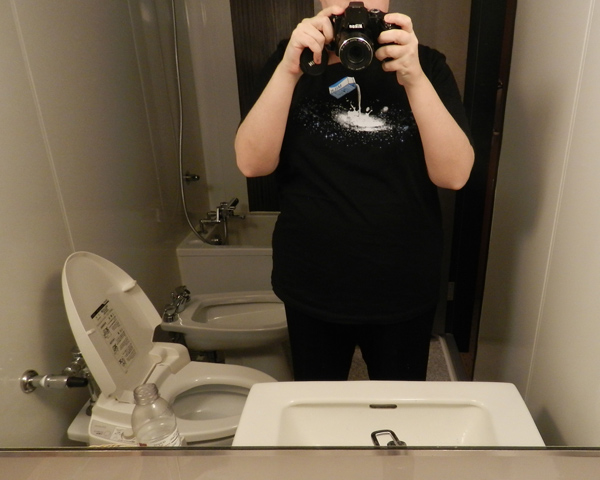
I didn’t come to Tokyo for the architecture, so it wasn’t an issue. If you go to Japan one thing you will notice immediately is that things are smaller. I noticed it when I checked into our hotel room and the doorframes were about 5’10”. And when I went into the bathroom I said, “I don’t remember signing up to be an astronaut.” Everything in the bathroom was a wee bit smaller and lower to the ground and the walls were covered with large plastic panels. Here is a pic I took in front of the sink. I am 5’6″. Notice where the sink is in relation to me.

bathroom-sink

The Moomins, who is 5’4″ at her tallest, is touching the ceiling. She isn’t even trying. Later on when we were on the tour bus, I had to sit either with my legs splayed in the most unladylike manner or smushed against the seat next to me on an angle. Because there was about eight inches between the end of my seat and the seat in front of me. That’s standard. Are you tall? Do you have long legs? Stay home.

bathroom-ceiling

The reason for this: Japan is about the size of California and has 125 million inhabitants (California had 38 million). Here’s the problem, though: 70% of the country is covered by pointy mountains and 5% is lakes, so the 125 million people live in an area 1/4 the size of California. There’s really not a lot of space. Look at this truck. I saw trucks like this everywhere. Teeny weeny trucklet.

small-truck

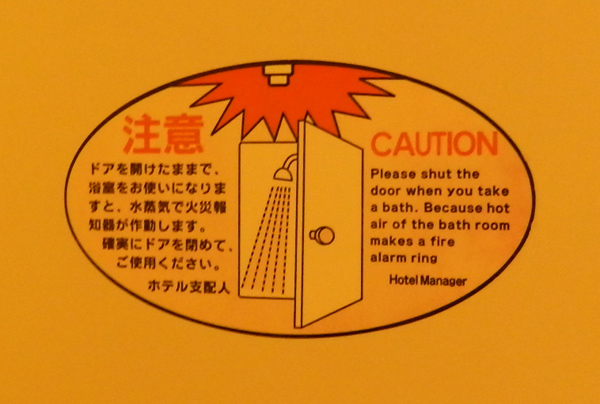
Not really topically related: This was the sign on the bathroom door. I found it amusing.

bathroom-door-sign

Don’t get me wrong, the hotel was excellent. It was not a fancy hotel or anything like that. The hotel had some of the worst design clashing I’ve seen in ages. Here was the elevator bay on our floor.

hotel-patterns

It was the equivalent of a Holiday Inn, but when we arrived there were pajamas waiting for us on the bed and sanitized floor slippers. In the bathroom there was toothbrushes and toothpaste and razors and shampoo and conditioner and body wash and shower caps and other things that I didn’t investigate. This was the case in all the hotels we stayed in. You can forget most of your toiletries at home and it is not an issue. The beds were comfy and we had fancy buckwheat hull pillows. It was great and not expensive (like almost everything else in Japan). I think the rooms were in the $125 a night range which is totally reasonable.

The Moomins really wanted to go to the Tsukiji Fish Market. It is massive and impressive and predominantly known for the giant tuna auctions. It is highlighted in the documentary Jiro Dreams Of Sushi. For some reason I could not for the life of me say Tsukiji. TSOO-KEE-JEE. Couldn’t get the hang of it somehow. I ended up calling it the Tuskegee Fish Market or the Tzatziki Fish Market. I fail at Japanese. We headed over to the market fairly early but it didn’t matter because it was a holiday, so there was no trucks or people.

tsukiji-market1

This sign was on the outside. Please notice the “no drunk” image.

tsukiji-market2

COME ON. There was no effort made there. I came up with this in ten minutes. I feel like going back and sticking this on the placard.

tsukiji-market3

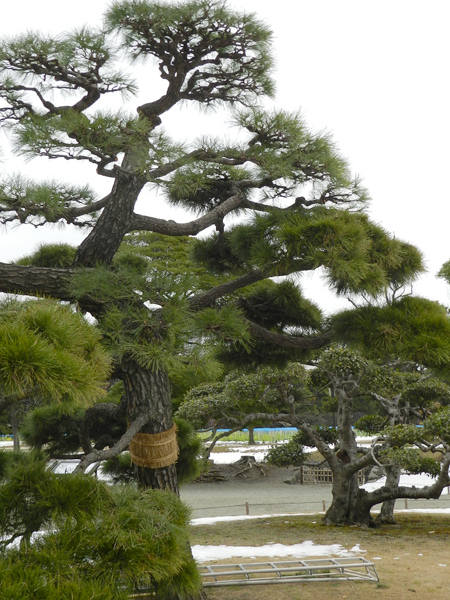
Since we had trekked all the way out to the industrial part of town, we decided to go to the park nearby. It was absolutely lovely. I have an unhealthy obsession with Asian pine trees. The pine trees we’re accustomed to are the cone-shaped ones, but in Japan they look like Dr. Seuss designed them. They’re all asymmetrical and some are dumpy and some are blobby, they’re just the greatest. This park had a lot of pine trees.

pine-trees1 pine-trees2

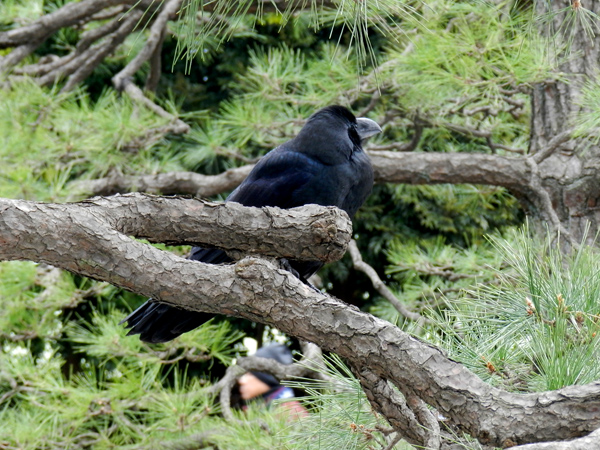
As a bonus, perched in the pine trees were ravens. As if the trees weren’t awesome enough on their own.

crow1 crow2

In addition it was my first interaction with Engrish. Engrish, in case you don’t know, is when people, like Asians who do not use the Roman alphabet, translate their language into English and the results are not quite right. There’s a website called engrish.com that has some stellar examples. I used to think it was funny but now after being there it’s more like, “So close! Valiant attempt!” Most of the time it was right technically, it was just a phrasing or word choice that was uncommon. Here’s the sign in the park that made me smile.

engrish3

This park was special for several reasons. One, it had really cool walls that sloped up in the corners.

stone-wall-curved

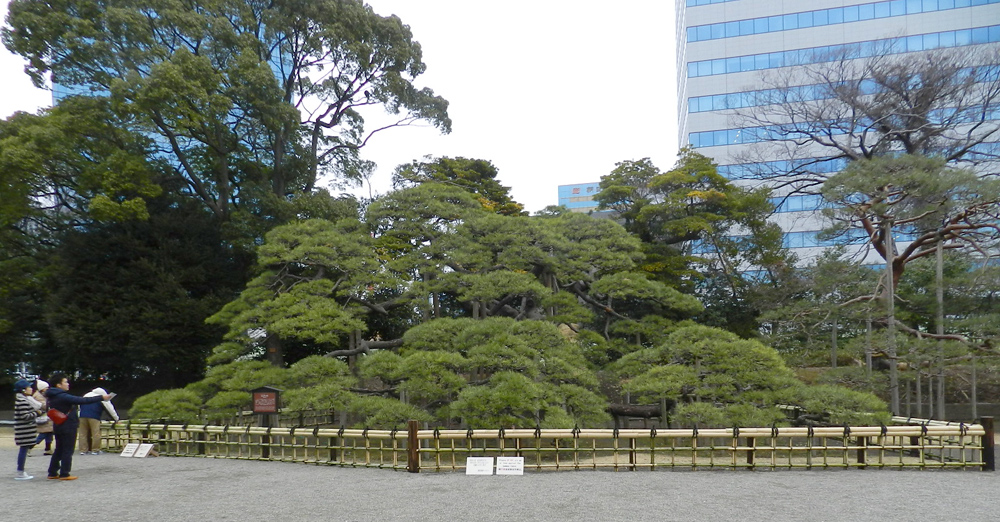
Two, they had a very old, very large pine tree. I believe it was 300 years old.

300-year-old-pine-tree1 300-year-old-pine-tree2

Three, in the brochure I saw the sweetest thing. Check it out.

duck-grave

That afternoon The Moomins and I headed to the train station to go to Kyoto. Please notice that To-Kyo and Kyo-To is the same thing switched. They were both capital cities at different points in time and I know Tokyo means “Eastern Capital” so am I to assume Kyoto means “Capital Eastern”? I’m going to make that assumption. At the train station I saw a sign for what appeared to be an amazing exhibition.

gallery-exhibition1

I loved the demented bunny (?) hat. I found an even better picture on the internet. Should this artist have a show in New York of his samurai figurines, I will go.

gallery-exhibition2

I didn’t spend very much time in Tokyo and someday when I go back to Japan I hope to remedy that. I was on an organized tour for the second half of my trip and we spent another day in Tokyo seeing sights and whatnot, but there’s plenty more I would like to explore. For example, I came across this when I got home:

http://www.robot-restaurant.com/E/

Yeah, I need to go to that. And I want to stay in a capsule hotel because I like the movie The Fifth Element and I would like to pretend I am Leeloo. Aside from Ghibli, I didn’t go to one museum the entire time I was there. There’s a lot left to do for me.

Before we move on to Kyoto, let’s look at a few more examples of Engrish.

engrish1 engrish2 engrish6 engrish8 engrish9 engrish11 engrish12 engrish14

And a poster I saw. That seems like an unfair fight.

tiger-vs-bunny

Next entry – Kyoto.

Japan 2014, Part 2.

March 2nd, 2014

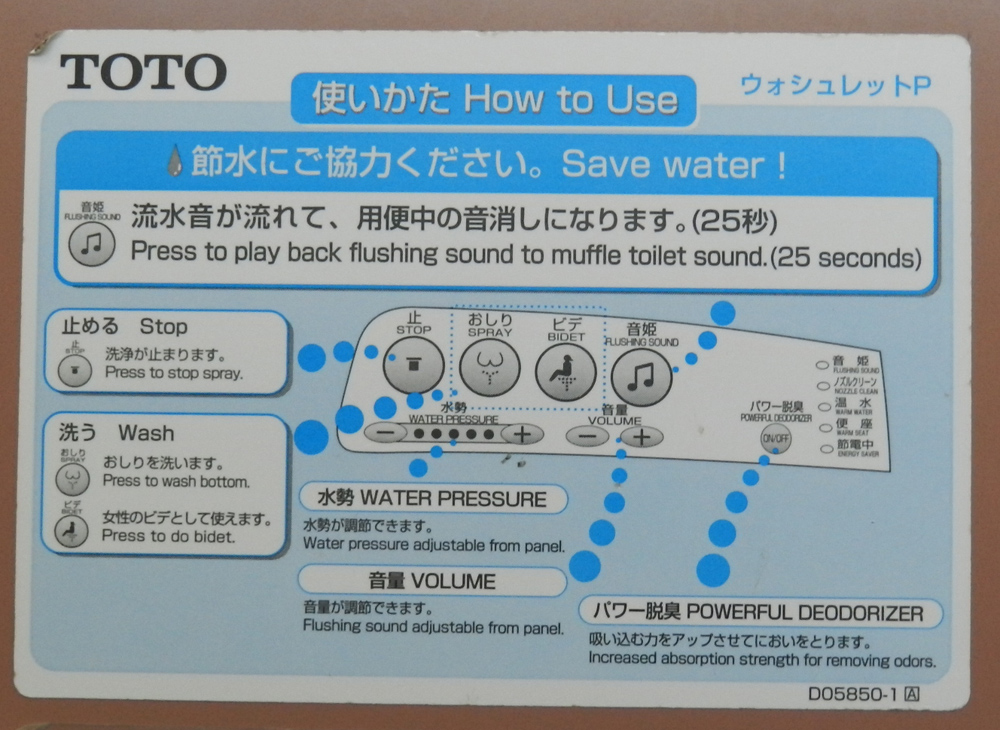
Ah, the heated toilet seats. I cannot speak highly enough of them. We trekked through a great many cold environments, it being winter and all, and we’d see some outdoor lavatory situation, pop in there for a tinkle and boom! Toasty seat. Invariably I would say, “I live here now. It is warm and I am happy. Move on with your life. This is my home.” In addition, I am accustomed to my toilet flushing and that’s about it. The toilets in Japan do everything short of your taxes. Here was a sign next to one.

toto-toilet-instructions

I could not bring myself to press any of the water-squirty features but I if anyone else has, please tell me if they’re magical or horrifying.

The other thing that I adored were the vending machines. They are everywhere. Seriously. Next to a giant Buddha, in the middle of the forest, in random residential cul-de-sacs. Seriously, everywhere. And they dispense both hot and cold beverages. I started liking certain flavors and looking for machines selling those flavors. I would buy the hot ones and keep them in my pocket warming my belly and then when it cooled a bit I would drink it. They were the greatest. If I lived there and wasn’t unable to drink carbonated beverages (they burn the inside of my mouth, I’ve never had Coke or Pepsi or beer or champagne) I would make a point to try each and every flavor of everything in all the different vending machines and make a spreadsheet of them. Because I am so very cool.

vending-machines1 vending-machines2

The way you know if the beverage is cold or hot is to look where the selection button is, right under the can. Is it blue? Cold. Is it red? Hot. The Moomins and I didn’t know that and one night she was hankerin’ for a beverage and I wasn’t allowing her to drink any more tea because it was after 7:00 p.m. and I didn’t want her to be up all night. We came across a machine that was selling this:

hot-ginger-ale

The Moomins and I didn’t see the red underneath (you can clearly see it there) so we thought the hot meant spicy. No, it was actually hot ginger ale. The Moomins, being the trooper that she is, drank it anyway. And here’s the kicker: she loved it. It was like sparkling ginger tea. She was suffering from a hacking cough the entire time we were there and she said the only thing that helped was this drink. I was on a constant pilgrimage to find some.

Look! Hot corn soup!

vending-machines3

Okay, the Ghibli Museum. Miyazaki is an animator of a variety of films, the most famous of which is either My Neighbor Totoro, Princess Mononoke or Spirited Away. This is Miyazaki’s museum. Snorth had told me about it and I felt like this needed to be checked out. It’s a small museum, so you need to buy tickets well in advance from a registered ticket seller. It’s all on their website. The museum only takes a certain number of people a day, so you need to get tickets no less than a month ahead. We took the JR to Mitaka Station where we got off and was greeted by exquisite ikebana flower arrangements right at the bottom of the escalator.

ikebana1 ikebana2

I was astonished how something like this was right out in the open and not in a glass case or behind bars. Are you familiar with the phrase, “This is why we can’t have nice things”? I think of that all the time in America. In Japan no one stole any of the flowers or wrote “L.M. <3 B.R.” on the paper tablecloth under the arrangement or poured their leftover soda in the vase. I noticed that the Japanese are really into being respectful and following rules. There’s a system and a structure and it is not to be meddled with. More than three times I found myself at a crosswalk and I could see no cars were coming from the left or the right, there were no cars on the road at all. But that crossing light was red and therefore no one crossed. No one moved until that light turned green. When I would go into a shop there would often be a little tray to put your money on when paying. In one store I put the money directly on the counter like an animal because I didn’t see the tray. The shopkeeper moved the money to the tray, then took it and put it in the cash register. Like, placed the money in the tray then immediately picked it up to put it away like if it didn’t stop off in the tray it was not legal tender. And people always reference the Harajuku district of Tokyo. “People dress so wacky there! It’s so edgy and cool!” Well, sort of. It’s only on Sunday between certain hours. It’s a contained individuality. Most everywhere else everyone dressed pretty much the same, often very modestly. I felt like I was surrounded by Asian Orthodox Jews, fashion-wise. I often caught people staring at me, not in a bad way, but in a curious way because I was different. Different is not really encouraged I think. That’s the vibe I got. I could totally be wrong, I was only there for two weeks. But that’s the impression I got. The point of this rambling paragraph is that Japan’s rule system may be constricting to one’s personal flair, but you can have stunning flower arrangements out in the open, so that’s a plus.

Back to Mitaka Station. It was a breath of fresh air. It was filled with gorgeous little food stalls that sold all kinds of beautifully presented snackery in pretty boxes. It was like Christmas. If we hadn’t had the tickets for the Ghibli Museum we might have stayed in the station all day, looking at flowers and eating unknown food items (we ended up getting a dumpling sampler from there on our way back from the museum, it was delicious). The museum is buried in the corner of a park and it’s about a mile from the station. A shuttle bus will take you directly there (I found a pic online of what the bus stop and shuttle looks like):

ghibli-bus-stop 52302905

but since we had just sat for a 12-hour flight the day before and the weather was cool and overcast, we decided to walk. Which was great because we walked past a dog cafe! Oh my God. It’s a place you can bring your canine and have English tea. That’s it. We went in and tea had just finished for about four people, one who had two poodles and one who had a sheltie and the owner had a phalene in her arms. As soon as The Moomins came over, the little phalene struggled to get in The Moomins arms for cuddles. It was heart-meltingly cute.

dog-cafe1 dog-cafe2

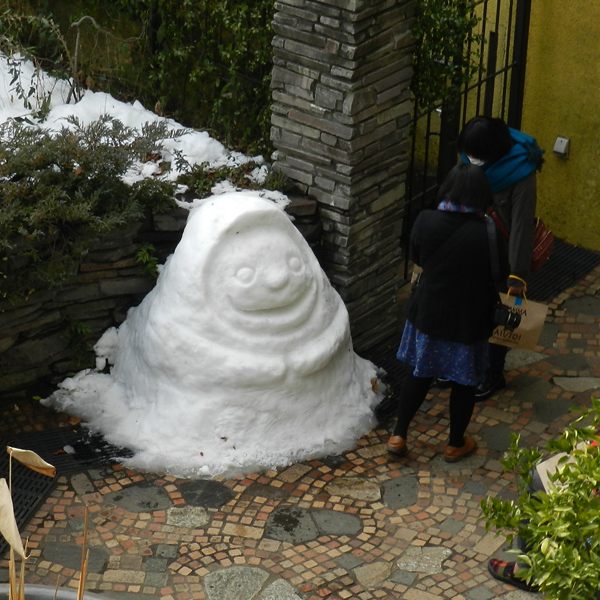
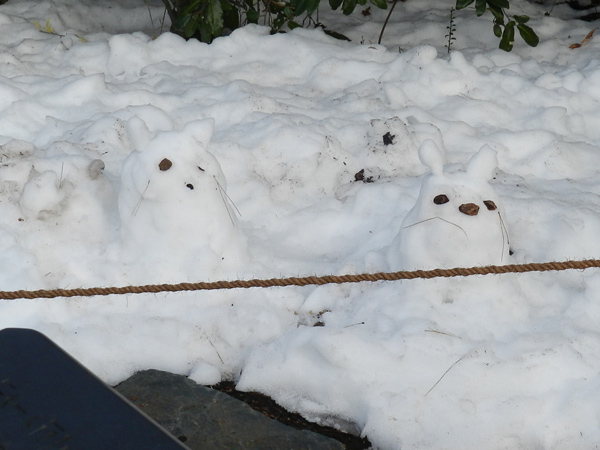
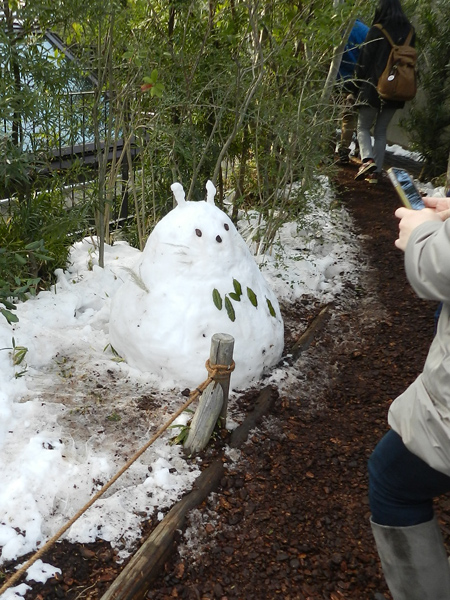
We walked along the brook that runs through that part of town and saw snowmen. Japan doesn’t make the kind of snowmen we make. They make little snow spirits and they are waaaaaaay better than the lumpy atrocities one sees on lawns in the area I live in.

snowmen1 snowmen2

What is that, a deer? Love it.

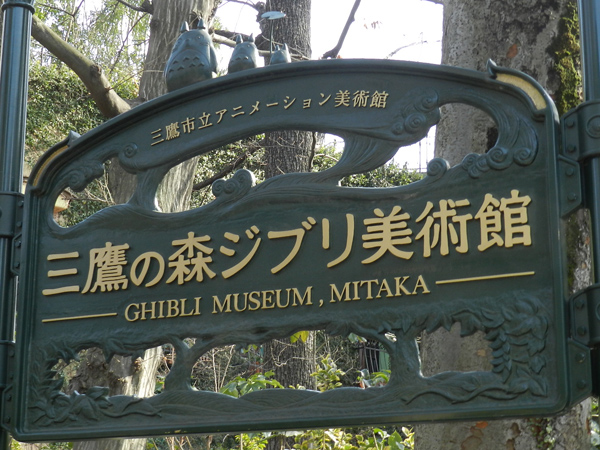
Then we came to the park and in front of us was an odd-looking yellow stucco house with this sign in front of it.

ghibli-museum1

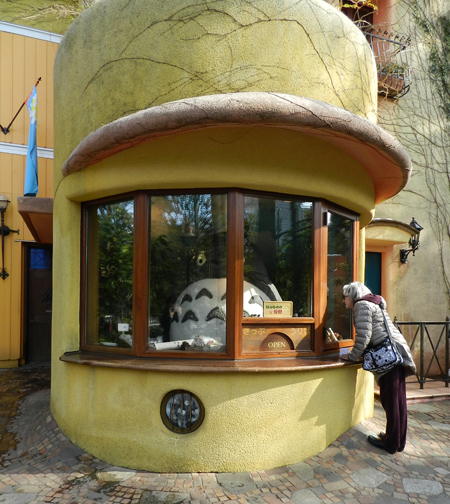
And then there’s a ticket booth manned by a giant plush Totoro.

ghibli-museum2

We went in with our printouts from the registered ticket vendor which at the front door were exchanged for two tickets containing three film frames of a Miyazaki movie. Ours were boring frames (one was a landscape at night, so blue and black and nothing else), but I found a pic on the internet of someone else’s better ones.

DSC_0007-1

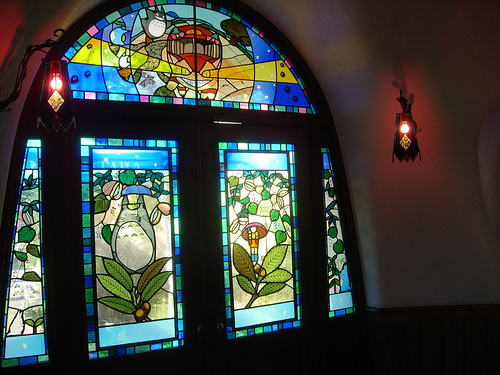
Then we walked inside and it is like a teeny tiny personal Disneyland. There’s a mural on the ceiling and gorgeous stained glass windows and fun little architectural details, all of which I would have taken photos of except I was informed that photography inside was prohibited. Okay, I thought, I’m sure they’ll have a pamphlet or a booklet of all the sweetness here that I will buy in the gift shop. The Moomins and I looked at all the exhibitions showing how the animation teams make the movies. There was a fantastic use of strobe lighting in the middle of the downstairs. It was a rotating disc with characters from the films as little sculptures and it spun at just the right speed so when the strobe hit it the sculptures looked like they were flying, skipping rope, etc. It punches you right in the heart. If someone told me they visited the museum and cried, I would in no way be surprised. I found a video of the strobe thing. If you’re planning to visit ever, don’t watch this because you should experience it fresh. If you’re never planning on going, go ahead and watch it.

http://www.youtube.com/watch?v=J0qYzJUoT7g

Apparently the spinning thing is called a zoetrope. You learn new things every day.

I walked around with a big dumb smile on my face the whole time. There was a little movie theater called the Saturn Theater showing a ten minute Miyazaki movie that was made only for that space, so we stood in line and we saw it. Neither The Moomins nor I speak Japanese but somehow we totally understood it. It was delightful.

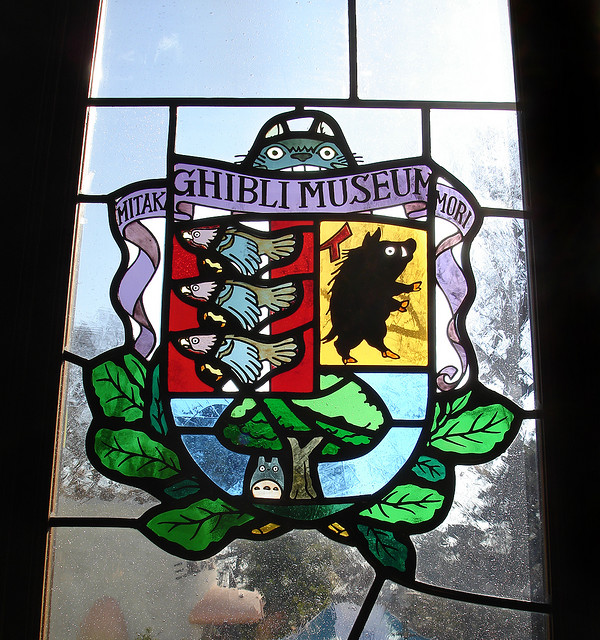
After seeing all the exhibitions we finally made it over to the gift shop where I promptly asked if there was something on the stained glass windows / the building itself. I was informed there was not. I was mad, but I continued to be a good rule-follower and not take pictures. Luckily other people broke the rules and I found their pics online.

0332 84086504_a7e18ebea3 84087848_fb00f7a9c7 3010276737_20396526bb_z large

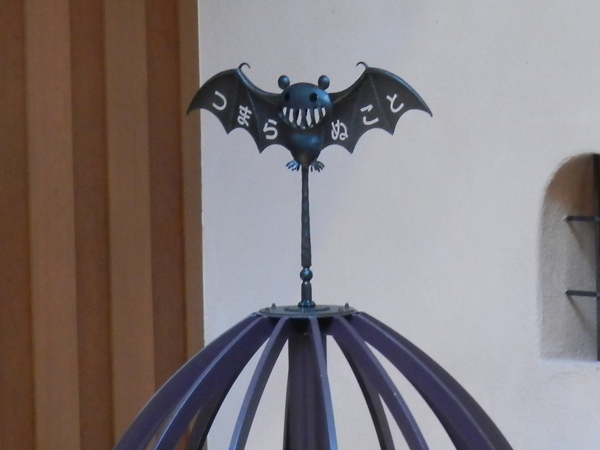
See? Right. And then I couldn’t take it anymore. Rules were meant to be broken. I positioned The Moomins in front of me and managed to get a pic of a metal bat on the top of the elevator tower.

ghibli-museum5

On the second floor there’s an enormous plush catbus that kids can play on with great cutouts of bugs in the wood that surrounds the play area. Took secret pictures of that too.

ghibli-museum6 ghibli-museum7

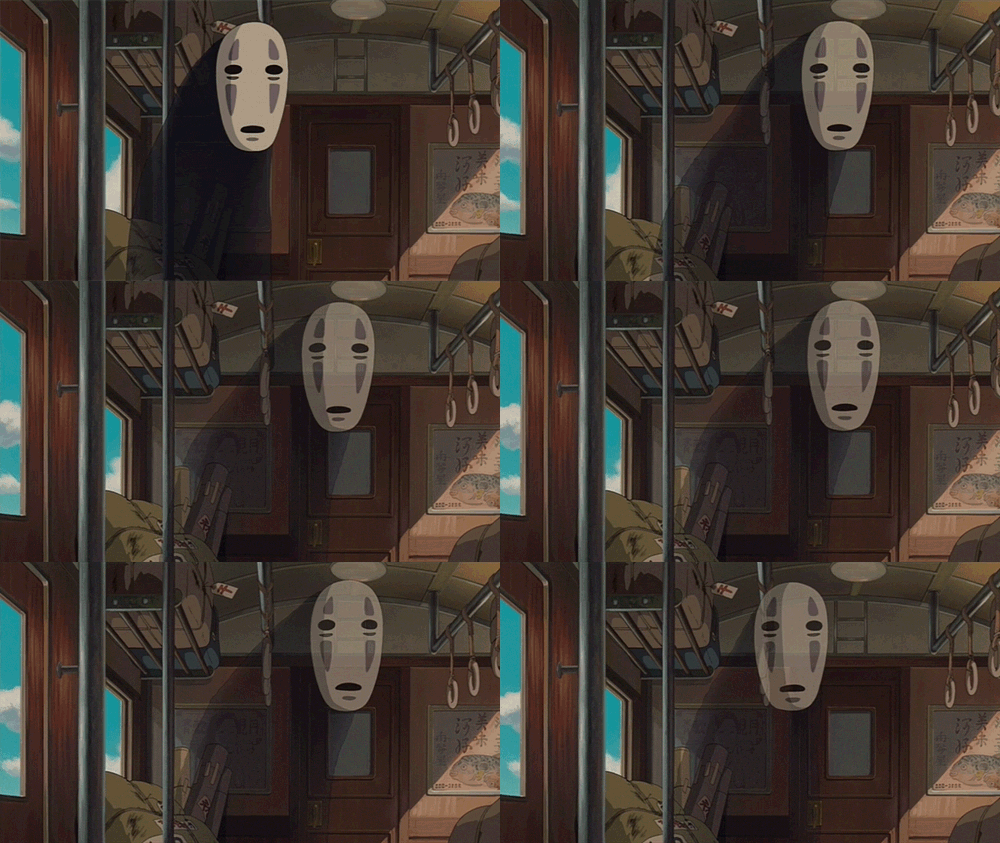
And then the piece de resistance for me, a small window with the Radish Spirit and No-Face from Spirited Away waving at me. Spirited Away was the reason I went to Japan in the first place. I saw it in 2001 and I was enchanted. The hell I’m not taking a shot of that.

ghibli-museum11

Just as I snapped the shot one of the museum attendants came past me and said, “No picture.” I imagine if I was Japanese I would have been disgusted with myself and possibly committed seppuku for bringing such dishonor on my family, but I truly didn’t care. IF YOU DIDN’T WANT ME TAKING PHOTOS YOU WOULD HAVE MADE A BOOKLET OF THE AWESOME STAINED GLASS WINDOWS MA’AM. I FEEL NO SHAME. BRING IT.

Before I ruined the U.S.’s reputation even further we went outside to the cafe. It was a lovely cafe where we shared a cup of roasted barley tea and I took a photo of the handles of the washbasin. I think it’s the cat from Kiki’s Delivery Service.

ghibli-museum4

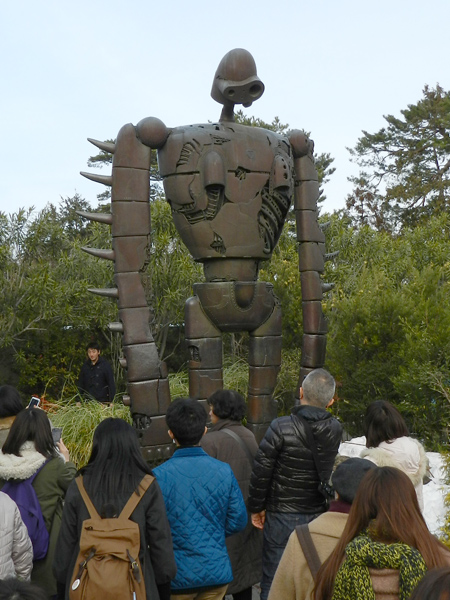
There were exhibits outside as well. On the roof there’s a big metal robot from one of Miyazaki’s other films (I have not seen his entire filmography so I don’t get all the references).

ghibli-museum8

And there’s a cube from another Miyazaki film. And some spinny noisemakers that look like fish. But in my opinion my favorite things were the snow sculptures. Near the front door was a stone forest dweller from Spirited Away.

ghibli-museum3

And on the roof someone had made both the main big Totoro and his two backup smaller Totoros. I (brilliantly, if I must say) decided they should be called snow-toros. Look. Look at the snow-toros.

ghibli-museum9 ghibli-museum10

That was a phenomenal start to my Japanese journey. The next entry will delve into some Tokyo sightseeing.

Japan 2014, Part 1.

February 28th, 2014

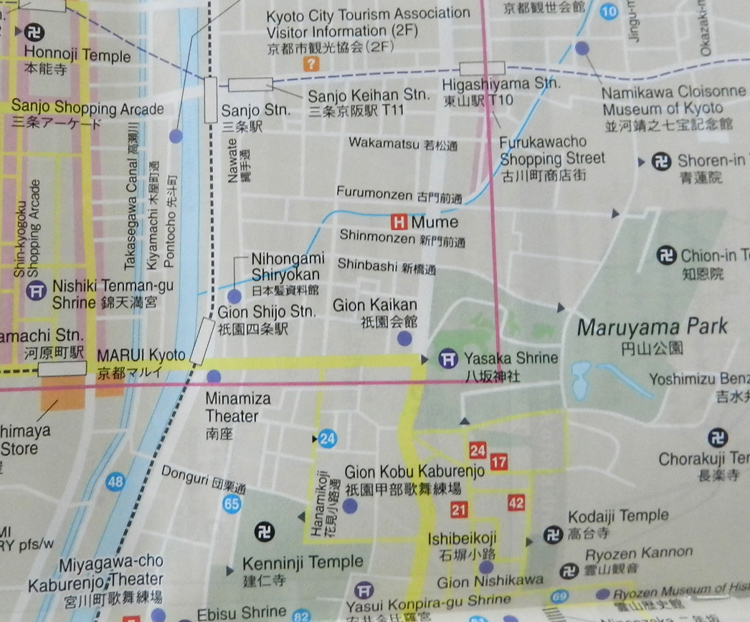
Okay! I finally sorted through the megaton of photos and whittled them down and now we can commence with the cutery and weirditude. Japan was great. I wanted to go someplace really foreign to me, and it certainly was that. You know how in, like, Europe or South America or Africa they use the Roman alphabet so even if you don’t know what you’re looking for exactly you can sound it out or at least recognize the order the letters are in and use that? You can even do that with Cyrillic. Not in Japan. Three alphabets. Three. One of them is crazy convoluted and every character looks like a maze. You cannot sound that stuff out. If the sign isn’t in English, you are S.O.L. Now a great many signs are in English, but then a great many are not and The Moomins and I were completely in the dark. Let me tell you about the street system. Fun fact: Many of the streets have no names. Yup, you heard me right. No names. And the houses are numbered by the order they were built, so 22 could be next to 458 which is next to 3. The post officer’s jobs are nightmares. Don’t believe me? Look at this small chunk of a map of Kyoto.

shrine-swastika-map

It can get rough if you stop paying attention. A lot of directions involve instructions like, “When you get to a corner with two lanterns and a Family Mart, make a left.” And don’t be concerned about the swastikas, they represent Buddhist temples. I saw them everywhere. I thought I would have a visceral reaction to them, but they didn’t bother me a bit. They always showed up in the most soothing of places so maybe, if I lived there, I could retrain my brain that they’re a good thing. No more wincing at swastikas would be nice.

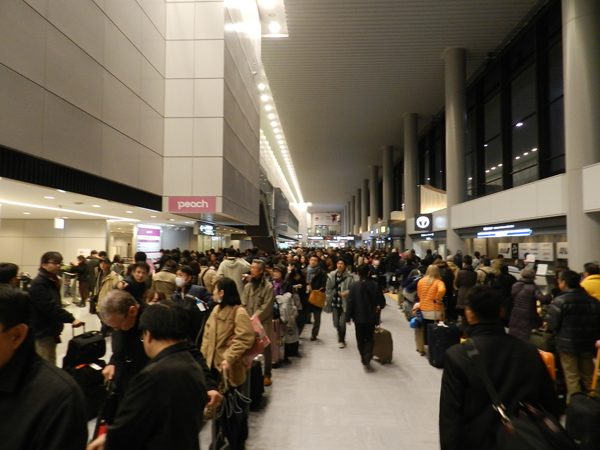
I’m going to do this chronologically because I think it will give you a better overview of the trip. First there was the 12-hour plane flight which I couldn’t sleep on because I didn’t take any sleepytime drugs and the seats are not comfy. It was cool, I watched movies the whole time. Delta has an amazing selection of movies and they leave all the cursewords in! I sent them a letter saying thank you for not tampering with my entertainment. Anyway, we landed and I had been up for twenty hours and was exhausted and looking forward to going to the hotel and passing out on the bed. However, it was not to be. It had snowed the day before in Tokyo, the most snow they had seen in forty-odd years and they didn’t have the manpower or supplies in place to deal with it. Then the highway had black ice so they closed it. This is the only highway that goes from Narita to Tokyo, which means no shuttles, buses, limos or cabs. We arrived and stood in a line outside freezing because there was a rumor some cabs were making it through. After two hours though it was clear that was not going to happen, so The Moomins and I went into the terminal. It was not a good scene. The airport was handing out sleeping bags, blankets and bubble wrap to people and they were setting up camp anywhere they could find a place – under the stairs, in the hallway to the bathroom, directly in front of the taxi and shuttle counter (no one was using it anyway). It was bleak.

airport1

I was ready to set up camp somewhere and taste the glorious dream-state that was being painfully withheld from me, but The Moomins would have none of it. She said she was old and we had booked a hotel room with beds and paid for it already. By Jove, we were going to sleep in those beds even if we had to bribe someone to lift us via helicopter to Tokyo. It turns out that the JR train (similar to Amtrak or Metro-North) was still running, so we got on line for that. The longest line in the history of lines. It snaked back and forth through the entire terminal, folding over itself four or five times.

airport2

This was interesting: I read somewhere that one of the unofficial mottoes of Japan is “suffer silently.” Not once did I see anyone in any of the lines or lying on the floor complain or get testy in any way. In America there would have been some clearly visible grumpiness. The Israelis would have commandeered a city bus, ripped up a garbage can to create makeshift chains for the tires and chugged off for Tokyo on the closed highway (they’re go-getters, those Israelis). At one point I saw a Chinese couple ( I could tell they were Chinese because the woman was talking on the phone) and she was hella-pissed. The husband was pushing the cart of luggage and wearing their infant in a Baby Bjorn on his chest, and he accidentally hit his wife in the legs with the front of the cart. She whirled around and kicked the cart. He curtly said something and she went to slap him but he flinched and she hit the baby who started crying. If I wasn’t so intent on not losing my place in line, I would have said, “Be back in a minute,” and followed them down the hall because I could hear them yelling at each other, Doppler-style, down the length of the terminal.  No one who was Japanese did that. The only complaining I heard was from an American pilot and and an Indian couple behind me. Finally, after standing in this line for about two hours we got tickets for the JR train. We got packed in like sausages and then it left the station. But because the tracks were icy it went fifteen miles an hour. It was torturous. I almost started crying from sheer exhaustion. After a thousand years we arrived at the main Tokyo Station where we stood in yet another line outside in the cold and got a cab to our hotel. The trip from the airport to the hotel should have taken about two hours. It took eleven and a half. We got to the hotel at 3:30 in the morning. When I got back to New York and people said, “You missed some snow, it was terrible,” I was like, “I felt the effects of snow on my trip. The joy and wonder of snow was not lost on me.”

http://rt.com/news/record-snowfall-hits-japan-202/

The next day was going to be vastly better because I was going to the Ghibli Museum. I went to sleep thinking about the fact that HOLY CRAP I’M IN JAPAN. And the toilet seats are heated and how glorious that is. More on that tomorrow.

I have returned.

February 25th, 2014

I’m back from my Japanese journey and I’ve started sorting through the 1,000+ photos I took. While I’m getting going on the blogging, please enjoy these two quintessential photos of Japan. One is a Hello Kitty branded giant dried squid, and the other is a little girl wearing a cat-ear headband eating green tea ice cream with someone in the background sporting a hoodie with a kawaii angry panda on it. BOOM. JAPAN. NUTSHELL.

quintessential-japan2 quintessential-japan1

Off to frolic with Totoro.

February 7th, 2014

Alright everyone, I shall be gone for two weeks in Japan. I will return on the 23rd, when I will begin the sorting and uploading of what will no doubt be a heaping great pile of photos. Enjoy this charming weather until my return and I’ll see you all when I get back.

Clarification in case you don’t know who Totoro is:

http://en.wikipedia.org/wiki/My_Neighbor_Totoro

Superb Owl 2014.

February 4th, 2014

Wow. Did everyone catch that amazing Super Bowl? Where the guy did the thing, and everyone cheered? That was something else. Meanwhile, for those who are into other sports and are curious how such athletes were able to reach the next level, feel free to read blogs where they discuss training equipment such as this nice tool.

Sports Exclamation

Truthfully, I didn’t watch. I came home at 9:30 at night and caught the last ten minutes when the Seahawks had destroyed the Broncos and everyone was just killing time until the pain was over. In case you didn’t watch (and chances are if you read this blog you did not) the final score was 43 to 8, Seahawks. I assumed that there would be two NFL teams playing, not one NFL team and a bunch of homeless people they rounded up from outside Metlife Stadium, but apparently I was wrong. Listening to the announcers try to fill up time in the fourth quarter when the game was clearly won was sad. I’m surprised they didn’t start reading their mail on air. Anyway, hooray or I’m sorry depending on which team you were rooting for and good luck to whoever plays next year that I will pay just the smallest amount of attention possible to.

And concerning the commercials: eh. I saw most of them and I didn’t really care about any of them. Radio Shack was good. Doberhuahua was decent. The Bud Light commercial was great only because Reggie Watts and a llama were in it. Other than that, whatevs. None of them were on par with the Mercedes chicken commercial. That, that was a masterpiece.

Addendum: ARE YOU KIDDING ME.