Archive for the ‘Travels – I Has Them’ Category

Costa Rica 2012, Part 4.

Sunday, February 19th, 2012

Anhingas! Anhingas are birds that dive for fish like cormorants. Anhingas are flawed in their design because, unlike ducks, they do not have that waterproof oil on their feathers so when they are wet they cannot fly. But they dive to eat fish and live in the rainforest, so I don’t know when they dry. We saw them sunning themselves all over the place but I never saw one fly, so maybe they don’t need to fly. Here’s a male anhinga.

And here’s a female anhinga.
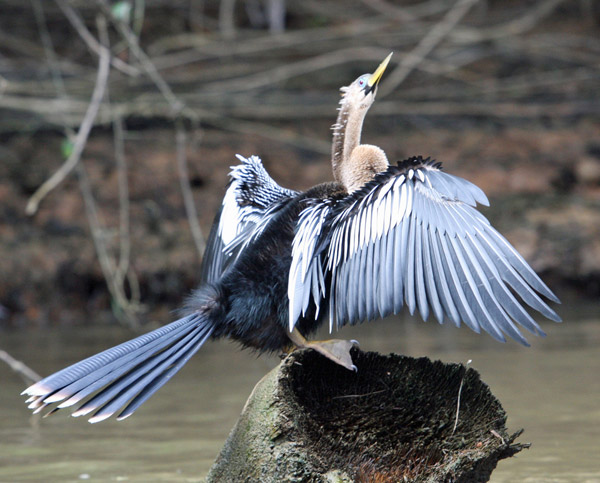
This is a female diving for fish and swimming. They are sometimes referred to as the snake bird, and when it’s in the water you can see how the anhinga got that name.

I mentioned how Cricket made me tromp through the forest so we could see a lagoon, and at one point I thought I was hallucinating because all of a sudden there was a wee plump bird next to my foot.
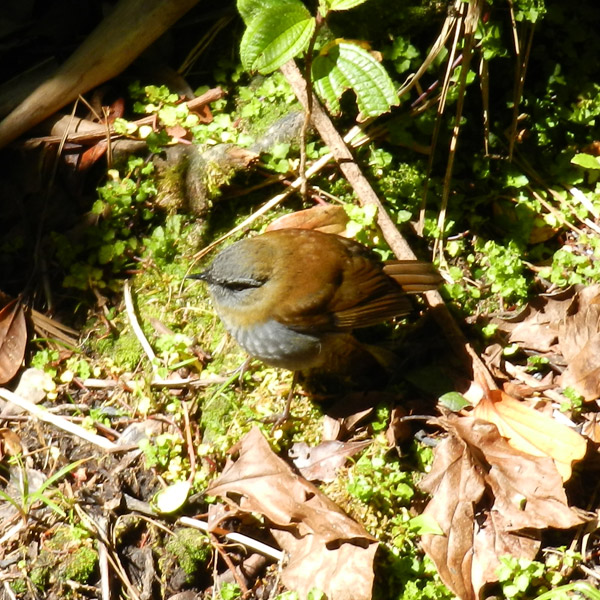
Here’s the weird part – he kept me company for a long chunk of the walk. He didn’t want anything from me, like food, and he wasn’t scared of me. As I would walk he would hop next to my foot, several times getting so close that I was concerned I would step on him. I liked my little walking companion.
The reason we were on the top of the mountain was to look at a resting volcano. I say resting and not dormant because it was full of steaming hot sulfuric water, so the volcano is still cranky and could totally pop its top at any time (I think the last time was in 1963).

Here’s the sun-faded information board off to the side, as well as the altitude sign.

And here’s the lagoon that we trekked to. It is a dormant volcano and hasn’t exploded in forever (you can tell because all the foliage has grown around the opening), and it is full of rainwater. It really is that insane shade of blue.

• | • | • INTERMISSION  • | • | •

Here’s a bird on a plant. Don’t know what kind of bird or what kind of plant. Cool photo, tho.

• | • | • INTERMISSION OVER • | • | •

Toucans! Wow, toucans are awesome. I think they’re great. Our guide told us the most common question he gets about toucans is, “How do they hold up that heavy beak?” but the beak is made out of a similar material to our fingernails, so the beak is not that heavy. Also, according to our guide, the beaks are not that strong either, like if the bird bites down on your finger it doesn’t really hurt because they don’t have the jaw strength. Here are the first toucans we saw. They are called Keel-Billed Toucans, but I heard them referred to as Rainbow Toucans a couple of times.

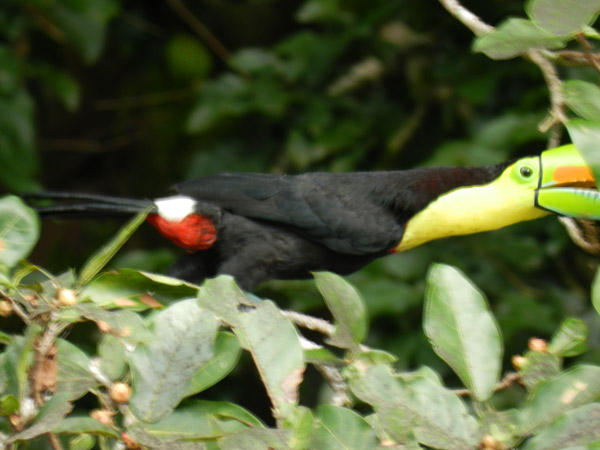
When we were in Tortuguero* we stayed in little bungalows surrounded by massive quantities of trees, so beasties would be right above us all the time. There was a Chestnut-Mandibled Toucan hanging out in a tree maybe ten feet away from me one day. He was delightful.

And one day Susan caught this fellow on the far end of a branch. I adore the shot where he’s looking straight-on at us.

She also got a shot of the scariest-looking toucan ever, the Collared Aracari. I think the combination of the goat pupil with the serrated edge on the beak really amps up the creepiness factor.

Herons! Herons and egrets are all over the place when you’re in the rainforest or wetlands. They stare into the water looking for shrimps or fishies, they have really evocative expressions because of that. Here’s a few examples.

“Why? Why am I here? When will I truly understand my purpose in life?” (Snowy Egret)

“I hate everyone.” (Little Blue Heron)

“I am very photogenic. And now I am leaving.” (Great Egret)

“You kids get off my lawn!” (Yellow Crowned Night Heron)
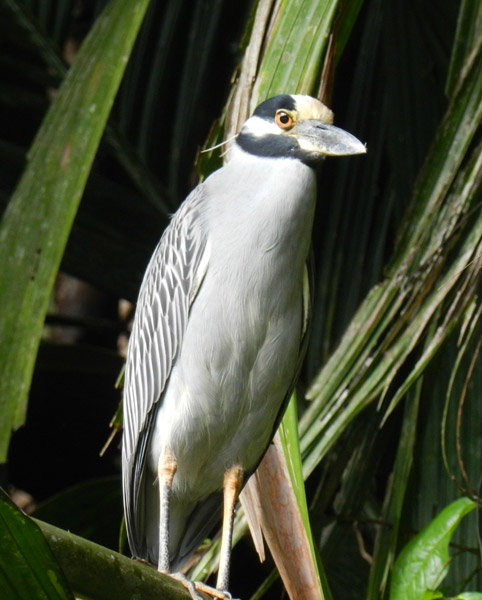
And, of course, “Hey lookit, a shrimp!” (Little Blue Heron again)

When we were in a crocodile reserve we saw a Bare-Throated Tiger Heron stalking up and down on the bank.

And we saw this guy. He is a heron of some kind. I couldn’t find him in the book. My friend B. figured what he is! He’s a green heron. Thank you, B.

Next entry I will continue with birds, and I may delve into some mammals. And talk about coffee. Good stuff.

* Tortuguero National Park is where a large quantity of the world’s population of green turtles come to lay eggs. Here’s an informative page on the park: http://www.wayfaring.info/2009/07/08/tortuguero-national-park/
Costa Rica 2012, Part 3.

Tuesday, February 14th, 2012

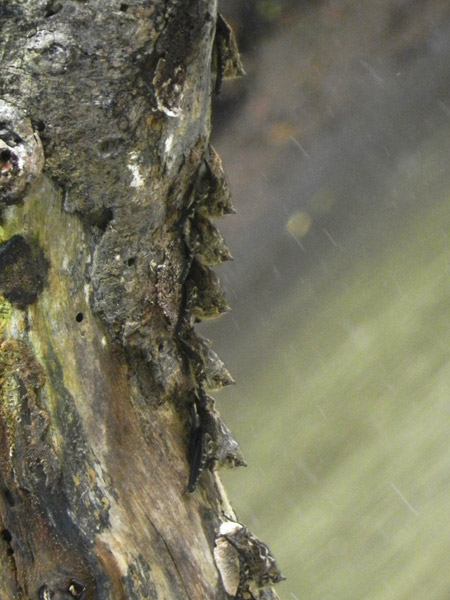
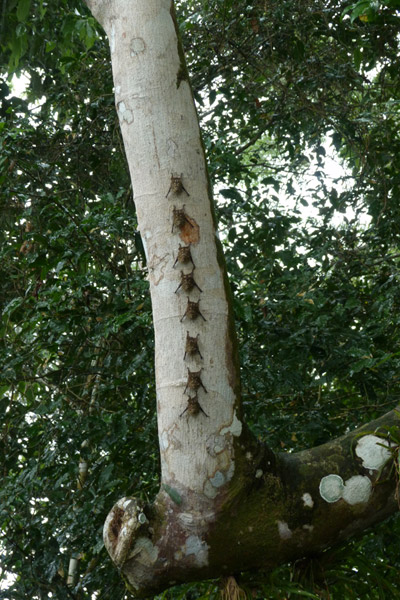
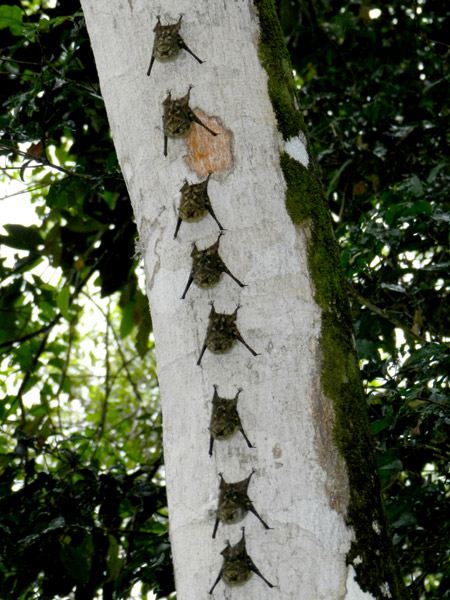
Someone asked me what was the cutest thing I saw in Costa Rica. Everyone assumes it was the sloths (I saw both the two-toed and the three-toed variety, more on those later) and they were fantastically cute, but it was not them. It was the bats. Specifically, what the bats were doing. Here is a row on bats on a tree, little bats about two inches tall, and they are hanging in a row because they are pretending to be a snake. I mean, seriously, how adorbs is that?

Occasionally they would wiggle in unison to look more snake-y and I would make a squee noise because, c’mon. We were on a boat in the rain (because in the rainforest -surprise!- it rains a lot) and we passed a cormorant on a branch which was lovely in itself, but then the guide pointed out there were bats doing their snake thing on the underside of the branch to avoid the rain. Awwww. Damp pointy-snooted bats being a snake. So cute.

Turns out, BTW, that is not the cutest bat thing in Costa Rica. I was reading my book, “The Wildlife of Costa Rica” and in the bat section there was this page.

Are you frickin’ kidding me?!? Puffy cottonball bats clustered under a leaf? I would have probably had a teenage-girl-seeing-Nsync-style-meltdown if I had seen those.

Let’s look at some trees. I saw a great variety of trees. While we were gliding around the rainforest we saw this tree with amazing roots, I think it was a Tea Mangrove Tree, but I could be wrong:

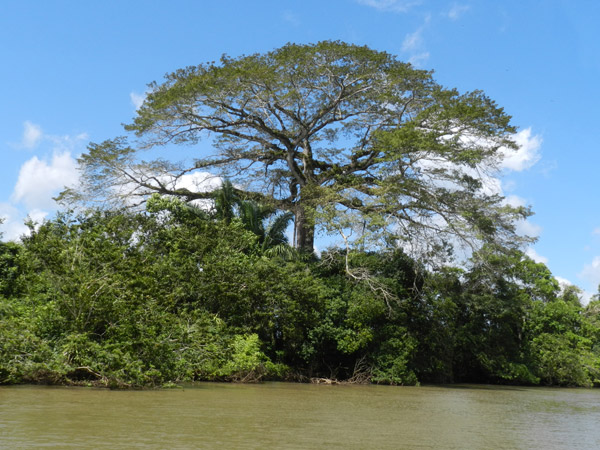
And there was this giant tree. Most of the trees aren’t nearly as big because a lot of the rainforest was felled for lumber before it was made into a protected national park, so it’s unusual to see gigantic umbrella-like trees.

This one looked like Snuffleupagus.

And this tree is called a Buttressed Tree. It is very large and I tripped over several of their roots throughout the journey. (Reiterating: very outdoorsy.)

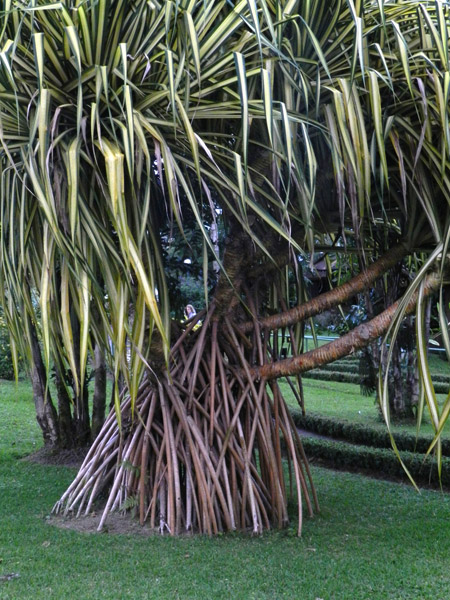
Outside of one of the hotels we stayed in was this cool-looking palm tree.

And one day we saw a Costa Rican Bamboo Palm with its flowers/fruit in all three stages, which was neat. They start all curled up in that banana-looking thing, then they are flowers in that white fluffy cascade and they finally turn into the fruit.

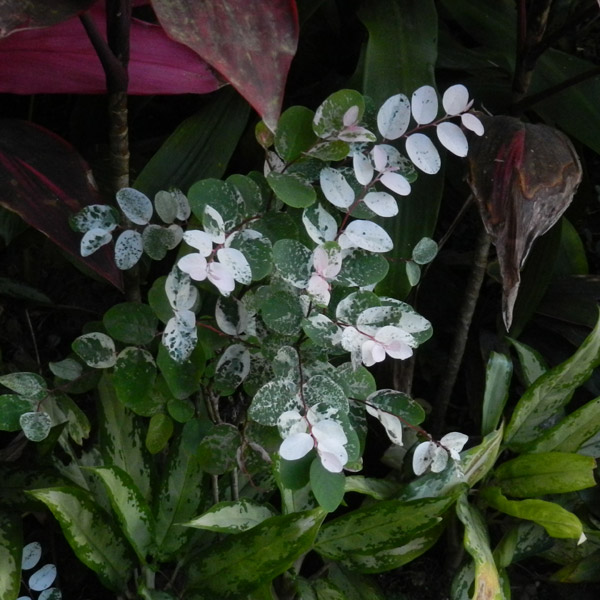
Finally (plant-wise) here are a bunch of awesome plants that I could not be bothered to learn the names of. This in no way negates their awesomeness, I just got tired.

Birds! Holy Moses, I saw so many birds. And many of them make a noise, often at the same time, which makes what we in the art world like to call “cacophony.” It was loud and amazing and if I lived there I would make a concerted effort to learn what bird makes what sound. Since we’ve already dipped our toes in Trogon water, here’s the other Trogon I saw, the Baird’s Trogon. Similar to the previous Trogon, this bird looks like it was dropped on its head as a wee birdlet and now is no longer “quite right.”

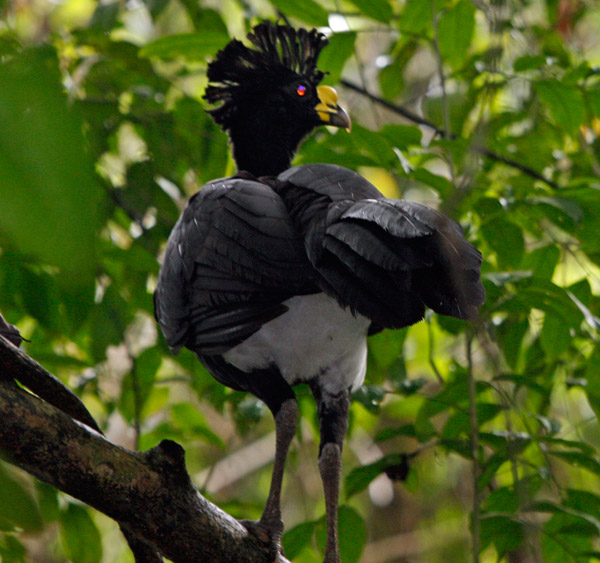
We saw an enormous turkey-like bird one day. It’s called the Great Curassow. This is a male. The best part about this bird is the clump of curly feathers on the top of its head. It looks like it’s rockin’ a big ole jheri-curled hairpoof. That, combined with it’s expression, makes it hysterically funny to see. Here’s a pic Susan took:

And here’s a better picture taken by my other co-traveler Lowell (thank you for the pictures, Lowell) where you can appreciate the silliness of this thing.

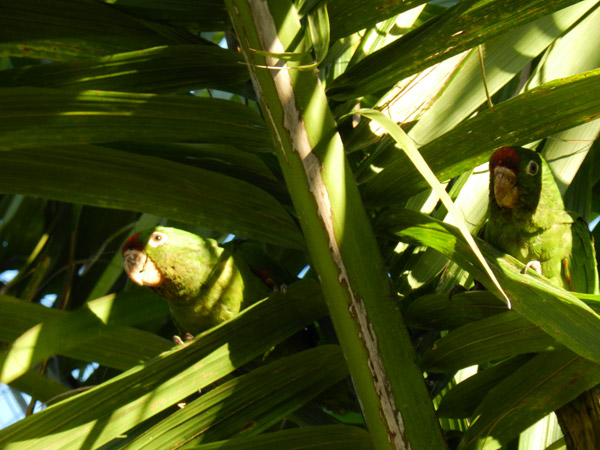
Our first day our guide told us that at 5:30 p.m. parakeets would come and nest in the palm trees outside the hotel. Sho’ nuff, they did do that with much screaming on their part. You get a couple hundred parakeets together that haven’t seen each other all day, they start shrieking all their daily activities at each other like crazy. “I PICKED TIMMY UP FROM SCHOOL!! OH, AND I WENT TO THE DMV AND RENEWED MY LICENSE!! THE LINE WAS SURPRISINGLY SHORT!! I BARELY HAD TO WAIT AT ALL!! etc.” Here are some yelling at me.

And I don’t want to appear paranoid, but it looks like these two are laughing at me, right? Not with me, at me.

And these ones are clearly holding a secret Masonic meeting or something.

Creepy birds, parakeets.

Next blog entry, more birds, all kinds. Also another extremely cute thing.

Costa Rica 2012, Part 2.

Sunday, February 12th, 2012

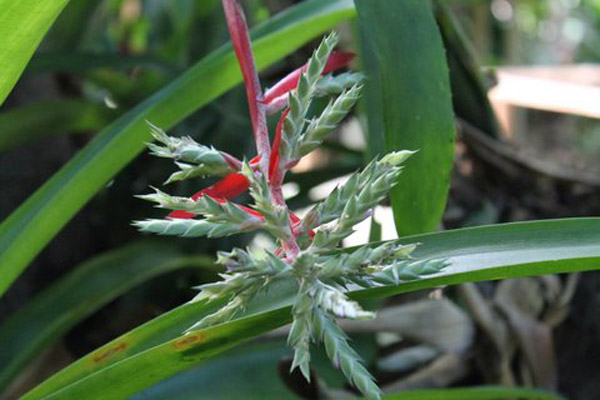
Bromeliads! Bromeliads are a type of plant. Here, I will let the Bromeliad Society International website explain them for you:

All bromeliads are composed of a spiral arrangement of leaves sometimes called a “rosette”. The bases of the leaves in the rosette may overlap tightly to form a water reservoir. This central cup also collects whatever leaf litter and insects happen to land in it.  Tank bromeliads (as the water storing species are often called) rely less heavily on their roots for nourishment and are more often found as epiphytes. The roots of epiphytic species harden off after growing to form holdfasts as strong as wire that help attach the plant to its host. Even though bromeliads are commonly called parasitos in Spanish-speaking countries, these epiphytes do not take sustenance from their host but merely use it for support. All bromeliads share a common characteristic: tiny scales on their leaves called trichomes. These scales serve as a very efficient absorption system. In species found in desert regions where the air is hot and dry and the sun beats down relentlessly, these scales also help the plant to reduce water loss and shield the plants from the solar radiation. These plants are so covered with scales that they appear silvery-white and feel fuzzy.

The most well-known bromeliad is the pineapple and the most well-known epiphyte (air plant) is the orchid. Epiphytes will attach any place they land on. Here are some epiphytes on a power line.

And here are some bromeliads scattered about growing on a horizontal branch in the forest.

We went to pineapple plantation to learn about the wonderful world of pineapples and I was taught how to choose a good pineapple in the store. It is not by sniffing it or squeezing it or poking it at its base to check for softness or tugging on its leafy crown. A good pineapple has large “eyes” in the pattern, it is shaped nicely (not pear-shaped or uneven), and the bottom part is golden-colored. I also learned that the bottom half of the pineapple is sweeter and less stalky than the top part, so save the bottom half for people you really like (or yourself). Here is a shot of the pineapple plantation that grows amazing organic pineapples. It is owned by the Collins Street Bakery in Texas, famous for having the best fruit cake in the world (their claim, not mine – I’ve never tasted their fruit cake, so I cannot judge).

They also grow ornamental pineapples. Like these cuties:

And these that I christened “tiny pineys”.

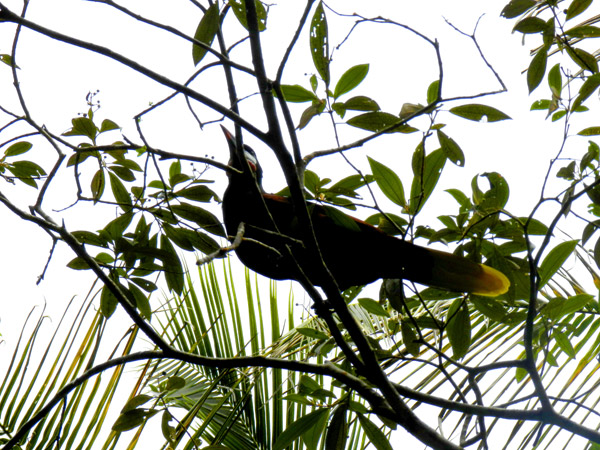
And now changing gears for a second: The Montezuma Oropendola! It’s a bird, not an ailment. A cool-looking bird, in fact.

What I loved about this bird was the amazing sound it made. It sounded like someone shaking a thick sheet of plastic. And apparently they are called “oropendola” because when they make the call, they will hang upside down from the branch for a second like a pendulum. I found a video on YouTube that kind of captures the sound and the motion. It’s way cooler in person, all tremulous and loud.

www.youtube.com/watch?v=-HjNZ1a0PTY

I could listen to that all day.

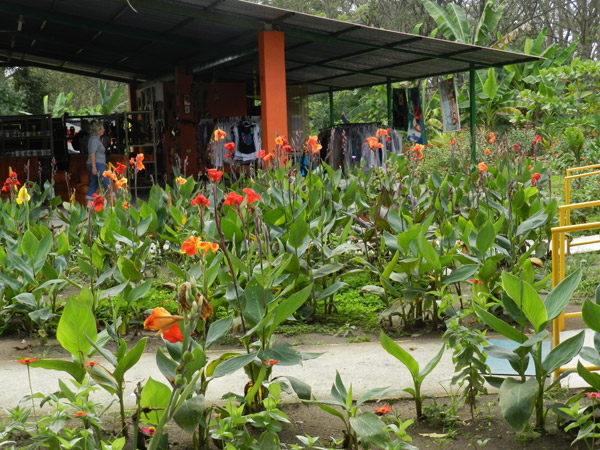
Check out this yard full of canna lilies being all flouncy and vibrant.

I like the way the seed pods look like unpeeled lychees.

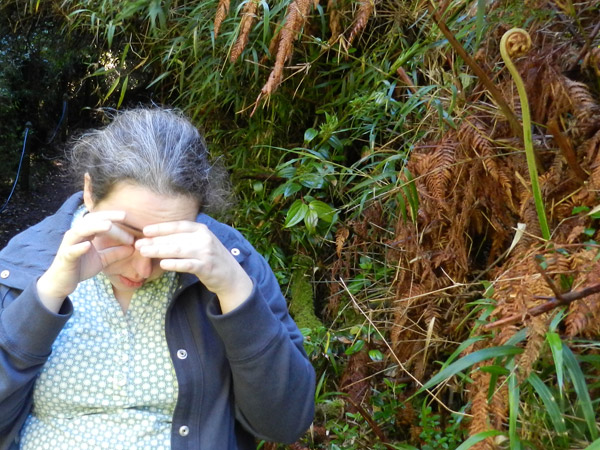
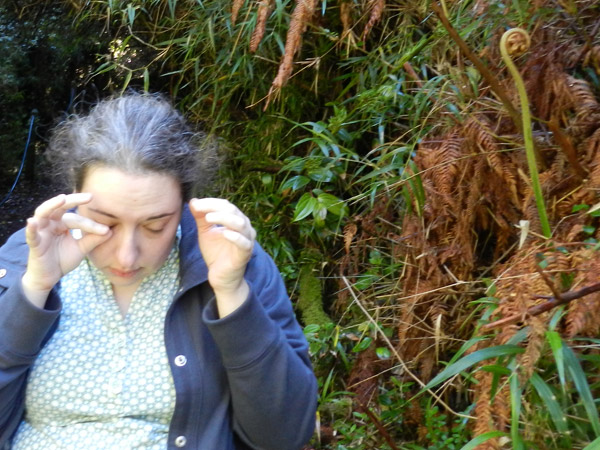
I spent a great deal of this trip taking (or attempting to take) pictures of ferns. I’ve always loved ferns, but the second I would get them into my house, they would become very sad and die. The first day we were in Costa Rica, we went to a volcano and Cricket insisted we go on a walk. In the rainforest. 6,000 above sea level. On a mountain. This did not go well for me. At one point I wrapped my arms around a moss-covered tree trunk and whispered, “I love you, tree. I hate my boyfriend. I hate him so much. I will live with you forever. Because I’m going to die here. Right now.” At one point Cricket tried to take my pulse but it was too fast for him to count. Periodically we would stop so I could catch my breath and stare daggers at Cricket and I noticed this lovely baby fern leaf all curled up. I said, “Hey, can you take a picture of me pointing to this?” Cricket went to take the shot just as some NATURE! flew up into my eye aaaaaaaahhh nature in my eye. So now we have two lovely pictures of a curled-up fern leaf and me making low moaning noises while trying to get what turned out to be a piece of leaf out from under my eyelid.

(I’m real outdoorsy.)

I learned a neat fact about ferns. We passed some fern farms and the wee fernlets were under large tents covered in black mesh fabric. That is because ferns grow on the forest floor where 60% of the sunlight is filtered out, so the black mesh is attempting to mimic that.

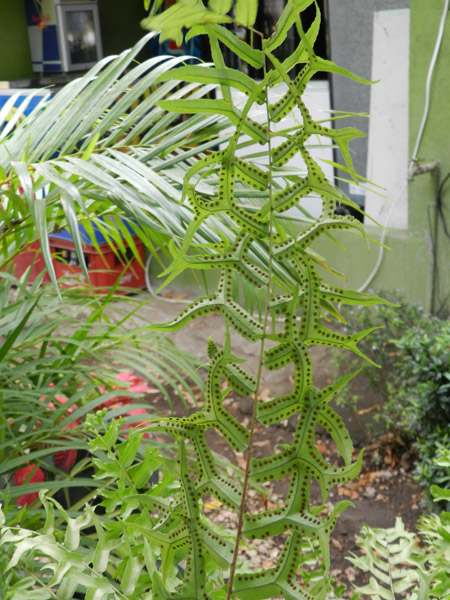
Here’s a fern I saw one day that had spores on the underside of its leaves.

Here are teeny-tiny ferns growing in the rainforest.

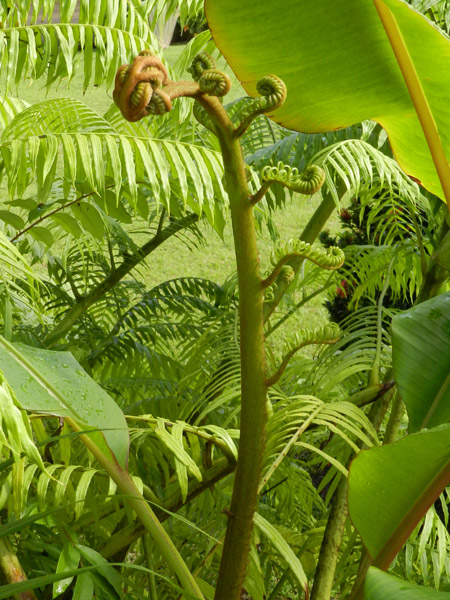
And here’s my favorite fern photo. FERN FIST.

Other plants: a stilt root tree.

A red ginger flower. I don’t know if it tastes like ginger, but that’s what it’s called. It’s used a lot in fancy-pants flower arrangements.

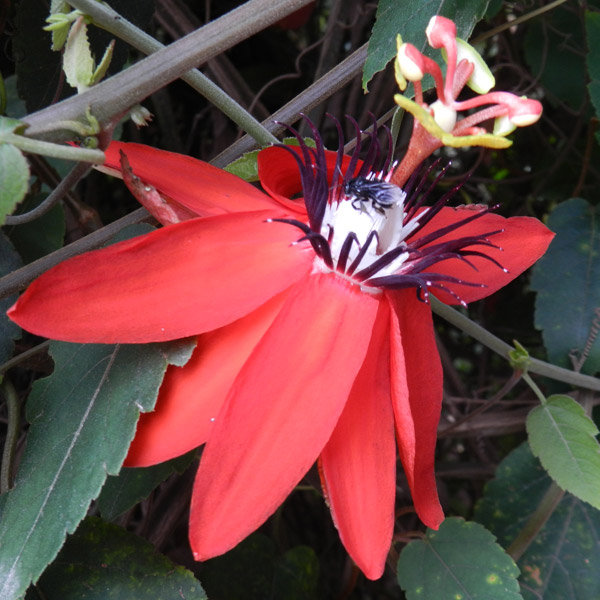
And a passion flower. I’ve always known passion flowers to look like this:

But did not know they also looked like the one I saw, this one:

Birds are next. A lotta birds. Very exciting.

Costa Rica 2012, Part 1 (officially).

Friday, February 10th, 2012

My books arrived! Now my avian photos are labeled correctly, no longer things like “teeny-bird.jpg’ or “bird-that-makes-cool-noise.jpg”. Seriously, has anyone noticed how freakin’ weird bird names are? I looked through this book and now I realize I have to go back to Costa Rica to see the Marbled Godwit, or the Lesser Yellowlegs, or the Great Potoo. I did see the greatest bird ever, not for its appearance (it’s a nice-enough-looking fella), but for its name – The Violaceous Trogon. Seriously. Here’s a photo of a Violaceous Trogon:

And here’s what something called a Violaceous Trogon should look like:

(This picture is taken from a website called ZeroFriends, they have lots of great prints, go check ’em out.)

A Violaceous Trogon should be laying waste to the cities of man, not sitting benignly in a tree looking like it got hit the back of the head with a brick. But I’m not an ornithologist, so I can’t complain about the naming system.

First of all, I would like to thank Susan for her photographs. Susan is this really cool dame from Kansas City who was with me on the trip and took about fifty of the photos you’re going to see here. A delightful and talented lady, she has a blog she updates periodically and it’s got some great pictures of her paintings and her glasswork and her fiber (or, if you’re pretentious, “fibre”) works. We bonded over our shared craftiness. And if you like paintings of dogs, she’s your lady. I love her dog paintings. Thank you, Susan. You da bomb. I am also using three photos from another co-traveller called Ami, so thank you to you as well, Ami.

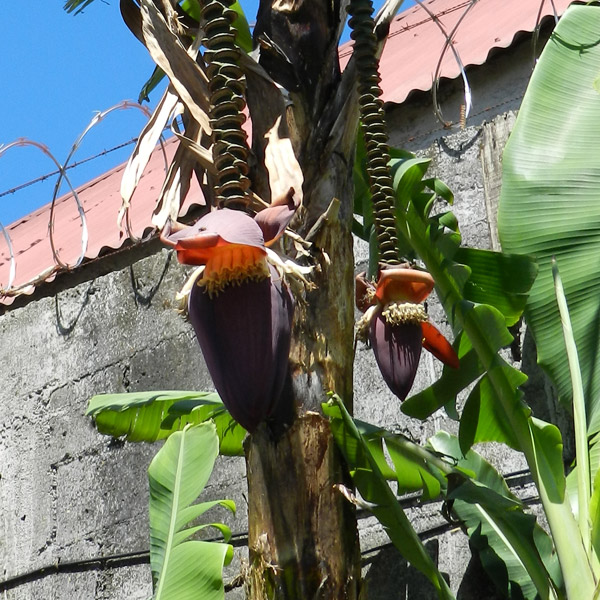
The first thing I noticed when I got off the plane in Costa Rica was the plant life. As I said, everything is huge and insanely bright. And more often than not, the plants look vulgar, like the engorged sexy-time parts of mammals. I found myself periodically holding my purse in front of various flowers, attempting to cover them up. I might have hissed, “You’re just embarrassing yourself,” at some of them. Specifically, the bananas gave me the most problems. At the bottom of the hands is a flower-thing that just screams, “Hey, lady, you lost? Want a ride?”

Unrelated note: Has anyone noticed how popular sloths have become of late? There are whole websites devoted to the awesomeness of sloths. And then today on Buzzfeed, I saw this:

http://www.buzzfeed.com/animals/sloths-are-so-hot-right-now-5685

They say it’s because of the Kristen Bell sloth-freak-out video that’s making the rounds, but I’d like to believe the entire internet is in a tizzy over sloths because of my recent trip. And I will continue to believe that. Please do not inform me of the truth. Thanks.

Back to plants: Heliconia! These are all in the Bird of Paradise family. They are, of course, are bigger and weirder than the regular Bird of Paradise. And the last one is hairy. I wanted to pet it, but I was afraid it would growl and bite my hand.

Concerning my houseplant comment of the previous entry, I had never given any real thought to where those plants originally come from. Imagine my surprise when I saw a poinsettia in someone’s garden, just hanging out. It was like seeing Santa Claus in the driveway of his house picking up the newspaper in a bathrobe. “Oh, you…live here. This is your home. Okay.”

The houses in Costa Rica are very simple and basic. Almost all of them are small, boxy ranch-style houses built out of cement blocks with corrugated metal roofs. I suppose if you live in vegetal bliss surrounded by glittering hummingbirds zipping to and fro, your house need not be particularly fancy. I got jealous of these humble dwellings. I hope the locals appreciate walking outside every morning into gorgeous weather and seeing something awesome like a monkey or an iguana. If I go outside my apartment, most likely I will see clouds and neighbor with a dog on a leash relieving itself. (The dog is relieving itself, not the owner. Watching the other thing would not be awesome, but it certainly would be something.)

Speaking of the weather, there’s a lot of NASA stuff all over Costa Rica. I saw them with a big tent at the airport, and then various other places after that. The reason is that large chunks of Costa Rica have the most stable weather patterns in the world. Every day: sunny. Nice. Little bit of wind, nothing drastic. So NASA does a great deal of testing down there. I thought that was extremely neat.

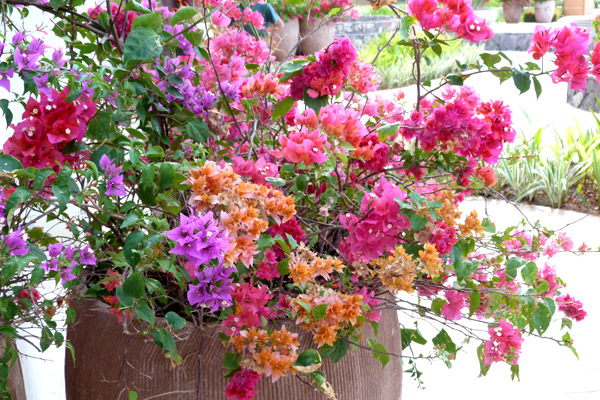
Not all of the plants were unfamiliar to me. I’ve seen bougainvillea before, just never this lush and in such a variety of colors.

And I’ve seen hibiscus flowers before too, but not double-petalled pinwheel duo-toned ones.

Anyone ever see Little Shop of Horrors? Well, Audrey II is real, and I have seen her.

Another gigantor leafy thing with a simply unacceptable flowering bit. C’mon, there are kids here, man.

Some of the plants I wanted to shove a clipping of into my bag and take home with me. Like this Powderpuff.

Or this Queen’s Wreath.

Next entry: more plants and some birds and other cool stuff.

Addendum: I have been informed by one of my co-travelers that the bird in the photo is not a Violaceous Trogon, but a Black-Headed Trogon. They look very similar. I’m guessing none of you give a crap about Trogons, so I’m not changing the blog entry.

I have returned from Costa Rica. Many photos await.

Tuesday, February 7th, 2012

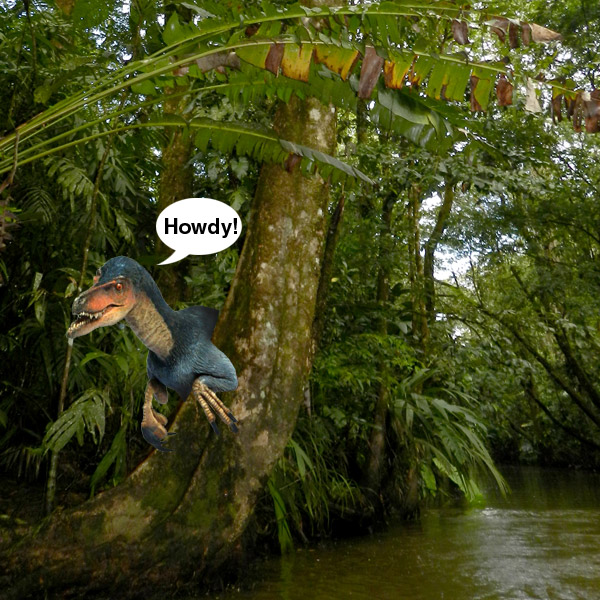
I have sorted through my 1,000+ photos and picked out the juiciest and tenderest morsels but I can’t post them yet because the books haven’t arrived from Amazon.com. The books I ordered are “The Birds of Costa Rica”, “The Wildlife of Costa Rica” and “The Plants of Costa Rica.” I need them because half of the time I had no idea what I was taking a photograph of. Specifically birds. Hoo boy, are there a lot of birds in Costa Rica. Periodically people would say the name of this bird or that one, but after a while it all sounded like, “That is a Yellow-Necked Deep-Vein Thrombosis, very rare in these parts,” so until the books come I have my photos labeled things like Plant1.jpg and Bird3.jpg. I can give a rough overview of the experience, though. This was my first trip to an America other than North America, so I was enthralled by everything I saw. I had never been to the rainforest either (the southern part of Africa is all savannah) so that was exciting as well. Lemme tell you about the rainforest – it looks really prehistoric. I kept waiting for a velociraptor to show up.

The name is super-accurate. It’s wet all the time. The rainforest gets something like eighteen feet of rain a year. If you stand still for five minutes, a fungus will take root on you, guaranteed. The picture below, they called this a “light shower”. By the end of the trip all my clothes smelled like I had washed them, immediately shoved them soggified into a non-breathable garbage bag and then chucked it into a corner of the basement for a month – even the clean clothes. I was charmed by the optimism of the local villagers, hanging their laundry out to “dry”.

You know all your house plants? All those sweet little leafy friends of yours? Well, they’re from the rainforest and they’re big. In their natural habitat they are enormous and they look like they are going to eat you. Here, look, some leaves with a hand for scale:

And I want to apologize to the artists of Central America. I never really liked the artwork from there because I thought it was a little garish, a little overly bright. Seriously, you don’t have to use the colors straight out of the tube, mix a little brown in there, fer cryin’ out loud. Now, having been there, I admit I was wrong. They were painting accurately because everything really is like that. A lot of RED and YELLOW and BLUE, so bright it buzzes in your eyes. When I correctly name my plant ‘n’ bird photos, you shall see for yourself.

This trip can be summed up by how many times I said the phrase, “Holy crap, look at the (fill in the blank)!!!” Everything was so big or so close or so much more than I had anticipated. I am already planning my next trip there (turtle-hatching season happens in July) and I’ve only been back for three days. I highly recommend going to Costa Rica. It’s only a five-hour flight, it’s relatively inexpensive, and their number-one industry is tourism (number two, technology; numbers three, four and five, coffee, bananas and pineapples) so they tend to know what they’re doing. If you have any questions about where I went or stayed, feel free to email me and I’ll hook you up with all the details.

Costa Rica.

Wednesday, January 25th, 2012

I am leaving for Costa Rica in two days for a nine-day vacation, and one of the places I’m going is a butterfly farm where hopefully this will happen to me:

I’m sure I will have a million photos when I return. Start getting excited about that.

Addendum: I’m back. That did not happen to me. Still a phenomenal trip, though.

Africa 2011, Part 10 and finished.

Thursday, November 10th, 2011

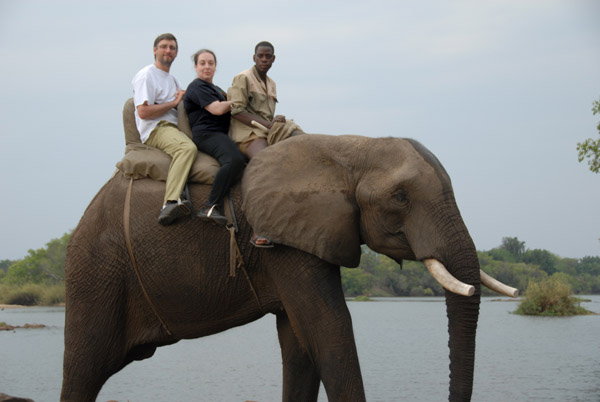
In the last few days of my trip I did two things that are very out-of-character for me. One was riding an elephant. It’s totally terrific. They move very calmly and you can acclimate yourself to the rocking motion they have while they’re walking. Then you can let go of the handles and look around. This particular elephant ride was unique because the guide-fellow decided that the scrub-brush was too dry and uninspiring, so we ended up walking through a series of small islands. I was also pleased with the lifestyle these elephants have. They only do two one-hour walks a day, and the rest of time they are free to graze across the street in a natural reserve. They can come and go as they please, but because they are herd-oriented animals, they come home together every night to a big paddock. They sometimes go a bit rogue. One day, one of the females saw some wild elephants that she liked, so she went off with them. She showed up again ten months later and was pregnant. And a different time the herd came home with an orphan elephant that had been abandoned. He’s part of the herd now too.

Three people ride on one elephant – the handler and two guests. To get up onto your elephant you have to go up a set of stairs, like the kind they have for small planes.

All of us walking through the islands. The Moomins and Drea rode on the promiscuous wandering-away elephant named Mashimba, the one I mentioned above, and Cricket and I rode on a large, 35-year-old male named Marula who has a soft spot for babies. He’s the one the orphan follows around all day. It’s just precious. Mishi rode on the teenage love-child of Mashimba.

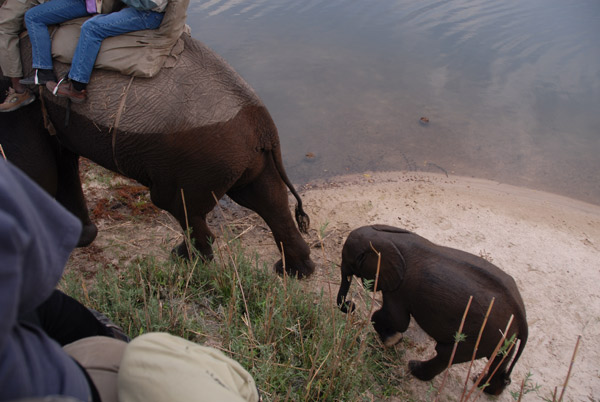
To get to the islands, we had to go through water. The handler said, “Give me your legs,” so I wrapped my legs around his waist and that water came right up to my pant leg. If you look in the second picture, you can see the little orphan elephant holding on to our elephant’s tail. Awww.

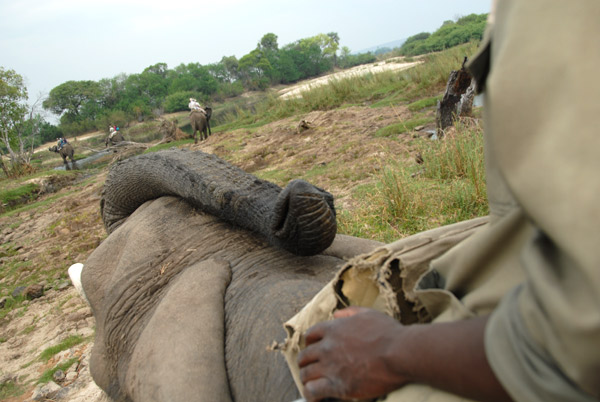
The handler has a bag of horse snacks, and don’t think the elephant doesn’t know it’s there all the time. Marula kept flinging his trunk over his head and pinching his prehensile nose-fingers at the handler, like, “Gimme snacks! Do it now!”

Here’s what things look like when you’re on top of an elephant.

Here’s a great shot of Cricket and me sitting there looking like Hannibal crossing the Alps. We would make excellent royals based on this photo.

This is Mishi giving the little orphan snacks from the snack bag. Awwww.

After you ride you get to feed your elephant, which might be my favorite part, because you really get to feel the way the trunk works. It’s surprisingly delicate and precise for such a large, heavy column of fleshitude.

And then we got to pet the orphan elephant! So sweet! Drea’s favorite animal is the elephant, so she very quietly had a meltdown while petting the little guy. He was covered in wiry bristles all over and I could have pet him all day forever. Here’s Drea standing next to her elephant trying not to poop herself with delight.

The other extremely cool thing we did was swim in Devil’s Pool. What’s Devil’s Pool, you ask? Well, when Victoria Falls is in full water capacity, the water pours over in a great rushing way. However, when it is the dry season, the water quantity ebbs and at the top of the falls is a pool of water, right near the edge, that you can swim in and cheat death. Here’s a diagram I made to help.

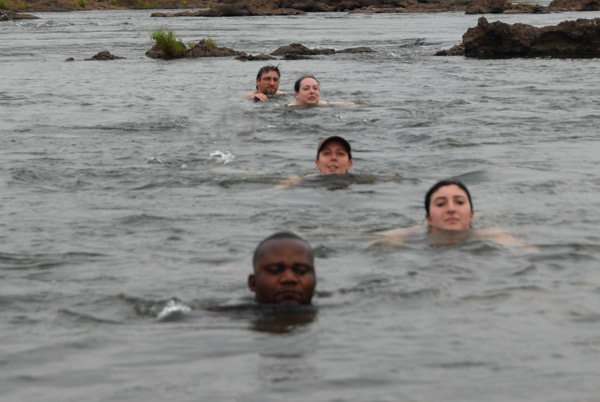
I won’t lie – I was scared. But then when I got there, I realized that in order for me to die, I would have to exert quite a bit of effort. There’s a four-foot wide rock shelf right before the edge, and I would have had to climb out of the pool, walk over that and then fling myself into the crevasse. So as long as I followed the guide’s instructions, I would be fine. First, he had us paddle out to a little rock outcropping in the middle of the river. Then, in order to avoid the current, we had to paddle in a specific line right to the Devil’s Pool because if we drifted too far to the right, we would get washed off. Here we are swimming. Mishi likes this picture because we all look like ducks.

First the guide jumped into the pool to show us how it’s done (how it’s done: jump into the middle). I want to point out that he is wearing a bathing suit bottom, he is not going commando.

And everyone jumped in…

…except me. I slithered down the rocks on my ass, because I am a hero.

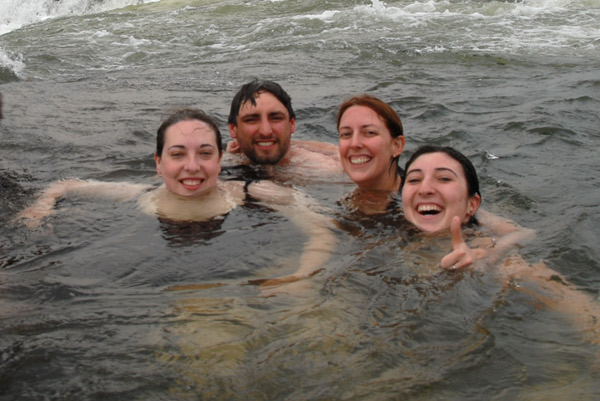
It was amazing. The water was rushing over us and around us and it wasn’t cold, but it was refreshing. I could have stayed there all afternoon.

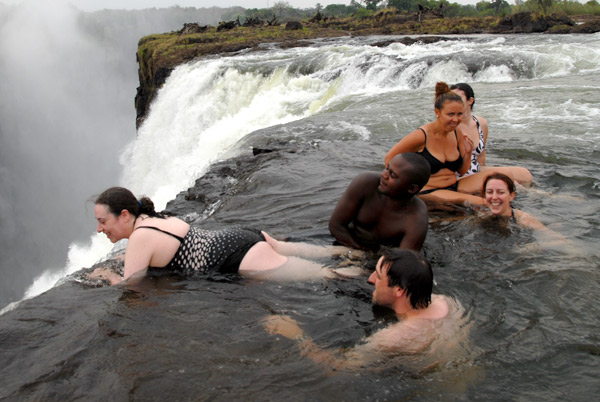
The guide pulled us up by our armpits so we could sit on the inner edge of the rock ledge.

And then he held our legs so we could look over the scary falls into the water.

Here’s a video I found of some other people’s Devil’s Pool experience. It’s pretty much identical to ours.

http://www.youtube.com/watch?v=FVFsiJBSQps&NR=1

That was all the crazy risk-taking I needed for, well, for ever, really, so the next day when Cricket, Mishi and Drea went rappelling and bungee-ing and swinging in an enormous gorge, I went as support and took pictures for them. The first time Cricket jumped with the combo-bungee-swing, he didn’t scream. When he got back to the top I asked him why and he said because it wasn’t really scary (!). I told him that made me sad, so he said he would do another jump and this time he would scream his nickname for me, which is Bucket. Drea videotaped it. My favorite part is when the pendulum part begins and the harness gets right up in his giblets. You can hear the tone of his scream change dramatically.

http://youtu.be/V7GlTS8o7bw

Alright, I think that covers everything. It was a fantastic trip and I highly recommend going to Africa to anyone. If anyone has any questions or wants to see any of the other 1,000 photos that were taken, please let me know and I will happily share them with you.

Africa 2011, Part 9.

Wednesday, November 9th, 2011

Continuing with the Chobe River boat ride:

Skimmers! With juveniles! Skimmers are a neat-looking bird because their lower jaw/beak is longer than their top jaw/beak. They fly along the surface of the water and scoop things up with that long lower part.

Elephants! So many elephants. Along the river we saw a male elephant eating roots. Because of the recent drought, roots are still edible. This guy had great technique – first, he would kick the grass to loosen the root, then, using his trunk, he would shake the dirt off of it. Then he would eat. Drea got a video of the whole process:

http://youtu.be/ZO53JrV7p9Q

Other elephants: Elephant throwing dirt on herself.

Large troupe of elephants coming down the hill to drink, looking very imposing.

And look at the babies! We saw a ton of elephant babies. Literally, it was a ton. They’re very heavy animals. See, I made a funny there.

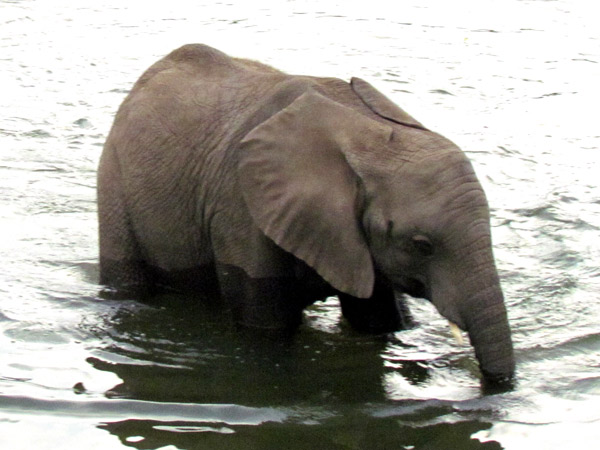
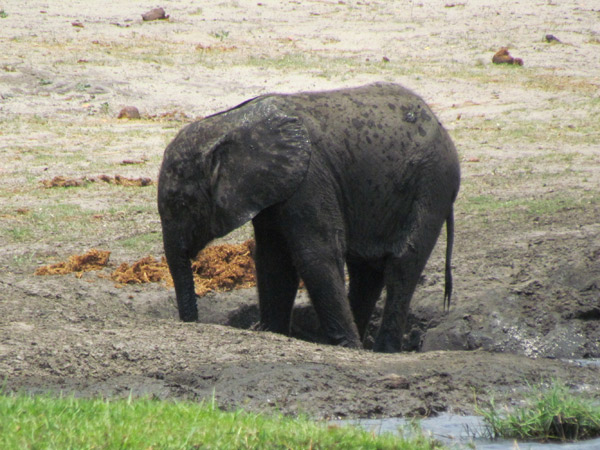
We saw a wee baby elephant drinking. They don’t know how to use their trunks at all until they are older than six months, so this little guy had to hunker down and bring his mouth to the water. Awwww.

I saw something I had never seen before and that I found fascinating: a clearly disabled elephant that was full-grown and functioning with a herd. You would think he would have been picked off by predators, but no, he was moving along with the rest of the group. I called him The Elephant Elephant, after The Elephant Man. Look, his spine is all jinky and his leg is wack and I don’t know what’s going on with his hips.

Bee-eaters! That little fellow who is flying by popped out of the hole directly above him at the top of the picture, the ones that’s only a tiny bit bigger than his body. It was amazing to watch him go in and out of there, getting food for his kiddies. To re-enter in he would fly-fly-fly and then fold his wings a nanosecond before he shot back in – perfect timing.

Other bee-eaters.

One of the neatest things we saw was a kingfisher pulling a hummingbird impression. In order to stay directly over the water, the kingfisher flew into the wind. Aside from the flapping, he didn’t move an inch. It was quite impressive.

And finally, spoonbills. They have spoon-shaped bills. I love it when ornithologists call it like it is.

So that was Chobe in Botswana. Amazing. It really is different to see the animals from the water.

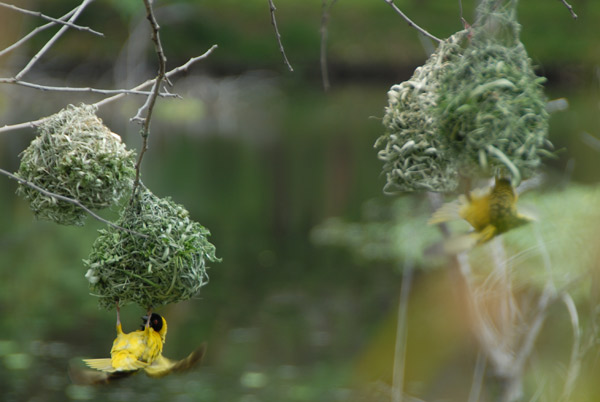
When we got back to the hotel (at about four in the afternoon) we went for a walk and passed by a pond, where we saw something really weird. There were two or three trees full of weaver birds, hanging upside-down flapping their wings and shrieking.

Here’s some video Drea took:

http://youtu.be/L78qvzE0b6Q

One of the weaver’s nests had fallen to the ground. They’re really impressive up close. They don’t use spit or mud or poo, just woven grass. Mishi tried to pull it apart and she was astonished by how difficult it was.

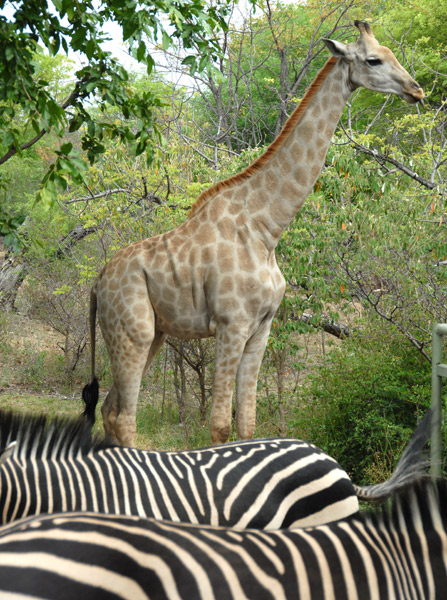
The next day we found out there was a feeding in the backyard shrubbery of the hotel. Eight zebras and three giraffes live on the hotel grounds, and while they were wild animals, the hotel game warden had a special relationship with them. He was laying out large plastic containers of grain when we wandered over. And sure enough, at about 2:58, all eight zebras showed up for snakkies. And they had a baby with them (awww).

Zebra yawning. Looks like he has dentures, don’t it?

The little guy wanted some milk from his mom, but she was otherwise occupied with stuffing her face full of grain, so he sadly rested his head on her butt and waited while she slapped him in the face with her tail. It was precious. Drea got footage.

http://youtu.be/MHpm-vINHOE

And then, like a floating dream, the creamiest-colored giraffe emerged out of the trees. I’ve never seen one that pale. I thought it was so lovely.

It was kind of an idiot, because it just stood there. It didn’t eat or anything. It just stood there. Then…it picked its nose with its tongue! And Cricket got the shot! I was ecstatic. Finally I got my giraffe-tongue pic!

The giraffe’s pregnant mom was off to the side eating leaves off of trees, and no joke, we were standing mere feet away from her when she decided to drink so we got to see her go down into her drinking posture right in front of us. It was breathtaking, like watching an Ent from LOTR bend down.

Afterwards we walked back to the hotel and saw this insane-looking flower. I don’t know anything about it except that it huge and it looks fake and it is not.

But the real icing on the cake was when we went to the main building for dinner that night and a vervet monkey was sitting on the wooden roof. I had explained to Mishi earlier that they are often called Blue-Balled Vervets because their testicles are a festive shade of cyan. Now this guy was sitting directly above our heads which allowed me the opportunity to get this super-special photo.

Vibrant, aren’t they?

Next, we cover me being a daredevil for about two seconds and spending the rest of the time watching other people be daredevils, and then that’s it for Africa.

Africa 2011, Part 8.

Monday, November 7th, 2011

Okay, now we have moved onto the country of Zambia, specifically right near Victoria Falls (or, as it’s called in the Kololo/Lozi language, “Mosi oa Tunya” which means “The Smoke That Thunders”). First thing, the sunsets continue to be very pretty.

We went to Victoria Falls during the dry season, so the falls were not in full…fall-age. The normally large and rushing waterfalls were sparse and there were gaps between them.

Here’s a bit:

Here’s another bit:

Here you can see the “smoke that thunders” part:

And here’s the most important thing I noticed. It appears that Africa is not as litigious as society as America, because there weren’t really any railings. Note the people standing right near the freakin’ edge of an undoubted death-plummet:

The attitude there was, don’t be a dumb-ass. If you die, chances are it’s your fault. And, in fact, two people died while we were there. Both of them were indeed dumb-asses and attempted to cross the rapids you see at the bottom on foot. They found the bodies downstream. I like that attitude. This is not a country where they have to put warnings on everything. “Do not use toaster in bath!” “Do not use curling iron while sleeping!” “Coffee might be hot!” I found it a pleasant respite from the usual.

So, The Moomins and Cricket and I arrived at the falls after picking up two additional people: Cricket’s sister Mishi and my niece Drea. Mishi was on vacation, but Drea was there on an eight-week overseas study thing. She’s becoming an engineer and she was there to improve the plumbing situation in some of the townships. We had many long talks about toilets.

The first day we were in Zambia we took a bus to the nearby country of Botswana for a game drive on the Chobe River. If you thought the crossing between Canada and America was laid-back, you ain’t seen nothing yet. Here is the border office between Zambia and Botswana.

Here is a poster outside the border office.

Here is a chicken guarding the border office.

We brought our passports and various disenchanted people stamped various things of various pages, and then we took a boat to meet our combi on the other side. Before we took the ride down the Chobe River, we viewed the area above (which is a national park) from the land.

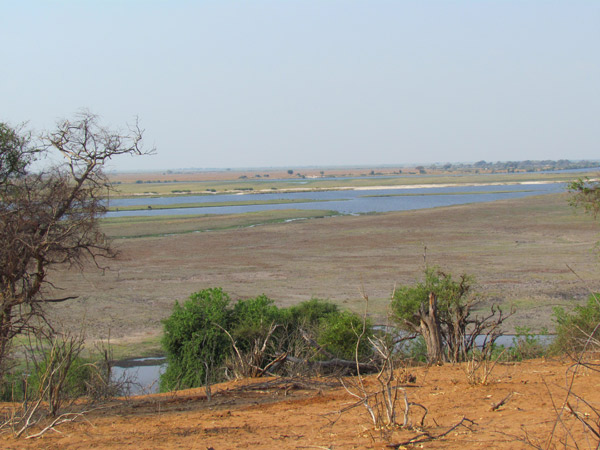
Chobe from land:

Juvenile birds whose name I forgot keeping cool under a tree:

A warthog with impressive mutton chops:

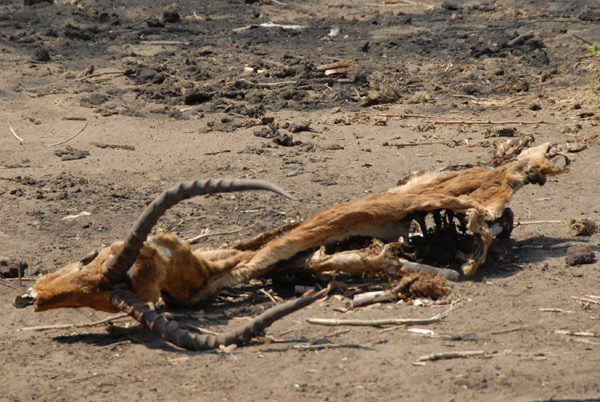
An impala that was ripped apart (most likely while still alive) by wild dogs:

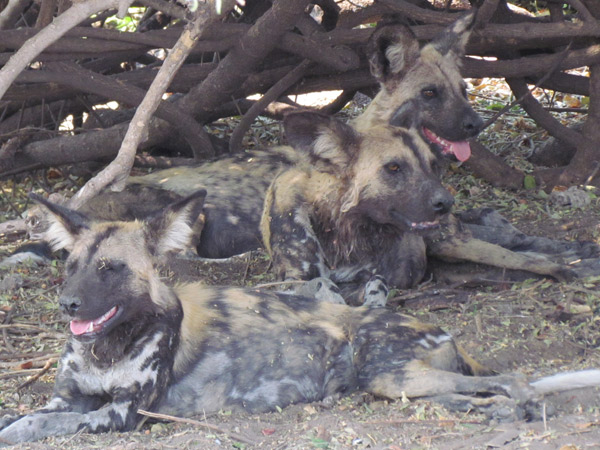
And then wild dogs. This was very thrilling because wild dogs are very rare, and that’s a good thing because they are one of the closest things to perfect killing machines. A group of lionesses kill about two-thirds of the prey they go after, but wild dogs kill 99% of the prey they go after. When they look directly at you it chills your blood because you can imagine they’re weighing you and guessing your speed and how they will take you down, and you know they would too. Also, they make a horrifying noise when they’re excited or hungry, it’s very shrill and hurts your ears.

Here’s a video of wild dogs killing and eating an impala (I’m warning you, upsetting, because I don’t think that impala is dead yet when they start eating it): http://www.youtube.com/watch?v=Kw4vnFeWnXQ

And here’s a video where the wild dogs make that noise (imagine it being way, way too loud so that you want to put your hands over your ears): http://www.youtube.com/watch?v=z4M1hf87vto&

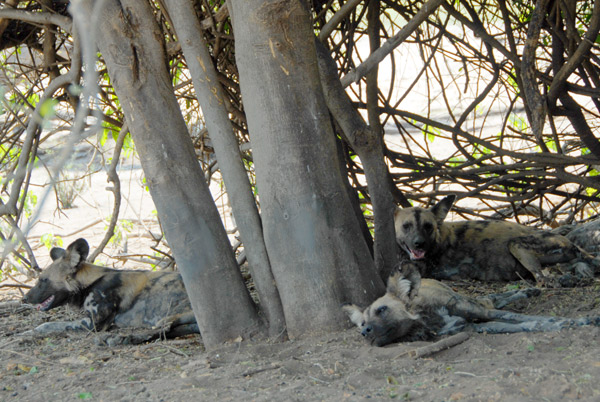
But these wild dogs were just hanging out under a tree avoiding the mid-day sun. I love the dappled pattern on their fur.

STOP LOOKING AT ME.

We saw quite a few animals rummaging through poo for seeds. It might seem gross, but you have to remember that elephants only digest 40% of what they eat, so 60% falls out the back ready to be consumed by others.

We then got on a boat and slowly navigated around the islands and grass piles. The first thing we saw was an open-beaked stork, and as no surprise to anyone it might have been my favorite animal of the day solely based on the fact that it looks like it was birthed from the mind of Edward Gorey. I mean, look at it. It’s practically like one of his drawings come to life.

The next thing we saw was an antelope called a red lechwe, and it might be the most beautiful antelope ever. It’s like the supermodel of antelopes.

While we were sitting there looking at the lovely lechwe, on our right was a fish eagle. I started to sing “God Bless America” at it, but everyone else in the boat told me to kindly shut the hell up. It’s just such a patriotic-looking bird.

Did you know the fish eagle can turn its head around? I did not.

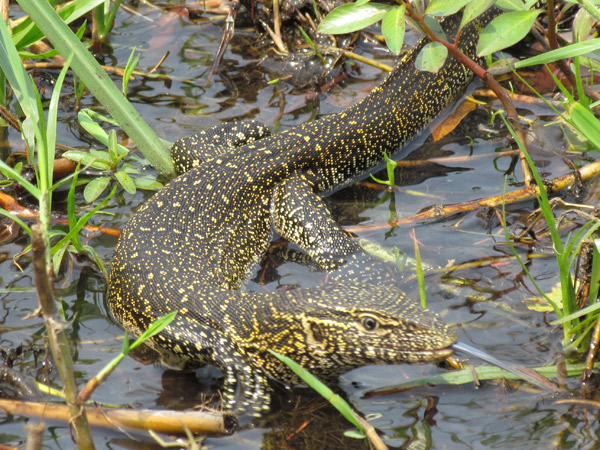
And on the left of us, big lizard. Real big. Right near the boat.

We trundled further on, and then we got to a big chunk of shore where there was an astonishing variety of creatures. First, more lechwe:

And then buffalo:

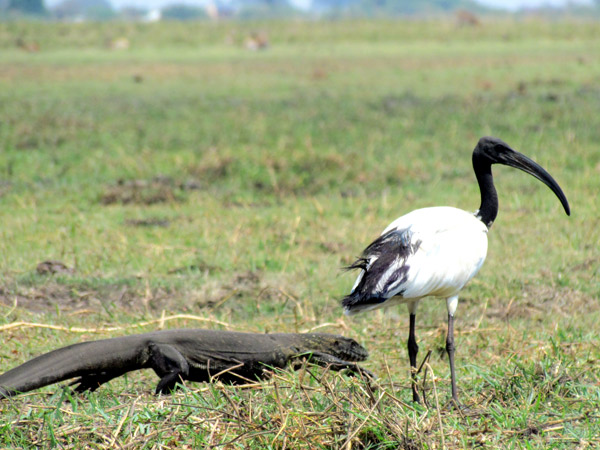
And elephants and many more lizards and a whole bunch of different birds, etc. What was funny was how little each animal cared about the other ones. We watched a gigantic lizard walk right past a sacred ibis (which is a creepy bird due to it’s mummified-looking head) and neither one gave any semblance of a crap about the other.

The buffalo were pretty great. One was drinking in the most ungainly fashion:

And one was in the water (which came up to his chin) eating the grass on the shore. What made this so amusing to me was because you couldn’t see his legs or most of his body, it looked like he had just flopped down on his face and given up on life and was being despondent in the grass. And then a bird came over and I visualized a conversation (please make the voices sound like New York construction workers):

“Hey Steve.”
“Hey Mike, what’s up?”
“Nothing. Just feelin’ blue.”
“Aww, that’s a shame, Mike. How’s Tina?”
“She left me, took the kids. The house is real empty.”
“Wow, I didn’t know it had gotten so bad. We should go out for a beer sometime this week, eh?”
“Yeah, that’d be nice.”

We also saw hippos in the water. That was the only animal the boat steersman was wary of. We stayed way way away from them.

Hippos grazing on land:

Hippos in the water:

Sleeping hippo:

Yawning hippo:

We finally saw a lilac-breasted roller. On my last trip to Africa I desperately wanted to get a picture of one of these birds, but every time I tried, they flew off. This time Drea got a terrific shot of one. I may or may not have clapped my hands like a small child at Christmas.

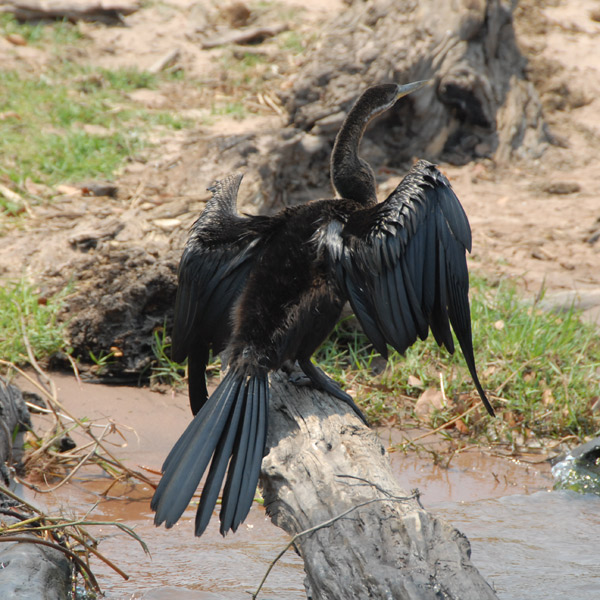
We saw various cormorants and darters (which might be part of the cormorant family, the guide was a bit vague about this).

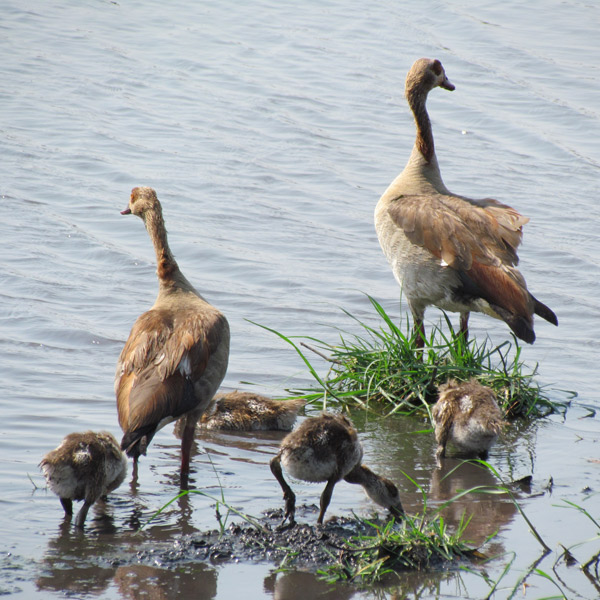
Geese! Egyptian geese, specifically. Many of them had wee goslings following them around (awww).

Crocodiles! There were two nine-year-olds laying like furniture on the shore.

There was one that eating a fish as it swam past us.

And once when parked the boat on the edge of the grass, I discovered a little fellow right in front of the boat. He was adorable, about a foot long.

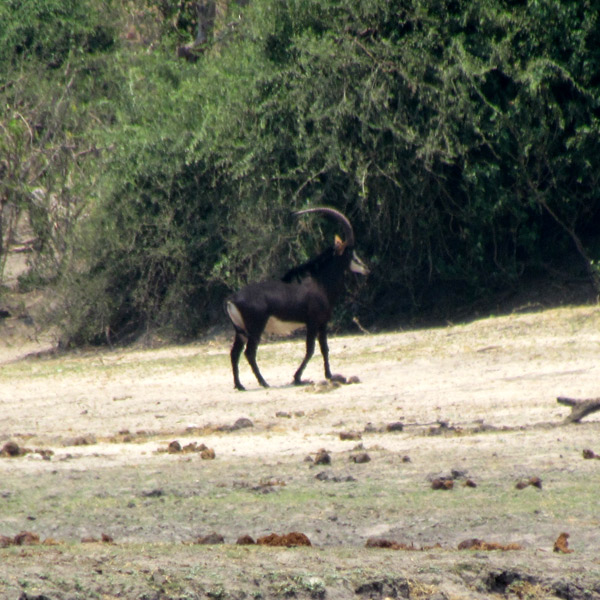
A Sable!

This was a super-big deal. They are known as “the shy antelope”, so seeing one at all is a big damn deal. That’s why the video I found in my travels around the YouTube sphere makes me scream with rage and jealousy.

http://www.youtube.com/watch?v=Vlpvrw03VJw

Look at all the freakin’ sable. That’s like the world population of sable. And babies! So very jealous.

The trees on the edge of the water looked amazing. Their roots specifically were intense.

Guinea fowl being photogenic on a root cluster:

Next entry: A continuation of Chobe with elephants and more elephants.

Africa 2011, Part 7.

Saturday, November 5th, 2011

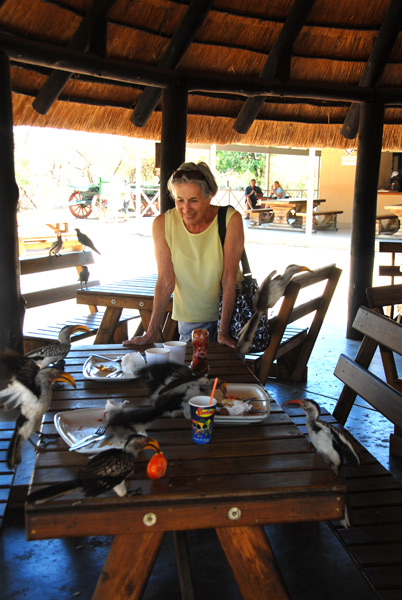
Cricket had made the decision before we left to go to on a three-day walk through the bush (with guides and whatnot, not all by himself, that’s guaranteed death). Therefore The Moomins and I had three days to just hang out and do our own thing. We went on a game drive and headed over to the rest stop that we had stopped at previously (the one where the hornbill attempted to punch his way through our car door with his body to get at our chutney-flavored chips) (it’s almost worth it, those chips are delish). The day we went there, it was on a busy day. A whole bunch of people were having a pleasant lunch, or they would have been if two varieties of hornbills and a bevy of other creatures were not trying to take the food off the plates. It’s pretty intense, attempting to have a meal.

Look at that one hornbill totally taking the tomato. It weighs more than you, buddy.

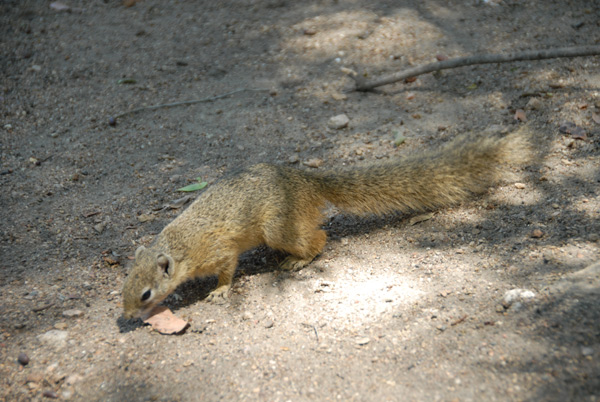
The Moomins was feeling a bit hungry, so she got a grilled cheese sandwich and we sat on the edge of the rest stop. Slowly, we started accruing a bunch of different little animals. Like these:

I felt like Disney’s Snow White: http://www.youtube.com/watch?v=cFp6vZ1oOWo. Except these are not the kind of forest-dwellers who help you feel better when you are down. These are the kind of things that steal your food from your pocket while you’re lying on the forest floor crying because the wicked queen turfed you out the castle. Cute, yes. Fluffy, yes. But not nice.

Look how they stare at The Moomins waiting for scraps. With malice.

Finishing up Kruger Park:

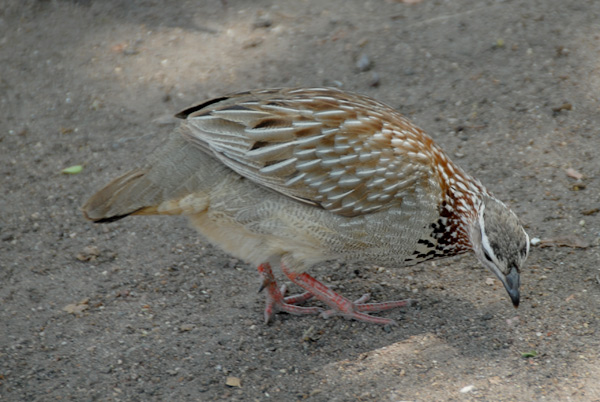
This is a Frankolin. Watching them run is hysterical. They run like they ate some cheese and they’re lactose-intolerant and if they don’t hustle hustle hustle there’s going to be apologies and embarrassment all around. Never gets old.

This is a fever tree. The bark is used in indigenous medicines to reduce fevers, hence the name. I like them because they look like they were painted with a thick coat of glow-in-the-dark paint.

Oxpeckers on a giraffe having some kind of oxpecker argument.

The sign outside the Kruger Gate. I appreciate what the designer was trying to do, but…that’s a fail right there. I swear I sat there for a good solid minute thinking, “Refyole? What is that, the name of this gate?” Good try, though.

Alright! That’s it for Kruger. Before we all headed to Zambia, A. was nice enough to take us around the countryside to look at some of amazing scenery in and around the Blade River. We drove two hours to see something called “God’s Window”. However, when we got there, a cloud had taken up residence right where the viewpoint is. The fog was so thick, you couldn’t see five feet in front of your face. I would not be deterred, though. Here is a picture I insisted we take of The Moomins gesticulating towards where the beautiful view would be if we could see it.

This is the three of us posing in front of this supposed view.

Cricket then complained that I always squint in photos (I do a great deal, me and sunlight do not get along) so right before we took the next shot, he quickly put his hands on either side of my face and hoisted up my eyelid skin. He’s so thoughtful. He’s almost as thoughtful as I am photogenic. SO PRETTY.

Then, I had a brilliant idea for a photo. I said to Cricket, “Wait right here,” and I hustled over to the other side of the parking lot, completely out of view due to the fog. Cricket then heard me making a noise, like I was gargling my own tongue. AAAAAAALGHBLAAAAACHHHAAAARG. And then I emerged from the mist doing my best horror movie monster impression. Cricket thought it was fabulous. If we ever meet in person and you ask me nicely, I will happily do a rendition for you. It brings tears to the eyes.

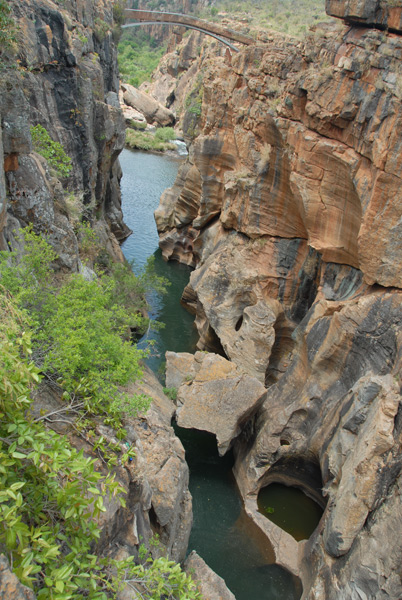
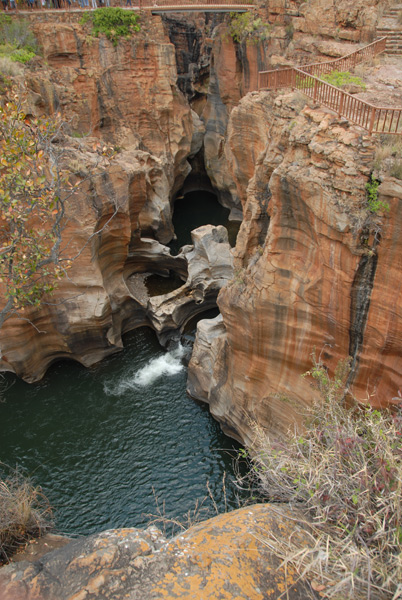
We all got back in the car to head off to non-foggy vistas. Our next stop was Bourke’s Luck Potholes, which is so picturesque it looks fake, like the background in a MGM musical from the forties. A. said that the rock there is soft, and the potholes were created by harder-rock pebbles and sand whirlpooling in circles for years and years, creating those round pits. I think they’re very beautiful.

We then went to an equally idyllic spot where there’s a different waterfall. And there was also a very weird-looking lizard.

And finally we made it to God’s Window and took some decent photos of what turned out to be a very lovely view. Also, at no point did Cricket stick his fingers in my eyes and hoist my face-flesh to his liking, so that’s a plus.

Tomorrow we will dive into Zambia and a bit of Botswana. More beasties await!